

Outdated and imprecise: why it’s time we retired the term ‘race relations’
- Written by The Conversation
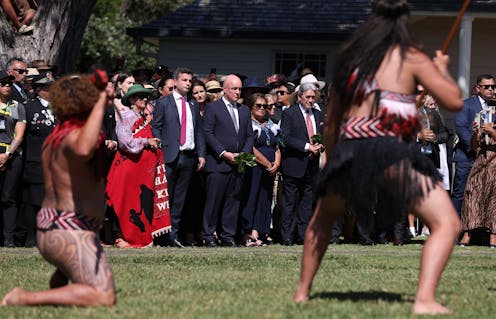
There’s a term that crops up whenever Aotearoa New Zealand’s political debates turn to the Treaty of Waitangi and its contemporary relevance: “race relations”.
We’ve heard it most recently attached to media punditry and political commentary about the ACT Party’s contentious Treaty Principles Bill, in former prime minister John Key’s plea to “take the temperature down a wee bit” in that debate, and now during the gathering at Tūrangawaewae marae in Ngāruawāhia.
But the term is a misnomer. Used or understood in the wrong way, it has the potential to harm social cohesion, increase political polarisation, and distract from the actual policy issues being debated.
What we are really talking about are Māori-Crown relations. But the distinction is not something we teach particularly well in schools or universities. It isn’t a debate about “race relations”; it’s about the Treaty.
Two groups signed that treaty in 1840: hapū (kin-based groups) and the British Crown. Those who signed te Tiriti consisted of rangatira – Māori leaders (or chiefs) representing hapū – and representatives of the Crown.
“Te Tiriti o Waitangi” is now commonly used to demarcate the version written in te reo Māori from the English-language one, “the Treaty of Waitangi”. But neither version refers to “race”.
Māori and the Crown
We now have many decades of scholarly and legal work defining the rights that came from te Tiriti. But if we did not have a treaty, as is the case for many Indigenous groups, international conventions and laws would guide the situation.
A central one would be the United Nations Declaration on the Rights of Indigenous Peoples – if one even dare mention it. Stopping any involvement in implementing the declaration was part of the coalition agreement with NZ First. Nonetheless, Indigenous rights are increasingly being recognised globally.
Indigenous groups are political groups. Yes, they are based in kin and a continuing culture and language, but not so often based in “race”. Internationally, if a country recognises Indigenous peoples, those groups generally get to determine their own membership.
This too varies depending on their history and relations with the state. Some groups still use “blood quantum” rules, based on fractions of one’s total ancestors. Others use citizenship rules that allow them to welcome in whoever they choose.
Māori, of course, have long used a whakapapa-based model to recognise belonging, tracing descent back to particular ancestors, places and waka.
An outdated concept
The term “race relations” was often used in the 1960s and ‘70s to contrast Māori–Pākehā relations with what was happening in other countries, particularly South Africa. This led to the widely accepted myth of New Zealand having the “best race relations in the world”.
The terminology was still used quite widely to describe Māori–Crown relations in the 2004–05 period, when the Foreshore and Seabed Act became a political flashpoint.
It is still even in official use, embedded in New Zealand’s human rights bureaucracy with the role of race relations commissioner, and observation of Race Relations Day.
However, it is now widely recognised that “race” is an outdated concept. The Māori Affairs Amendment Act in 1974 moved us away from a race-based categorisation system by defining “Māori” on the basis of descent.
In the decades since, other key government activities, such as the Census, also moved away from the construct of race in favour of ethnicity.
Electoral law also changed in 1975, abandoning a blood-quantum rule for enrolment on the Māori or general electoral rolls to one based on self-identified descent. Previously, someone who had identified as being of more than half blood quantum had no choice but to be on the Māori roll.
Furthermore, many have highlighted limitations in the definition and scientific basis of “race” as a concept. As the American Association of Biological Anthropologists has explained, “Humans are not divided biologically into distinct continental types or racial genetic clusters.”
Ultimately, the so-called “race relations” issue is more a discussion of the rights of political groups (iwi and hapū), on the basis of te Tiriti and being tangata whenua (their indigeneity). The “relations” in question are between Māori and the Crown.
Social cohesion
In the current political climate, the very term “race relations” can make it sound as though all Māori and all Pākehā are in a difficult relationship and in danger of not talking to one another.
I’ve even heard the terms “race war” or “racial tensions” used. Yet we know from psychology research that (on average) different ethnic groups’ views of one another have been consistently improving over time in New Zealand.
A Māori hīkoi or protest does not represent a single Māori view of ordinary Pākehā. It is targeted at the Crown, or those with decision-making power. The idea of tensions between “races” heightens the perception of a zero-sum standoff between New Zealanders.
Using the term “race” also positions groups of regular people against one another. It is often used in a way that ignores multiculturalism and the sizeable New Zealand populations with Pacific and Asian ancestry, among others.
We know that, individually, Māori are politically and culturally diverse, as the composition of the current parliament shows. A multitude of factors, from active choice to experiences of disconnection, contribute to this diversity.
The idea of “race relations” homogenises Māori, whereas we know Māori sit on both sides of any given Māori-Crown relations debate.
The key target of Māori dissatisfaction is the Crown, for not upholding its part of the Treaty deal across various laws. Using the terminology of “race relations” is outdated and imprecise. Ironically, it also erodes social cohesion – the very “relations” we are trying to talk about.


