

Poor compliance and broad exemptions mean land clearing continues apace in northern Australia – despite our laws and pledges
- Written by The Conversation
In 2021, Australia was one of 141 nations pledging to end deforestation by 2030 – just over five years from now.
On paper, Australia should be well placed. It is wealthy, politically stable and has modern environmental laws. But the trees keep falling. Australia is the only deforestation hotspot among developed nations. Forests are still being cleared for farming, mining and expansion of urban areas. More and more species are becoming threatened, and populations of threatened species keep declining.
So what’s going wrong? We investigated land clearing across northern Australia, including longtime hotspot Queensland and the Northern Territory, where land clearing is accelerating at worrying rates.
Forests and woodlands across Australia’s south were deforested many decades ago. But our northern reaches have stayed far more intact – until recently.
In research out today, we found key reasons why the trees are falling faster in the north. Most clearing took place without being assessed under Australia’s national environmental laws, which covers damage to threatened species and ecological communities. And state laws have many exemptions, especially in Queensland.

What did we do?
To assess how effective Australia’s suite of laws are, we used Queensland land clearing data, and forest extent data in the NT and Western Australia to find examples of forest (denser canopy) and woodland (sparser canopy) being cleared between 2014–15 and 2021.
We focused only on land clearing above the 28th parallel south – the latitude line running from near Kalbarri in Western Australia to the Gold Coast in Queensland.
To avoid including small-scale clearing for firebreaks and access tracks in our data, we set a minimum clearing size of 20 hectares. This gave us a large sample of more than 18,000 clearing events done by humans.
National laws are ineffective
Australia’s main environmental law, the Environment Protection and Biodiversity Conservation Act, does not explicitly regulate land clearing. But it does regulate Matters of National Environmental Significance, including loss of threatened species habitat and threatened ecological communities.
In our sample, around 80% of clearing events appeared likely to require assessment under these laws, as they involved the loss of at least 20 hectares of likely threatened species habitat or threatened ecological communities. We found no application for approval of clearing in the public database for 78% of these.
Following the blistering critique by the independent Samuel Review, the Australian government pledged to reform and strengthen the laws. But this year, the government indefinitely delayed the most important components of the reforms.
If our national laws are to properly conserve – let alone recover – our threatened species, any reforms must protect their habitat. This would mean clearer communication of when these laws apply and stronger enforcement.
Broad exemptions under Queensland law
For decades, Queensland has been the top state or territory for deforestation.
Most Queensland clearing complied with state laws. But the vast majority (75%) was done under legal exemptions, meaning no assessment was required.
Queensland’s Vegetation Management Act contains many broad and sometimes subjective exemptions such as “clearing for an urban purpose in an urban area”.
One specific exemption stood out: clearing regrowing forests and woodlands. Most exempt clearing was done under this exemption. But most cleared regrowth was over 15 years old, meaning it could have been habitat for threatened species.
Read more: Why Queensland is still ground zero for Australian deforestation
Many poorly protected species are found largely on private land – not in national parks. In fact, private landowners manage around 60% of Australia’s continent, including many forests and woodlands.
A 2023 expert panel assessment of clearing in Queensland suggested far better support and incentive schemes for private owners to manage trees on their land. Why would this help reduce clearing rates?
Protecting vegetation can come with direct costs such as weed management, as well as opportunity costs (for example, denser forests are less suitable for grazing). But forests and woodlands on farms bring benefits such as boosting farm production through natural pest control by birds and bats, as well as shade and shelter for livestock.
Routine NT clearing approvals
In the Northern Territory, clearing approvals are relatively easy to get – especially if you own a farm. Almost half (45%) of the entire NT is pastoral land – public land leased for use as cattle stations.
The Northern Territory is the only jurisdiction lacking specific vegetation management laws. While the Northern Territory has previously cleared land at slower rates than other states and territories, clearing rates are now on the rise.
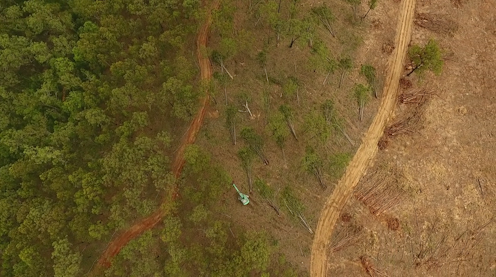
 Land clearing is accelerating in the Northern Territory, home to the world’s largest intact tropical savanna. This drone photo shows clearing done last month on the Sturt Plateau, south of Darwin.
Wilderness Society/AAP
Land clearing is accelerating in the Northern Territory, home to the world’s largest intact tropical savanna. This drone photo shows clearing done last month on the Sturt Plateau, south of Darwin.
Wilderness Society/AAP
The NT government has ambitious plans to develop both its agricultural and resource sectors. This will likely mean much more land clearing, and there are growing concerns over what that will do to landscapes, waterways and wildlife.
Effective laws are essential if we are to protect vegetation and wider biodiversity in the Northern Territory, home to the largest intact tropical savannah we have left on the planet.
 Famously colourful Gouldian finches are found only in Australia’s northern savannahs, but their numbers have fallen sharply. This photo was taken on pastoral land.
Bruce Thomson/AAP
Famously colourful Gouldian finches are found only in Australia’s northern savannahs, but their numbers have fallen sharply. This photo was taken on pastoral land.
Bruce Thomson/AAP
What’s next?
In recent decades, huge swathes of native forest and woodland have been cleared across Australia’s north. The loss of this vital habitat has contributed to the worsening plight of our threatened species, ecosystems and human health.
Australia has promised to end deforestation. The problem is, our environmental laws and enforcement are failing to do so. Reforming our national laws will be essential, alongside better support for landowners managing trees on their land.
After all, ending widespread clearing is the most cost-effective and least risky way to protect our wealth of species.


