News Daily

The Times

Australia

  • Written by The Conversation
We need to better support First Nations women with violence-related brain injuries. Here’s how

Please be advised this article contains details of family violence.

Domestic violence causes disability for women through lasting impacts on their brains.

Traumatic brain injury refers to damage to, or alteration of, brain function due to a blow or force to the head. This leads to bruising, bleeding and tearing of brain tissue.

Such injury can have short-term (acute) effects or cumulative effects (over months or years).

A 2008 study by researchers in Adelaide found Aboriginal women experience head injury – including traumatic brain injury – due to assault at 69 times the rate of non-Indigenous women.

We spoke to Aboriginal and Torres Strait Islander women and communities in regional and remote Australia about their experiences of traumatic brain injuries from violence and their decision-making about health care access.

We also spoke to family members about what they observed in other women who were important to them and had experienced traumatic brain injury.

Here’s what we found – and how it can inform the development of better health care and support services.

Not feeling like the person I used to be

Violence-related traumatic brain injuries are not isolated experiences. The Aboriginal and Torres Strait Islander women we spoke to reported repetitive, violence-related head injuries over prolonged periods. Most women reported dozens of head injuries or had lost count of the number of injuries suffered.

The violence experienced was usually from Indigenous and non-Indigenous current or former male partners.

Aboriginal and Torres Strait Islander women reported living with and managing many common changes from traumatic brain injuries, including:

  • memory troubles
  • dizziness and headaches
  • difficulty with concentration and organisation
  • trouble with taking in information and thinking (sometimes described as “mixed up thinking”)
  • finding it hard to start a yarn or keep conversations going with family and friends (described as “losing the words or having the words disappear” or feeling like “my brain went blank”)
  • mood swings and impulsivity.

Coral shared:

Black out, now suffering from memory loss, like finding hard to be telling a yarn. These are stories that have happened to me. But I can’t remember it.

Kirra said about her own experience:

I put something somewhere, like, book, keys, phone. If I can’t see it, I forget where I put it. I have troubles keeping focused on one thing.

The women we interviewed also frequently mentioned being strangled. Non-fatal strangulation is also harmful to the brain because it reduces blood flow to the head and deprives the brain from getting oxygen.

When and why women access health care

Women felt accessing health care and support services after violence-related traumatic brain injury was not always an option for them. This was primarily because they were experiencing coercive control or were worried they would be reported to child protection authorities.

The characteristics of the injury also influenced their decisions about accessing health care. If there was no visible bruising, lacerations or marks, blood or recalled loss of consciousness (or blacking out) many Aboriginal and Torres Strait Islander women did not go to hospital and managed their own symptoms.

As Cathy explains:

Then one night he hit me. There was no hospital, no blood, bleeding, no one would have thought there was domestic violence that happened to me. Didn’t think it was serious enough to go.

How women manage symptoms of traumatic brain injury

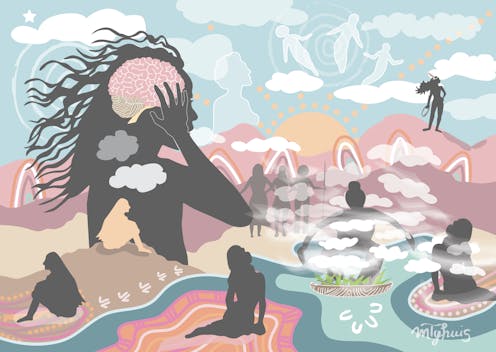
Journey Home After Brain Injury, Shirleen Nampajinpa Campbell, 2021. Aboriginal and Torres Strait Islander women practised a range of activities to help improve their memory and manage anxiety after their traumatic brain injury. This included: painting and weaving listening to meditation music completing puzzles and other tactile activities. Family and friends helped Aboriginal and Torres Strait Islander women with daily activities like shopping at the supermarket, paying bills and attending appointments. As Pat shares: Someone from the family talks to me on the phone when I’m at the shop so I don’t forget. Sometimes my daughter or grandchildren will take a photo and send to me. However, homelessness, isolation and ongoing violence undermined many Aboriginal and Torres Strait Islander women’s capacity to seek medical care for traumatic brain injury and to use these strategies. The need for regional and remote investment We need to strengthen access to health care and other support services for Aboriginal and Torres Strait Islander women with violence-related traumatic brain injuries. Our research shows this should include: developing standardised coordinated care pathway within emergency departments and remote community clinics developing a specialised workforce with training in traumatic brain injury and violence (such as Aboriginal social workers and Aboriginal allied health workers) who can support women in the health-care setting and in the community the inclusion of traumatic brain injury pre-screening questions in primary health and family violence screening tools, including Aboriginal and Torres Strait Islander health checks and state/territory family violence risk assessments educational resources that raise awareness and knowledge of traumatic brain injury and non-fatal strangulation among women, families and communities. This must include information that lasting harm to the brain can occur even when the person doesn’t lose consciousness or there is no visible injury needs-based funding for crisis accommodation services in regional towns and remote communities to ensure services can respond effectively to local need investment in the development of concussion clinics in regional and remote Australia. Any recommendations implemented must include local partnerships with Aboriginal and Torres Strait Islander peoples to ensure these practical measures are community-led, culturally appropriate and are beneficial overall, without doing further harm. If this article raises issues for you or someone you know, contact 1800 RESPECT (1800 737 732) or 13YARN (13 92 76). In an emergency, call 000. We acknowledge and thank the Aboriginal and Torres Strait Islander women whose stories appear in this article. We also acknowledge the artists who contributed to the project, including Shirleen Nampajinpa Campbell and Michelle Tyhuis.

Read more https://theconversation.com/we-need-to-better-support-first-nations-women-with-violence-related-brain-injuries-heres-how-233329

Pinboard Solutions for Offices, Schools and Shared Information Spaces

Why a Pinboard Remains Useful A pinboard provides a simple way to display information that needs to remain visible without being rewritten. Lawdex supplies fabric and cork options for offices, schools, staff areas and other environments. A pinboard can be used... Read more

Retractable Hose Reel: A Practical Guide To Choosing The Right Hose Storage

A retractable hose reel can make hose storage more organised, accessible and practical in workshops, commercial facilities, service areas and other working environments. Instead of leaving a hose coiled across the floor or requiring staff to manually wind it after... Read more

Car Removal Melbourne: What To Know Before Selling An Old Or Damaged Car

Start By Assessing Why The Car Needs To Go An old or damaged car can become difficult to justify keeping when repairs, registration, storage or ongoing maintenance outweigh its usefulness. Car removal Melbourne services can help owners arrange both the sale... Read more

Calm Marketing: Why You Don’t Need Flash to Win Online

There is a growing trend happening across websites, social platforms and digital storefronts, and it goes by the name calm marketing. Rather than shouting for attention with flashing banners, countdown timers and aggressive pop ups, calm marketing invites people to... Read more

Australian Off Road Caravans: What Makes Them Different from Standard Touring Vans?

Australian off-road caravans are designed for travellers who want to go beyond sealed highways and established caravan parks. A standard touring caravan is perfect for bitumen roads and conventional holiday routes. On the other hand, off-road models are built with... Read more

Why Compact Designs of Caravan Travel Transform Short Getaways

A caravan makes exploring Australia more flexible. For many Australians, a compact and practical setup makes short breaks easier, more comfortable and far more spontaneous. The layout inside significantly impacts how comfortable, organised and enjoyable your travels become.  Travellers often compare... Read more