

How do you make a giant gold nugget? Take a vein of quartz, add a few thousand earthquakes
- Written by The Conversation
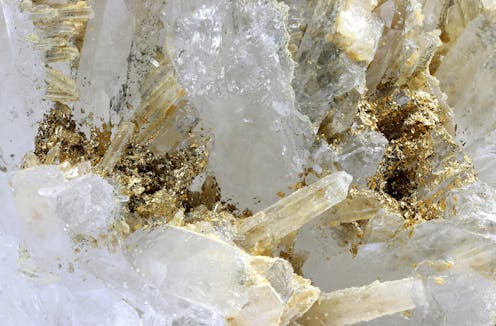
Humanity’s fascination with gold stretches back thousands of years. Gold mining is described in ancient Greek and Roman sources, and gold rushes – especially in the 19th century – played a powerful role in shaping the modern world.
The dense, yellow metal is often found in veins of the rocky mineral quartz. This is because the two condense together from hot fluids underground as a result of changes in temperature, pressure and chemistry.
Geologists understand this process quite well, but large gold nuggets have been a bit of a mystery. Gold is only dissolved in natural fluids at around one part per million, so how does it concentrate into lumps that weigh tens or even hundreds of kilograms?
As we report today in Nature Geoscience, the answer likely has to do with the unusual electrical properties of quartz – and what happens when an earthquake puts it under pressure.
Quartz under pressure
Quartz is what is called a piezoelectric material. There aren’t many minerals like this on Earth, and quartz is by far the most abundant.
Piezoelectric materials generate an instantaneous electric charge when put under stress – when there is a physical force compressing or stretching them. The bigger the force, the bigger the charge.
Quartz is one of the most strongly piezoelectric materials found in nature. Its piezoelectricity is what provides the spark in a BBQ lighter, as well as making most wristwatches tick.
During earthquakes, the movement of Earth’s tectonic plates can put quartz in the ground under huge stress. This can produce significant buildups of electric charge. Some have suggested this may be the cause of “earthquake lights” – flashes or glows in the sky seen during an earthquake.
Could this piezoelectricity also have something to do with how gold nuggets form?
Dissolved gold
The largest gold nuggets are often found in places where fluids flow through faults in rock during earthquakes. This creates veins of quartz that can contain gold.
It takes hundreds or thousands of earthquakes to create a deposit, so the quartz crystals in veins may experience thousands of episodes of stress.
When gold is dissolved in a natural fluid, it is often bonded to other molecules. If something makes these molecules unstable, the gold atoms may pop out of these molecules and form a deposit on a nearby surface.
One thing that can destabilise a molecule is hitting it with an electron. We know quartz can develop a buildup of electrons when stressed – as happens during an earthquake – but can it transfer these electrons to gold dissolved in a fluid?
We needed a way to find out.
A mini earthquake in the lab
Doing experiments with real earthquakes is quite tricky, so we tried to simulate one in the laboratory. We designed an experiment to replicate the “rattling” a quartz crystal would feel during an earthquake.
Our experiments involved submerging quartz crystals in gold-bearing fluids and then applying back-and-forth stress to the crystal with a motor. Each time the motor head hit the quartz, it generated a voltage.
Afterwards, we put the quartz sample under an electron scanning microscope to see if any gold had been deposited on the quartz surface. The results were shocking! (Sorry.)
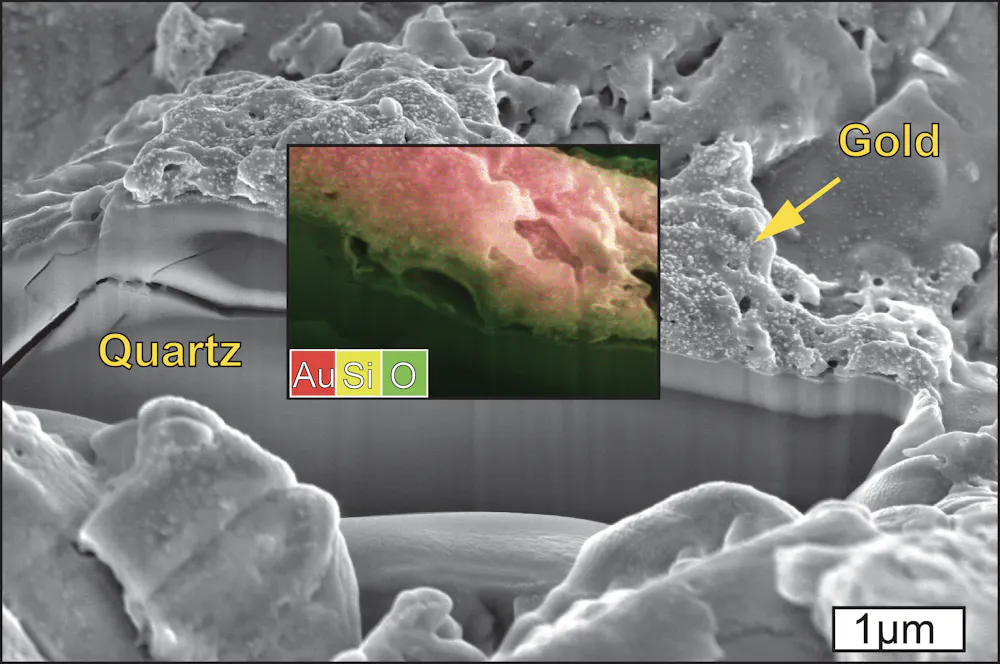
Not only did we see gold deposited onto the quartz surface, we also saw it clumping together into nanoparticles. What’s more, once the process began, gold was more likely to be deposited onto existing grains of gold than on quartz.
This actually makes a lot of sense, as quartz is an electrical insulator and gold conducts electricity. The existing gold grains adopt the electric potential from the nearby quartz and become the focus of reactions that deposit gold.
Industrial gold-plating works in much the same way, only here we are gold-plating other gold.
Back to nuggets
Now we know how quartz and gold behave this way in the lab, we can think about geology again.
Some of the most impressive gold nuggets ever found have been in quartz veins where gold-bearing fluids flow through faults in earthquake-prone rock.
During seismic activity, the stress on quartz can generate piezoelectric voltages capable of drawing gold from these fluids. Once deposited, gold becomes the focus of further piezoelectric plating as fluid infiltration continues – so the gold deposits grow bigger over time.
Over millions and millions of years, this process will be repeated again and again. Is this the reason we see such large gold nuggets in this kind of quartz vein? We think it must be at least part of the picture.


