

Principles or raw power: 3 steps NZ can take to resolve its confused stance on Gaza
- Written by The Conversation
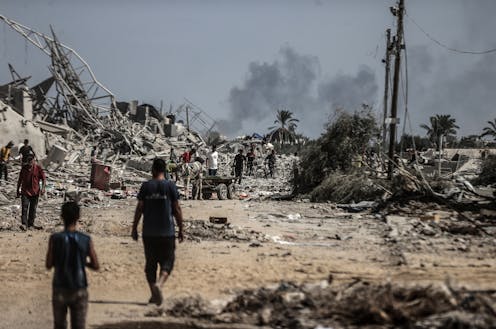
The Gaza crisis is a major moral and legal challenge for New Zealand’s sense of national identity, and to its worldview based on rules and principles rather than raw power.
Over the past 11 months, the world has watched as the Hamas terrorist attack on Israel prompted an unrelenting ground and air offensive in Gaza, with financial, logistical and diplomatic backing from the Biden administration in the US.
In the words of New Zealand Foreign Minister Winston Peters, the results have been “catastrophic”. It is estimated 69% of the more than 40,000 Palestinians killed in Gaza are women and children.
To date, the National-led coalition’s policy on Gaza seems caught between a desire for an immediate ceasefire and its push for closer alignment with traditional allies like the US. The upshot is a real lack of moral and legal clarity.
Ambiguous foreign policy
Last year, New Zealand backed calls in the UN General Assembly for humanitarian truces or ceasefires in Gaza. It also joined Australia and Canada in February and July of this year to demand an end to hostilities.
Peters told the General Assembly in April the Security Council had failed in its responsibility “to maintain international peace and security”.
He was right. The US exercised its veto on October 18 and December 8 last year, and in February this year, to block Security Council resolutions calling for humanitarian pauses or immediate ceasefires.
And the Biden White House has done little to ensure Israel complies with a US-sponsored ceasefire proposal adopted by the Security Council on June 10.
Nevertheless, the New Zealand government had few qualms about sending a small Defence Force deployment to the Red Sea as part of a US-led coalition effort to counter Houthi rebel attacks on commercial shipping there.
While such attacks are clearly illegal, they are basically part of the fallout from a continuing international failure to stop the US-enabled carnage in Gaza.
By sending the Defence Force team, the government has shown a selective concern for the erosion of international law at a time when the International Court of Justice (ICJ) has intervened in the Gaza crisis.
Upholding international law
Closer alignment with the US should not diminish Wellington’s longstanding commitment to a rules-based international order.
Above all, this means the New Zealand government has to participate and adhere to the judgments, orders and advice emerging from the ICJ. It can do this in three ways.
1. Join South Africa’s ICJ action
New Zealand should join other Western countries (including Spain, Ireland and Belgium) and involve itself in South Africa’s case at the ICJ against Israel.
This would allow New Zealand to express an opinion on the plausible applicable of the Genocide Convention. Although official documents show the Ministry of Foreign Affairs and Trade has been considering this, it remains unclear whether the government will act.
There is a real risk New Zealand’s international credibility will be on the line if it remains detached from the debate over whether the intentional destruction of a people, in whole or in part, is happening in Gaza.
Such inconsistency is doubly worrying when New Zealand is participating at the ICJ in a similar case involving Russia and Ukraine – under the auspices of the same Genocide Convention.
2. Be consistent on Gaza and Ukraine
New Zealand needs to add its support to the ICJ order of May 24 (part of the ongoing South African case against Israel). One of the key points of the order was that Israel must:
take effective measures to ensure the unimpeded access to the Gaza Strip of any commission of inquiry, fact-finding mission or other investigative body mandated by competent organs of the United Nations to investigate allegations of genocide.
New Zealand’s approach to Gaza should be consistent with its actions over Russia and Ukraine. On that matter, it has supported the International Criminal Court’s calls for accountability for breaches of international humanitarian law.
3. Follow ICJ advice on the Occupied Palestinian Territory
New Zealand should follow the advice of the ICJ’s recent advisory opinion on the “legal consequences arising from the policies and practices of Israel in the Occupied Palestinian Territory, including East Jerusalem”.
Very clearly, the court concluded Israel’s continued presence in the Occupied Palestinian Territory is unlawful. The court also advised other countries to:
abstain from all treaty relations with Israel in which it purports to act on behalf of the Occupied Palestinian Territory
abstain from entering into economic or trade dealings with Israel concerning the Occupied Palestinian Territory
and take steps to prevent trade or investment relations that assist in the maintenance of the illegal situation.
The ICJ also noted that safe and peaceful Palestinian self-determination and independence “as envisaged in resolutions of the Security Council and General Assembly, would contribute to regional stability and the security of all states in the Middle East”.
Given New Zealand is a signatory to the ICJ, it needs to participate in and comply with the court’s rulings.
This is important for bringing an end to the appalling suffering in Gaza. But it is also central to whether New Zealand can sustain its broader credibility as a country that upholds and advocates for an international rules-based order.


