

Unwritten rules, nostalgia and subtle rebellion: how school photos capture childhood and the changing times
- Written by The Conversation
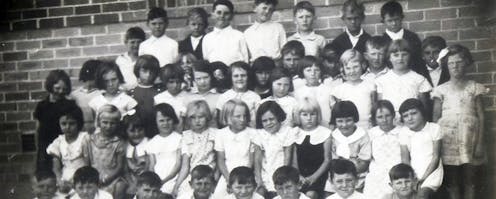
In the town of Kandos, New South Wales, there’s the local Kandos Museum run by volunteers. The museum holds relics from the cement works that once defined the town, but there are other treasures, too.
As part of the Cementa24 festival, I became fixated on the museum’s collection of school photos. Neatly organised into ring-bound folders by the volunteers, the group portraits span decades of students from Kandos Public School and Kandos High School, from 1924 through to the 1990s.

I enlarged and cropped some of these photos to turn them into street posters to scatter around town. I asked permission before sticking a few outside the local pub, the radio station, the post office and the op shop. I spot the locals smiling as they pass them, stopping to look for someone they know. I watch them point at the pictures and hear them naming names.
Working on this project, I can’t stop thinking about the weight of these photographic rituals. School photos aren’t just memories; they hold social histories. Through them, you can trace changes in hairstyles, fashion, attitudes and even migration – yet there’s something homogeneous and unchangeable about how they’re made.
School photo rules
There’s always a physical hierarchy in these photos. The photographer organises the group to ensure compositional acuity. The students are lined up in rows, with tall people in the back and shorter people in front – evenly spaced, arranged by height and symmetry.
When was the rule made that says this is how a group should look? Balanced, orderly and with everyone fitting neatly into place, whether they socially do or not. Somehow I always ended up on the edge of the middle row. The social dynamics of the playground found their way into the organisation of our bodies, forever captured in a split second.
 A photo of Kandos’ 5th Form, 1967.
Author provided, courtesy of the Kandos Museum
A photo of Kandos’ 5th Form, 1967.
Author provided, courtesy of the Kandos Museum
Looking at the Kandos photos from the 1940s through to the 1970s, then at my children’s photos from 2013 to 2024, and my own school photos in the 1980s and ‘90s, I can see the difference in public, private and catholic school uniforms. I can see the difference in racial diversity (or lack thereof) between a small regional town, inner-city Sydney and suburban southwest Sydney. I can also see how much photographic technology has changed.
Despite this, the organisational structure of the school photo remains the same. The kids still stand stiffly in their rows, with identical tunics and ties. Standing too close, someone’s elbow digs into someone else’s side.
As a photographer now, I often think about these school photos and the rituals that have remained largely unchanged in Australia. Every year, kids are shuffled onto tiered steps. Those in the front put their knees together, hands in laps, while the girls must “try to look like ladies”. Then there are the “nobodies” in the middle row (or is that just me reading into it?)
The perils of posing
Posing for school photos can be complicated. One year my daughter came home from school and declared the photographer was sexist because he made all the girls sit in the front row while the boys got to stand. I asked her why sitting was sexist. She couldn’t explain – she was eight years old – but she certainly felt the power difference between sitting with your knees pressed together and standing tall.
And what about the solo portrait? I still think about my kindergarten class from 1979. The group photo was fine. I was happy, standing next to my new best friend. But my solo portrait was a disaster. I looked possessed, my eyes half-closed, lashes blurred, caught mid-blink.
My mother didn’t buy the solo photo, but she kept the group one. After that I promised myself it would never happen again. I told myself every year: “don’t blink, don’t blink”. Back then, photography was on film. There were no re-dos, no instant feedback, no photoshop and no AI. Once the camera clicked, that was it.
 ‘Don’t blink, don’t blink,’ I’d think, while trying to keep my eyes open.
Author provided
‘Don’t blink, don’t blink,’ I’d think, while trying to keep my eyes open.
Author provided
At the end of primary school, I’d visit my best friend’s house and envy the neat, chronological line of her school photos framed on her kitchen wall. Year by year, there she was, changing just slightly – a slow, steady record of growing up. I didn’t know why, but seeing framed evidence of time passing made me emotional. Maybe it was the certainty of the way her life was so neatly documented.
My own school photos never made it to the wall in such a tidy fashion. But they did make it into my father’s wallet, my mother’s purse, in frames above the piano, on the fridge, in photo albums and in many a drawer.
Small acts of rebellion
The 1950s photos are formal and solemn. Back then you stood straight, faced the camera and no one smiled too much. By the 1970s and '80s, the kids started to smirk – with hair loosened, mullets, and bodies shifting like they were trying to resist the pose. In one photo, the basketball team boys have their shoes off, feet raised above the blistering asphalt in the summer heat. The rules were still there, but you can see them pushing back.
 Bare feet raised in a photo of the Kandos High School Open basketball team, 1975.
Author provided, courtesy of the Kandos Museum.
Bare feet raised in a photo of the Kandos High School Open basketball team, 1975.
Author provided, courtesy of the Kandos Museum.
What if we invited the rituals to change? What if students could self-organise, be silly, pull faces, wear their own clothes, and resist gender binaries and institutional uniformity?
Some of the photos in the Kandos albums hint at this potential for small acts of rebellion. There’s the girl pulling a face, one laughing in profile. In one photo there’s a kid wearing a non-regulation jumper, and another in which they were clearly allowed to be silly because the teacher is laughing too.
 Photographic rebellion in the class of 1996.
Author provided, courtesy of the Kandos Museum.
Photographic rebellion in the class of 1996.
Author provided, courtesy of the Kandos Museum.
In the pre-digital era, these small mishaps and moments of failure were captured unpolished and unfiltered. Those are the images I find myself drawn to; these are often the best ones. They reveal how uncomfortable it can be being photographed and how forced a pose can feel. Shirking a smile and a stiff stance is maybe the only power we have in that brief moment.


