

Scientists have found carbon dioxide on Pluto’s largest moon – offering clues about how it formed
- Written by The Conversation
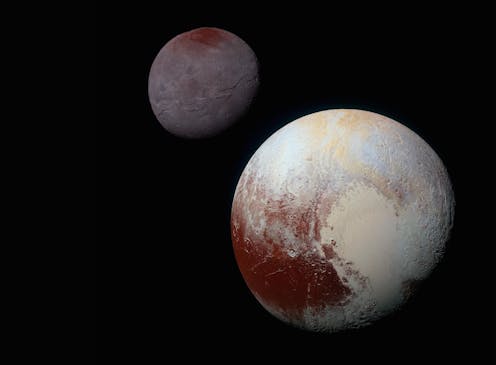
In the outer reaches of our Solar System, 5.7 billion kilometres from the Sun, lies the dwarf planet Pluto. Smaller than Australia, it is an icy world of mountains, glaciers and craters where the average temperature is –232°C.
Five moons orbit Pluto – Styx, Nix, Kerberos, Hydra and Charon. Of these, Charon is the largest. Unlike most other planetary systems, it exists in a “binary system” with its parent body, meaning they both orbit a point in space between the two.
Much mystery still surrounds Pluto and its moons. But in new research published in Nature Communications today, a team led by astronomer Silvia Protopapa from the Southwest Research Institute in the United States announced they’ve found carbon dioxide and hydrogen peroxide on Charon’s surface.
The findings, based on data from NASA’s James Webb Space Telescope, offer vital clues about how our favourite not-planet/planet system was formed.
What is Charon?
Scientists first discovered Charon in 1978 when they were studying the orbit of Pluto.
Charon is kind of like Pluto’s smaller twin. It is just over 1,200 kilometres wide – about half the size of Pluto, which makes it the largest known satellite relative to its parent body in our Solar System. Pluto itself is already small when compared to our Moon, with Pluto being about two-thirds the size and one-sixth the mass of Earth’s satellite. Charon’s mass is about one-eigth that of Pluto’s.
Charon and Pluto have an unusual orbit. While Charon goes around Pluto, Pluto also spins around a central point. They act almost like a double dwarf planet. This is unlike the Moon and Earth, where the Moon goes around us, and we don’t really change our position.
This is one reason why Pluto is no longer considered a planet, but is now labelled a dwarf planet. Its orbit with Charon means Pluto has not cleared its orbit, or has become the gravitational boss. This is the criteria Pluto failed in the planetary checklist.
The composition of Charon
In 2015, NASA’s New Horizons became the first spacecraft to explore Pluto and its moons up close after a nine-year journey from Earth. It showed Charon is composed of a variety of chemicals.
It is a very cold moon, rich in water ice. But it also contains ammonia and a wide variety of carbon-based compounds. Charon is also believed to have cryovolcanoes – areas that erupt ice instead of magma like on volcanoes on Earth.
Charon’s composition is different to Pluto’s and that of other objects beyond Neptune, which are dominated by nitrogen and methane ice.
The new detection of carbon dioxide and hydrogen peroxide on Charon can give valuable insight into how various processes interact on these trans-Neptunian objects.
Carbon dioxide is always a key molecule to understand – it tells us a lot about the history of an object.
In the case of Charon, it is believed the carbon dioxide comes from below the icy surface and has been exposed through asteroids and other objects hitting the moon and creating craters which reveal the fresh underground surface.
James Webb Space Telescope does it again
Scientists were able to detect carbon dioxide on Charon thanks to observations from the groundbreaking James Webb Space Telescope. Launched in 2021, this space telescope has a large mirror, six-and-a-half metres wide, which makes it very powerful and sensitive.
It can “see” in the infrared – colours of light our eyes and most telescopes on Earth can’t detect. The infrared is a key type of light for finding various molecules present on other objects – from planets to stars, galaxies and more.
To find these compounds, the telescope uses a technique called spectroscopy. The colours of light are broken up into individual colours, like breaking up white light into a rainbow. Each element or molecule has its own colour signature, like a fingerprint.
These new observations of Charon showed the signatures of carbon dioxide and hydrogen peroxide, along with the other previously known water ice.
 NASA’s James Webb Space Telescope helped scientists study Charon.
NASA/Chris Gunn
Vital clues to an ancient mystery
The formation of Charon is a scientific mystery. One of the leading theories is that it formed in a similar way to our Moon. According to this theory, some 4.5 billion years ago, a large object in the Kuiper Belt – the area where Pluto and Charon live – collided with Pluto and part of it broke off and formed into Charon.
It also could be that Pluto and Charon were two objects that collided, and then got stuck orbiting around each other.
Understanding the composition of Charon helps advance our understanding of how it formed. In this sense, the discovery of carbon dioxide and hydrogen peroxide represents an important step forward. Importantly, this can also give clues not only about Charon, but other objects out near Pluto.
More insights into Charon will help us understand this distant part of our Solar System – and the strange worlds that lie there.


