

Dingoes are not mating with dogs – but that could soon change if the culling continues
- Written by The Conversation
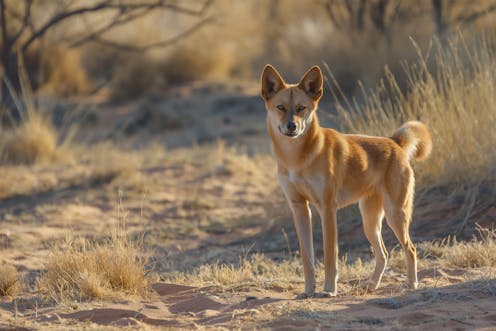
The dingo was completely isolated from other canines on the Australian mainland for more than 5,000 years, until domestic dogs arrived on the scene. Subsequent concerns about livestock loss formed the basis of Australia’s “wild dog” (dingo) pest control programs, which continue today. Stretching 5,614km across Australia, the “dingo fence” or “dog fence” was built in the 1880s to keep dingoes away from livestock in the southeast.
Dingoes are protected as a threatened species in Victoria. But dingo–dog hybrids are considered pests, and therefore allowed to be killed.
Unfortunately, past research claimed to find evidence dingo-dog hybrids are common in the wild across eastern Australia. This research has been used to defend the trapping, poisoning and shooting of these animals in some parts of Australia, particularly Victoria.
But other studies and now our new genetic research show dingoes are not breeding with domestic dogs in the wild. Rather, they are maintaining their independence as a unique evolutionary branch.
Our research also highlights the precarious state of dingo populations in Victoria. We fear dingo genetic diversity will continue to decline as long as lethal control measures are used. Ironically, this could prompt dingoes to mate with dogs to survive.
Two tales of Victorian dingoes
Victoria has two main populations of dingoes: northwestern and eastern.
The northwestern population consists of as few as 40 dingoes and is protected.
But the eastern population of 2,640–8,800 dingoes is not fully protected. Lethal control measures are allowed on private land and on public land within 3km of a private land boundary. This “unprotection order”, introduced to safeguard livestock, was recently extended until 2028.
In 2022 alone, 683 dingoes were trapped and shot on public land as part of the Victorian wild dog program. But this number doesn’t include deaths from baiting programs, or farmers shooting dingoes on private land. Altogether, it’s estimated up to 1,500 dingoes are killed in eastern Victoria each year.
This means a substantial proportion of the eastern Victorian population is being killed every year. Even if population size is maintained despite culling, it may still reduce genetic diversity.
The threat of inbreeding
When a population shrinks, related individuals start to breed with each other. Inbreeding decrease litter size, increase deformities and pup deaths, and reduce resistance to diseases.
We think this is already happening in the northwestern population. Our research shows its genetic diversity is critically low. Recent observations of tail deformities underscore the potential consequences of low genetic diversity.

What we did and what we found
We obtained 434 frozen canine DNA or tissue samples for genetic analysis, from organisations around Australia.
The Victorian samples mainly came from the state’s wild dog program (2014–19). Other samples came from government officers, private landholders, conservation groups and dog owners.
Most (380) of the samples were originally collected in the field from free-ranging animals believed to be either pure dingoes or potential dingo–dog hybrids.
The remaining 54 samples came from domestic and captive animals. These were 39 domestic dogs, seven known hybrids born in captivity, and eight known “backcrossed” dingo–dog hybrid × dingo crosses born in captivity.
We found the free-ranging animals were all dingoes. They fell into one of three distinct groups: alpine, desert or mallee. They were distinct from the domestic dogs and known hybrids born in captivity.
The results also revealed low genetic diversity in all three dingo groups.
The isolated population in northwest Victoria is in particularly bad shape. Local extinction is probable in the near future. That’s why the unprotection order was lifted there.
If culling of the eastern population continues, it could soon follow suit.
Indigenous farmers are supporting the fight to save the dingo. | 7.30.Ongoing decline may prompt desperate measures
The ongoing unprotection order is likely to further diminish genetic diversity. As dingo numbers decline and options for mates become increasingly limited, this could force dingoes to mate with dogs.
In North America, hunting of red wolves decimated their populations, while the numbers of coyotes increased, forcing these two species to hybridise.
Mating with domestic dogs may actually increase dingo genetic diversity and allay concerns about inbreeding. But the implications will be profound, not just for the dingo itself, but for the ecosystem, Traditional Owners and even graziers. Balancing livestock protection against conservation of this iconic species is more crucial now than ever before.
In the next decade or so, Victorian dingoes may reach a “genetic cliff” where their genetic decline is irreversible. So it is essential to develop strategies that both support graziers and the unique dingo lineage.
Several non-lethal management strategies have been previously described. These need to be further developed with input from graziers, so they can be applied effectively across Victoria.
Treading a different path
Our research reveals dingoes remain genetically distinct from domestic dogs, despite more than 200 years of coexistence. This is consistent with recent research challenging previous claims about widespread interbreeding.
Unfortunately, our research also found low genetic diversity in all dingo populations. We are continuing to explore the genetic state of dingoes across Australia using new genomic approaches. This work promises to provide more insight into the decline of this iconic Australian animal.
In the meantime, we urge governments across Australia to consider the biological consequences of killing dingoes. It is becoming increasingly clear that “wild dog” control programs are contributing to their genetic decline.


