

First among equals: how Kamala Harris must rewrite the history of female political leadership to win
- Written by The Conversation
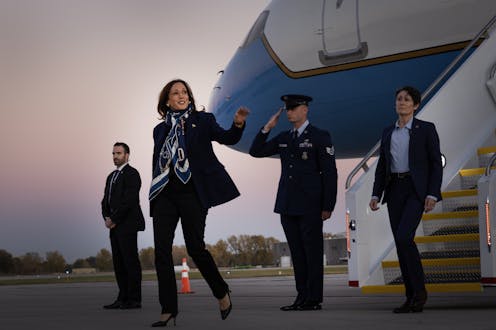
In the final week of the US presidential election campaign, there is a real possibility a woman will make it into the top job. But why has it taken so long – and has Kamala Harris got what it takes to make history?
My research examines celebrated women in history and how, collectively, they represent women’s changing status in society. In particular, I have looked for the historical themes and patterns that explain the rise of the first elected women leaders.
Women in politics are generally assumed to be a minority, emerging from a position of disadvantage. When successful, they are considered exceptions in a masculine system that was previously out of bounds.
But due to the complex workings of gender, race, class and culture, it’s not quite that straightforward, as discussion of Harris’s biracial identity shows.
I have identified three broad groups of women who have succeeded in becoming elected leaders of their countries since Sirimavo Bandaranaike of Ceylon (now Sri Lanka) became the world’s first female prime minister in 1960.
Does Kamala Harris fit within any of these groups? And, if so, based on the pattern so far, does she have what it takes to become president? Or does being a global superpower mean the US demands a new form of female leadership?
Born to rule
This first group came to power largely due to old hereditary, dynastic traditions rather than through new democratic systems.
Bandaranaike was known as the “gentle widow” of Solomon Bandaranaike, the fourth prime minister of Ceylon, who was assassinated in 1959. After her came a cohort of dynastic women leaders, including three others who succeeded assassinated fathers: Indira Gandhi (India), Benazir Bhutto (Pakistan) and Park Geun-hye (South Korea).
Three others in this group – Corazon Aquino (Philippines), Violeta Chamorro (Nicaragua) and Khaleda Zia (Bangladesh) – followed their assassinated husbands into office.
There by default, coming to power to regenerate family dynasties, these women built images based on traditional mother figures, offering deliverance by “giving birth” to newly decolonised nations. In the words of her biographer, Bandaranaike was “the symbol, the figurehead that was necessary; the spark to ignite the flame”.
It took until 2016 for Taiwan’s Tsai Ing-wen to become the first woman leader from Asia not born into a political family.
The importance of family dynasty explains the apparent paradox of female leaders emerging in countries with extreme gender, class and ethnic inequalities, with Islamic nations being among the earliest to elect women.
While hailing from an elite political family has benefits for women leaders, the inverse may be true for Kamala Harris: not coming from a dynasty may be an advantage in a nation that prides itself on being an egalitarian, self-made melting pot.
Of course, US political dynasties have developed with the Bush and Kennedy clans. But Hillary Clinton’s loss to Donald Trump in 2016 was likely due in part to voters rejecting a Clinton dynasty. Being the daughter of migrants from India and Jamaica might actually help Harris this time.
Conservative ‘honorary men’
There’s a second group of politically conservative, largely White Western women. Some, like Golda Meir (Israel) and Margaret Thatcher (United Kingdom), were elected.
But others – Kim Campbell (Canada), Jenny Shipley (New Zealand) and Theresa May and Liz Truss (UK) – were chosen by their parties during an elected term. This may reflect a general reluctance by conservative voters to embrace change and vote for women.
As such, women in this group seek to be male equals, to reach the top as “honorary men”, ready to prove their strength. Margaret Thatcher played the “iron lady” and upped her ratings during the 1982 Falklands War. Golda Meir could be cast as a nurturing grandmother who made chicken soup, or “the overbearing mother who ruled the roost with her iron hand”, as later Israeli president Chaim Herzog said.
Harris doesn’t fit within this group. Were she a Republican she might be able to present as an auntie and caring stepmother who upholds the right to bear arms. But with her appeal to the politically progressive side of US society, not fitting the conservative mould may be to her advantage.
Social change-makers
A third group of women leaders skews left and actively resists restrictive maternal and gender roles. While the great majority of women world leaders have had children, this group contains a number who have not.
Unlike those in the first two groups, they often question dominant, masculine power structures and seek reform of the political system. Generally, it is hardest for these women to be elected.
Being highly educated, with careers in academia and public service, is a common experience and route to political power for this group. For example, Gro Harlem Brundtland (Norway) trained as a medical doctor, Mary McAleese (Ireland) as a lawyer and academic, and Angela Merkel (Germany) has a PhD in quantum chemistry.
These women attempt to craft new forms of leadership. They encourage more women to join them in power, and challenge sexism, homophobia and racism. More generally, they work to transform global governance, promoting pluralism, tolerance and kindness.
Since Elizabeth Domitien was elected prime minister of the Central African Republic in 1975, more women leaders of this stripe have emerged, including Vigdis Finnbogadóttir (Iceland), Mary Robinson (Ireland), Sylvie Kinigi (Burundi), Michelle Bachelet (Chile), Helen Clark and Jacinda Ardern (New Zealand), Julia Gillard (Australia), and Tarja Halonen and Sanna Marin (Finland).
The Harris challenge
Kamala Harris fits most obviously within this group. She is highly educated and experienced in public service. And she has not had children, unlike so many in the other two groups.
For that she has been branded a “childless cat lady”, of course, which points to perhaps her biggest obstacle: the alpha male culture in an alpha military superpower.
Unsurprisingly, rival military powers Russia and China are yet to elect a woman leader. It may be that being a social change-maker and having one’s finger on the nuclear button requires a new form of female leadership – a new-age warrior woman, perhaps.
It only remains to be seen whether the US, the world and Harris herself are ready for that role.


