

Cricket balls can concuss and even kill batters – at all levels, helmet use must be taken seriously
- Written by The Conversation
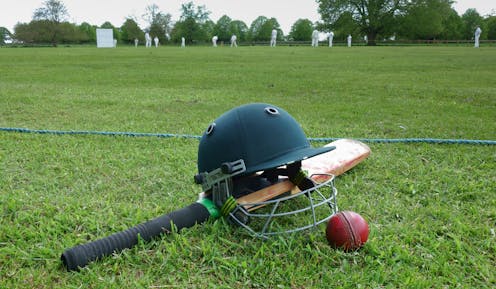
The ten-year anniversary of the death of much-loved Australian cricketer Phillip Hughes falls on November 27.
The 25-year-old’s life was tragically cut short in 2014 when a bouncer struck the back of his neck during a match for South Australia.
Despite wearing a helmet, Hughes never regained consciousness after the ball struck an unprotected area just below his left ear.
A decade later, another supremely talented batsman, Will Pucovski, is facing premature retirement due to concussion-related concerns.
With player safety such a high priority area in cricket, how have the rules changed over the past decade? And even if you only play cricket at a community level, what do you need to know to stay safe?
Managing risk in a dangerous sport
Batting is a daunting and dangerous activity: batters stand about 18 metres away from bowlers who can hurl a hard leather cricket ball at speeds exceeding 130 kilometres per hour for women and 150 km per hour for men.
At the inquest into the death of Hughes, the New South Wales coroner reinforced the innate danger of cricket.
The coroner also noted Hughes was not wearing a helmet that complied with the highest-level safety standards at the time. He said cricketers’ personal protective equipment was “essential if death and injury is to be minimised”.
He recommended Cricket Australia continue collaborating with developers and players’ associations to identify a neck protector that could be mandated for use in all first class cricket matches.
Cricket Australia changed the playing conditions for the 2023–24 season, and now all Australian players in international and domestic cricket must wear neck protectors.
Deaths in cricket
The death of Hughes was not the first to occur in a cricket match. But it served as the catalyst for researchers to take a closer look and gather data on cricket-related fatalities.
One historical review found cricket-related fatalities in Australia date back to 1864, with 174 deaths related to the game – of those, 83 were in organised settings, such as club or school competitions. The others were in informal play such as in backyards and on beaches.
In organised cricket, the most common cause of death was a batter suffering “a ball to the head (temple, forehead or face), to the side of the head, below or behind the ear, or on the neck”.
Notably, these fatalities decreased significantly after the introduction and widespread use of helmets by batsmen from the 1980s.
Concussion and traumatic brain injury
Even with the protective equipment available to players today, batters, wicket-keepers and even umpires and bowlers are still at some risk of severe facial and skull fractures, concussion and traumatic brain injury.
A 2022 UK study involving about 2,300 mostly male cricketers found 10% of players experienced at least one concussion during their career.
In Australian elite male and female cricket players, concussions were the third most frequent injury (in terms of time lost to a sport) from 2015 to 2022.
These statistics are particularly concerning given the potential long-term negative effects of sports-related concussion.
The importance of helmets
The first cricketer reported to have worn a helmet was Englishman Dennis Amiss, who in 1977 wore a customised motorcycle helmet.
Closer to home, the collapse of Australian batsman David Hookes after being struck in the jaw in the same year was the catalyst for changing attitudes towards helmet use.
Over the past decade, the International Cricket Council (ICC) and many national members have supported the United Kingdom’s Loughborough University research to improve the design of helmets.
This research is used to improve many of the rules regarding helmet use, and concussion testing and management approaches.
Helmet design technology is continuing to develop. High-impact materials are being used to reinforce the hard outer shell of the helmet (including the face guard), with the protective inner shells being further refined to better distribute and absorb ball impact forces.
As observed by the coroner in the Hughes inquest, helmets must now comply with what is known as the British Standard.
Who needs to wear helmets?
At all levels of the sport, the ICC and Cricket Australia owe a duty of care to players and helmet rules now apply across all levels.
International level
At international level, the ICC issued a directive in 2015 making it mandatory for elite cricketers to wear a compliant helmet in ICC-sanctioned matches.
For example, in Test matches, a helmet must be worn by batters who are facing pace bowlers, wicket-keepers who are standing up to the stumps, and fielders who are close to the batter in front of the wicket.
The ICC states “the use of a neck protector when batting in international cricket is optional”.
National level
Since the 2019–20 season, Cricket Australia mandated players wearing British Standard-compliant helmets when batting, wicket-keeping up to the stumps and fielding close to the batter.
It changed the playing conditions for the 2023–24 season, making it mandatory for batters in all Cricket Australia-sanctioned competitions to wear neck protectors when facing fast or medium paced bowlers.
The 2023-2024 playing conditions also state the umpires are the sole judge of whether bowling is fast or medium-paced.
Community level
Cricket Australia developed simplified playing conditions to help community clubs navigate the rules and enforcement options.
These recommendations and resources reflect its administrator role as the custodian of the game of cricket in Australia.
On the use of helmets, Cricket Australia “strongly” recommends community club players use British Standard-compliant helmets when batting, wicket-keeping up to the stumps and fielding close to the batter.
Cricket Australia also strongly recommends participants wear neck protectors.
Some leagues are going above and beyond these recommendations in an attempt to make their competitions safer.
For example, in October, Cricket Gold Coast introduced a rule making helmets compulsory in all competitions.
Other leagues have also adopted extra precautions.
Future focuses
Cricket administrators at all levels are moving in the right direction in terms of helmets and player safety.
Whether neck guards for all international matches should be mandatory continues to be debated. Even if the risk of cricket related fatalities is rare, administrators still need to take precautions due to the greater knowledge around the dangers of head injuries.
The sport’s administrators need to remain vigilant by ensuring rules remain consistent with research evidence, are fit for purpose, and compliance is consistently enforced.


