

Ant stings can be painful. Here’s how to avoid getting stung this summer (and what to do if you do)
- Written by The Conversation
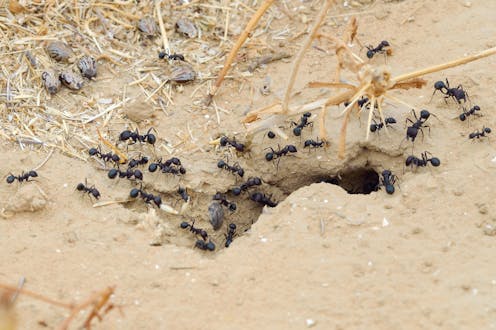
With the start of summer just days away, many of us will be looking forward to long sunny days spent at the beach, by the pool, out camping or picnicking in the park.
Insects also love summer. This is when most of them breed and feed. But this shared appreciation of the season can sometimes lead to conflict.
Insects have long been prey to many species, including birds, mammals, amphibians and other insects. As such, they’ve evolved a diverse range of defences – perhaps none more familiar to humans than the sting.
Many ants have a sting at their rear end which they use to deliver venom. It’s not the sting itself that causes pain, but rather the venom. Ant venom contains a cocktail of different chemicals, some of which have evolved specifically to manipulate nerve endings in our skin to cause pain.
Let’s look at some of the different ant stings you might experience this summer in Australia, and how to respond.
Bull ants
Bull ants (also known as bulldog ants, jumper ants, or jack jumpers) are large, for an ant. Some species can reach a length of 4 centimetres. They are easily recognisable with their large eyes, long mandibles (jaws) and aggressive nature.
Their sting is immediate, hot, sharp, and unmistakable, not dissimilar to that of a honeybee. The intense pain will last only a few minutes, before it’s replaced by some redness and swelling around the sting site.
Green-head ants
Green-head ants are also called green ants (but not to be confused with the green tree ants of northern Australia which do not sting). Green-head ants are common, and love our grass lawns.
At around 6 millimetres long, they are significantly smaller than bull ants. They can be recognised by their shiny green and purple exoskeleton.
Green-head ants tend to be less aggressive than bull ants, but they can still deliver a meaningful sting. The pain of a green-head ant’s sting can build more gradually, and create an intense, sticky ache.
Fire ants
Fire ants (or red imported fire ants) are originally from South America. They were first detected in Brisbane in 2001, thought to have hitched a ride in shipping containers, and have since spread across south-east Queensland.
Fire ants are reddish-brown and black and range in size from 2–6 millimetres long.
You’re most likely to encounter fire ants at their nests, which look like a pile of powdery soil. A fire ant nest doesn’t have an obvious entry, which is a good way to distinguish them from other similar ant nests.
Disturbing a fire ant nest will awaken an angry mass of hundreds of ants and put you at risk of being stung.
The initial pain from an individual sting is like an intense, hot itch, though manageable. But fire ant stings rarely occur in single digits. One ant can sting multiple times, and multiple ants can sting one person, which can lead to hundreds of stings. Fire ant stings can lead to pus-filled ulcers and scarring in the days afterwards.
If you live in an area where there are fire ants, it’s worth taking a few minutes to educate yourself on how to recognise and report them.
Electric ants
Electric ants are another nasty accidental import, originally from Central and South America. Currently restricted to Cairns and surrounds, these are tiny (1.5 millimetres long) yellow ants.
Like fire ants, these ants will typically defend en masse, so many will sting at once. Their sting is more painful than you’d expect from such a tiny creature. I liken it to being showered in red hot sparks.
If you think you see electric ants, you should report this to Biosecurity Queensland.
Aussie ants aren’t the worst
You might be surprised to hear Australian ants don’t even make the podium for the most painful ant stings. Among the prize winners are harvester ants (North and South America) which cause an extreme, sticky ache, likened to a drill slowly turning in your muscle – for as long as 12 hours.
The gold medal goes to the sting of the bullet ant of South and Central America, which has been described as:
Pure, intense, brilliant pain. Like walking over flaming charcoal with a 3-inch nail embedded in your heel.
How to avoid getting stung (and what to do if you do)
Fortunately, the solution is usually very simple. Look before you sit on the ground or lay out your picnic blanket, avoiding areas where you see ant nests or lots of foraging ants.
Choice of footwear can also be important. In my experience, perhaps unsurprisingly, most stings occur on thong-wearing feet.
If you do get stung, in most cases it’s going to get better on its own. Pain will usually subside after a few minutes (sometimes a little longer for a green-head ant sting). The redness, swelling and itch that typically follow can last for a few days.
In the meantime, if needed, an ice pack will help with the pain. If it’s particularly bad, a local anaesthetic cream containing lidocaine may offer some temporary relief. You can get this over the counter at the pharmacy.
A small proportion of people may have an allergic reaction to ant stings. In very severe cases this might involve trouble breathing or swallowing. If you or someone you’re with experiences these symptoms after an ant sting, seek urgent medical attention.


