

Welcome to Babel: new documentary charts the creation of painter Jiawei Shen’s three-storey magnum opus
- Written by The Conversation
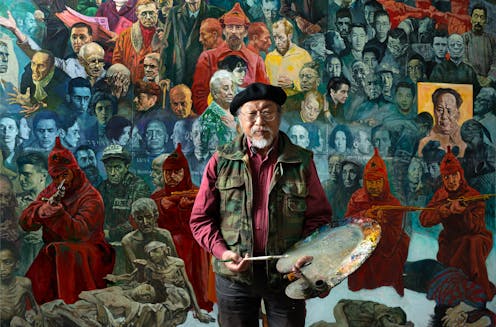
When Jiawei Shen first came to Australia, he bought a copy of that great western ideological text, the Bible. The doctrine that had shaped his life until then had come from the writings of the great Marxist thinkers – Karl Marx, Vladimir Lenin and of course, Mao Zedong.
It made sense, therefore, to study the source of the ideology that supposedly shaped this strange new world. Right near the beginning, in Genesis chapter 11, he found the intriguing story of the Tower of Babel, a myth on the origin of linguistic and cultural confusion.
It tells of a time when all people spoke the same language, and out of pride, they built a tower to the heavens so it would be seen from wherever they went. God realised if they continued to collaborate, nothing could stop them:
If as one people speaking the same language they have begun to do this, then nothing they plan to do will be impossible for them. Come, let us go down and confuse their language so they will not understand each other.
The tower was abandoned – and the people scattered across the earth, with many different languages.
Many years later, when Shen contemplated the way his life and his wife’s life had been shaped by ideology and circumstance, he remembered the lesson of the Tower of Babel
Settling in Bob Hawke’s Australia
In June 1989, when student demonstrations in Beijing resulted in the Tiananmen Square massacre, Jiawei Shen was in Australia. As all affected Chinese citizens were granted asylum by then Prime Minister, Bob Hawke, he was able to settle in Sydney.
He was soon joined by his wife, fellow artist Lan Wang, and their baby daughter, Xini. While Lan Wang worked as a cleaner, Jiawei Shen started his Australian career by drawing portraits for tourists at Circular Quay. Most art competitions are by invitation only, but in 1993 when he entered the open-entry Archibald Prize with a portrait of Professor John Clarke, his work was hung.
He soon became an Archibald favourite. The smooth, almost photographic finish that characterised his style made him a popular artist for portrait commissions. In 1995, he was awarded the Mary MacKillop Art Award. His interpretation of the future saint pleased the conservative hierarchy of the Roman Catholic Church.
In 1997, Shen and Wang bought a small fisherman’s cottage at Bundeena on the edge of the Royal National Park. After the changing political climate in China saw his art (which had been out of favour) come into fashion once more, Jiawei Shen considered the nature and impact of ideology.

He thought again of the story of Babel – and how it could be seen as a metaphor for what had happened to the original ideals of Communism.
On October 30 2017, exactly 100 years after the Bolshevik Revolution, Shen began to paint his magnum opus, The Tower of Babel. The painting is so large it fills the walls of the three storey house that was built to contain it.
James Bradley’s documentary, Welcome to Babel, records both the painstaking process of making the painting – as well as the contradictions and commonalities of Jiawei Shen and Lan Wang’s lives in both China and Australia.
 The documentary played at the Sydney Film Festival earlier this year.
Bonsai Films/Peter Solness
A vision to build the communist mansion
The painting itself (which remains in Shen’s possession) is divided into four parts, one for each wall: Utopia, Internationale, Gulag and Saturnus.
The images are drawn from both historic documents and copies of works of art made by artists identifying with Communism. Utopia, the first painting, starts with Lenin and the ideals of the Bolshevik revolution, which evolved into the tyranny of Stalin and, in China, Mao.
 Utopia is one of four murals that make up Shen’s colossal painting.
Bonsai Films/James Bradley
Portraits of the great men evolve into images based on the propaganda they spread about the new society they were creating. As their ideas spread around the world, they influenced many artists – such as Picasso, Matisse, Léger, Frida Kahlo and Diego Rivera – who came to admire the idealism of this brave new world.
Shen was a child of Mao’s revolution. Born in Shanghai in 1948, he was the son of loyal party members. In his childhood he knew “we were building the Communist mansion”. He still honours the idealism of the those thinkers who imagined a world where all can flourish.
His childhood within the Party is contrasted with Lan Wang’s experience of childhood as a daughter of a despised “Rightist”. Throughout the film, her sometimes tart observations give essential leavening to her husband’s heroic narrative.
The third wall, “Gulag”, shows the cost of unthinking ideology. He remembers being hungry in Mao’s Great Famine, when overeager Party figures falsified production numbers to please their leader and people starved. Wang remembers seeing the dead.
 The third wall, Gulag, captures a darker side of unchecked ideology.
Bonsai Films/Greg Weight
As with other students, they were both sent to work in the country alongside peasant farmers. But while Shen remembers this as “the happiest time in my life”, Wang was sent to a remote northern province where it was cold and people starved.
‘He didn’t experience the suffering’
Jiawei Shen’s career as an artist came from his time in the country when his painting, Standing Guard for our Great Motherland, attracted the attention of Madam Mao.
 Jiawei Shen’s painting Standing Guard for Our Great Motherland caught the eye of Madam Mao.
Bonsai Films
His status as a heroic worker artist ended after Mao’s death, and he became an art student. The same event also freed “children of the dogs” like Lan Wang, to be educated, and so she become an artist. Her painting is whimsical and decorative, with a sense of fantasy that is absent from her husband’s work.
 Lan Wang photographed in China during her youth.
Bonsai Films
Wang’s experiences, as well as Shen’s own time spent out of favour, colour the wall he calls Saturnus – the dark side of the revolution. The great art featured here is Goya’s Saturn devouring his son. Shen argues China’s Cultural Revolution and the French Revolution have a great deal in common, wherein “good intentions bring about the most evil results”.
The success of Welcome to Babel largely comes from the contrast between Jiawei Shen and Lan Wang’s approach to their new life. He is the showman, turning his memories, and those of others, into a giant collage – a painting that will be his legacy “for the people of China”.
Wang grows a small garden behind the imposing new house. “He is able to create this work because he didn’t experience the suffering,” she says.


