

New research reveals a key evolutionary benefit of sleeping for a season – or for centuries
- Written by The Conversation
What can plants or animals do when faced with harsh conditions? Two options for survival seem most obvious: move elsewhere or adapt to their environment.
Some organisms have a third option. They can escape not through space but through time, by entering a dormant state until conditions improve.
As it turns out, dormancy may not only benefit the species who use it. In new research, we found that a propensity for dormancy may affect the balance of competition between species, and make it possible for more species to survive together when environments change.
What is dormancy?
Many organisms use dormancy as a survival strategy.
Bears hibernate in winter, for example, and many plants produce seeds in summer that lie dormant in soil over the cold months before sprouting in spring. In these examples, the organisms use dormancy to avoid a season where conditions are hard.
However, other organisms can remain inactive for decades, centuries, or even thousands of years.
The oldest known plant seeds to germinate are 2000-year-old seeds of a Judean date palm.
Even older plant material (though not seeds) has been brought back to life: placental floral tissue more than 31,000 years old, found in an ice age squirrel burrow.
In our research we focus on a particular kind of dormancy in animals called diapause, in which organisms reduce their metabolic activity and resist changes in environmental conditions. Here, animals usually do not eat or move much.
Does dormancy protect species from extinction?
In theory, dormancy can allow species to escape hostile conditions. However, it has been difficult to directly link dormancy to the persistence of a given species.
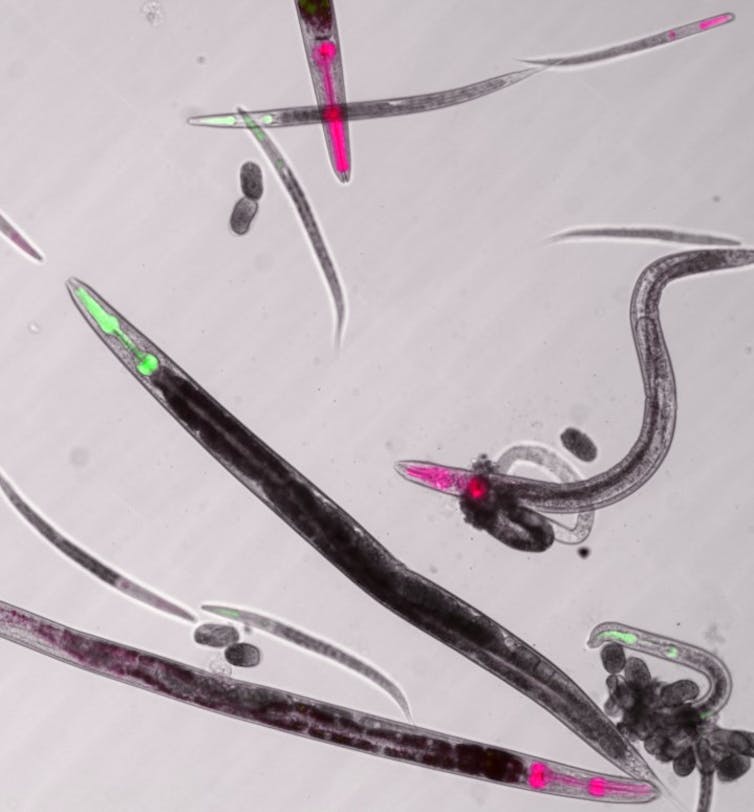
We tried to make this link by means of experiments using a kind of nematode worm often found in soil called Caenorhabditis elegans. In these worms, the genetic pathway that affects dormancy is well understood.

We looked at four groups of worms. The first group were genetically more inclined to enter dormancy, the second group were less inclined to enter dormancy, the third group were completely unable to enter a dormant state, and the fourth were ordinary wild-type worms with a medium propensity for dormancy.
We created an experiment where all these groups competed with a common competitor species – another worm called C. briggsae – for food in different environments.
Using data from these experiments, we then ran millions of computer simulations to determine whether one species would drive the other to extinction over the long term, or if they could coexist in different environmental conditions.
Dormancy and competition between species
We found that when species are more inclined to dormancy, competing species can coexist under a wider range of environmental conditions.
When we simulated fluctuating environmental conditions, species with a higher investment in dormancy were able to coexist with a competitor over a wider range of temperatures.
This outcome is what is predicted in theory, but it is an exciting result because the prediction has been difficult to test. The experimental system we used has great potential, and can be used to further explore the role of dormancy in species persistence.
Our results also raise an important question: will species that have a dormant form be more resilient to the huge environmental fluctuations the world is currently experiencing? Organisms that can avoid heatwaves and drought may well be more prepared for this era of unprecedented global change.
We hope to begin finding out in the next phase of our research: linking the dynamics we saw in the laboratory to dormancy in plants, animals and microbes in the real world.


