

Fantasia 2000: celebrating 25 years of a concertless film in search of a concert
- Written by The Conversation
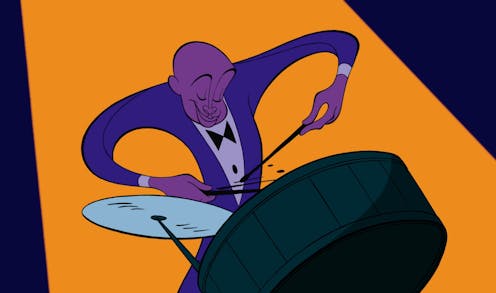
Imagine attending a concert including excerpts from Ludwig van Beethoven’s 5th Symphony, Ottorino Respighi’s Pines of Rome, George Gershwin’s Rhapsody in Blue, Dmitri Shostakovich’s 2nd Piano Concerto, Camille Saint-Saëns’s Carnival of the Animals, Paul Dukas’ The Sorcerer’s Apprentice, Edward Elgar’s Pomp and Circumstance, and Igor Stravinsky’s Firebird Suite – all packed into 74 minutes.
Sounds like a fantastic concert! But this isn’t a classical music concert in the traditional sense. This is the program for Disney’s Fantasia 2000, which premiered 25 years ago today at Carnegie Hall, New York City, as part of a five-city concert tour of live orchestra and screened animation before its theatrical release the following year.
For years, Fantasia 2000 flew under my radar; I thought the only Fantasia was Disney’s 1940 original. Like many, the original film was my introduction to classical music at an early age.
My parents, frustrated by my endless rewatching, gave me headphones to listen to the soundtrack instead. They didn’t anticipate me shouting out the names of the animated sequences for every piece (“Dancing Mushrooms!”).
Unlike my childhood enthusiasm, Walt Disney himself had a more ambivalent relationship with classical music. While he attended concerts, he famously fell asleep during a performance of Bach’s Toccata and Fugue in D Minor. That nap inspired a visual sequence that would later open the 1940 Fantasia.
For Disney, music often served his primary goals: advancing animation techniques and storytelling.
Music and animation
Disney’s interest in pairing music with animation began with the Silly Symphonies, a series of (mostly fantasy) shorts from the late 1920s to late 1930s synchronised to music.
The Old Mill (1937) was the first Disney film to use the revolutionary multiplane camera, creating depth by layering animation.
Though Disney wasn’t a musician, he demanded high-quality scores for these shorts. As historian Ross Care describes it:
[Disney] wanted class, but nothing too classy, and seriousness, but not the type of music to be taken too seriously. Ergo: Silly Symphonies.
This balance reflected the Western tension between popular and “serious” music at the time.
Fantasia (1940) evolved from this concept, framed as a concert experience. As introduced in the film by American composer and music commentator Deems Taylor, the film explored “three kinds of music”:
First, there’s the kind that tells a definite story. Then there’s the kind that, while it has no specific plot, does paint a series of more or less definite pictures. And then there’s a third kind, music that exists simply for its own sake.
However, the film’s ambitious vision was initially its downfall.
Audiences who fell in love with the character-driven musical storytelling of Snow White and the Seven Dwarfs (1937) found Fantasia’s abstract, plotless segments “baffling or boring”.
The expensive “Fantasound” format, requiring theatres to install special equipment, and World War II preventing a release in Europe, further limited its reach. Only through re-releases in later decades did Fantasia find its audience and become a beloved classic.
Fantasia 2000
Believing the concert film idea of Fantasia as “timeless”, Walt Disney originally imagined new versions of Fantasia with new musical repertoires every year. Due to the original’s financial difficulties, Disney shelved the idea.
In 1999, decades after Walt’s death and nine years of production later, that dream was realised with the release of Fantasia 2000, a new musical program interpreted by the latest Disney artists and storytellers. Fantasia 2000’s program featured seven new sequences and the return of Dukas’ The Sorcerer’s Apprentice from the 1940 original.
Shorter than its 124-minute predecessor, Fantasia 2000 focused on music that told stories or painted vivid imagery. Using then-modern computer animation, each sequence was introduced by celebrity hosts like Steve Martin, Quincy Jones and Angela Lansbury.
I first discovered Fantasia 2000 when I was a late teenager beginning my university studies many years after the film’s release. My favourite sequence is Respighi’s Pines of Rome, mainly for its bizarre pairing of an Italian tone poem depicting Pine Trees along the Appian Way in Rome with … flying whales!
A close second is Gershwin’s Rhapsody in Blue, which captures 1920s Manhattan through a mosaic of narratives, including a construction worker moonlighting as a jazz musician.
A concert without an orchestra
After its five-city concert tour, Fantasia 2000 premiered in IMAX and standard theatres in 2000 as an event film.
Despite its innovative animation and music, it met a similar commercial fate to the original, grossing US$90 million against its $80 million production cost (films generally have to return double the production costs to break even). The issues that plagued its predecessor persisted.
As well as the plotless sequences, no dialogue and unpopular music, the concert format was the primary challenge. Film music concerts are wildly popular today, but their appeal lies in nostalgia: audiences connect with the original scores and narratives. Fantasia lacks this connection.
The Fantasia films are concert films without a concert. The spectacle in today’s film music concerts is shared between the screen and the orchestra. However, Fantasia’s format as a concert film means, outside of its first five cities, its spectacle is the screen.
Without the shared spectacle of screen and live orchestra, this format struggles to hold the attention of younger audiences or those unfamiliar with classical music.
I’d love to see Fantasia 2000 – or the original – performed with a live orchestra like their premieres. Experiencing the synchronisation of animation and music in a concert hall could create a synaesthesia of sound and visuals that enhances both.
Disney’s history with music suggests the studio might eventually revisit this format. After all, Walt Disney’s interest in music and devotion to the arts culminated in a Los Angeles concert hall bearing his name. One wonders if he’d have stayed awake during a performance there.
On Fantasia 2000’s 25th anniversary, it’s worth celebrating the film as a bridge between Disney’s past and its future — one that continues to inspire awe and curiosity.


