

How China’s appetite for salmon could reshape global seafood markets – new research
- Written by The Conversation
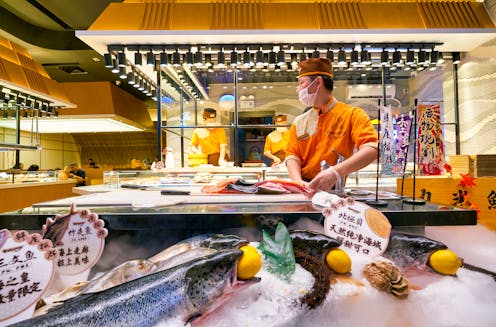
China’s demand for farmed salmon is growing at an unprecedented pace. In 2023, its imports grew by 46% year on year – with imports of fresh and chilled Atlantic salmon up 63%.
This remarkable growth is reshaping the global seafood trade. Exporters from Scotland, Norway, Chile, Australia, Faroe Islands, Canada and Iceland are racing to supply the needs of this vast and rapidly evolving market.
At the same time, China’s efforts to produce its own Atlantic salmon have faced significant challenges, highlighting the need for substitutes like rainbow trout to meet the country’s growing appetite for seafood delicacies.
An important shift occurred in 2018, when the Chinese government permitted rainbow trout to be labelled and sold as salmon. This decision blurred the distinction between imported Atlantic salmon and locally farmed rainbow trout, creating a more accessible option for cost-sensitive consumers.
Trout is comparable to salmon in appearance and size, with firm and oily meat that has a similar orange-pink colour. Nutritionally too, the species are alike, as are the ways in which they can be cooked and prepared.
In our new research which included taste tests, we found that many Chinese consumers could not distinguish between domestic rainbow trout and imported Atlantic salmon in blind testing. But when informed about the origin, testers’ preferences shifted strongly in favour of imported Atlantic salmon, highlighting the power of provenance in consumer tastes.
Although people’s willingness to pay did not vary initially in our blind tests, it became a decisive factor once the origin of the fish was revealed.
But we found that origin alone was not enough. For our testers to be prepared to pay higher prices, they also had to like the look, smell and taste of the product more, or be persuaded by its ecolabel (indicating environmental standards).
Transporting Atlantic salmon from Scottish lochs, Norwegian fjords or Chilean waters to Chinese markets involves complex logistics and significant environmental costs. The carbon footprint of this trade, combined with the resource-intensive nature of salmon aquaculture, raises critical concerns about sustainability.
These challenges are particularly pronounced in China, where consumers have a strong preference for freshness. This drives demand for quick delivery of imported salmon despite its environmental impact, and consumers are increasingly turning to online platforms to buy their seafood.
E-commerce has reshaped seafood retail in China, offering quick delivery and products that cater to consumer demand for quality and freshness. Salmon stands out in this market due to its perceived high value, premium quality and price point. Unlike other expensive seafood that often needs to be sold live to maintain its value, salmon retains its appeal when chilled or frozen.
This makes salmon particularly suited to modern retail models, where sophisticated cold-chain logistics ensure its freshness without the complexities of live transport. However, these innovations come at a cost.
The energy-intensive storage and rapid transportation required for imported salmon contribute significantly to environmental harm. As China’s seafood market continues to grow, addressing the sustainability challenges associated with this trade will be critical to balancing consumer demand with environmental responsibility. Current international certification schemes aiming to improve the sector’s sustainability have had limited impact in China so far.
China has made significant efforts to establish a domestic Atlantic salmon industry, but these attempts have largely been unsuccessful due to technical challenges and environmental constraints. This has left a gap that domestically farmed rainbow trout is poised to fill.
In 2022, China produced 37,000 tonnes of rainbow trout. This is a relatively small amount compared with international production levels, but still notable considering that rainbow trout is a new farmed species in China, unlike traditional species like carp.
However, rainbow trout farming in China is geographically constrained, as the species thrives in cooler freshwater temperatures found in higher-lying lakes and reservoirs, as well as in “raceways” (channels supplied continuously with fresh water diverted from rivers).
Advances in aquaculture systems offer a potential pathway to expand China’s production. Trout farming is a more sustainable, locally sourced alternative to Atlantic salmon that reduces the carbon footprint associated with imports and ensures fresher options for Chinese consumers. Developing a robust domestic trout industry could enhance food security, reduce dependence on imports, and create economic opportunities in rural areas.
China’s evolving seafood market offers valuable lessons for the global industry. Emphasising quality, freshness and sustainability will resonate with the increasingly sophisticated Chinese consumer.
At the same time, investment in eco-friendly aquaculture practices, both domestically and internationally, will be essential to balance the growing demand for premium seafood with environmental responsibility. These could include reducing feed waste and recirculating aquaculture systems (which filter and reuse water) to minimise water use. Recycling waste nutrients by using them elsewhere in food production could also be key.
As rainbow trout gains prominence in China’s seafood landscape, the relationship between consumer preferences, environmental concerns and economic opportunities could in turn shape the future of the global salmon trade.
If domestic fish captures a larger share of the Chinese market, salmon producers in Europe, Canada and other exporting regions may face significant challenges. This could ultimately force them to rethink their strategies in order to adapt to shifting market dynamics.
Although the goal of creating a domestic Atlantic salmon industry has proved difficult for China, trout farming presents a practical and sustainable solution for its luxury seafood sector.


