News Daily


Men's Weekly

Australia

  • Written by The Conversation
Taller tennis players have a natural advantage – but shorter athletes shouldn’t despair

We’re nearing the halfway point of this year’s Australian Open and players like the United States’ Reilly Opelka (ranked 170th in the world ) and France’s Giovanni Mpetshi Perricard (ranked 30th) captured plenty of attention despite early-round exits.

These two players caught the eye of the tennis world for not only their towering height (standing 2.11 metres and 2m respectively) but their thunderous serves.

Players of this height don’t just stand out in the players’ lounge – they enjoy a significant advantage on court.

But why exactly does being tall help create those blistering serves? The answer lies in some fascinating physics and biomechanics.

The numbers don’t lie

The connection between height and serving power isn’t just something we imagine – analyses of Grand Slam tennis players show our eyes aren’t deceiving us.

The fastest server of all time might be considered relatively short – Australia’s Sam Groth stands “only” 1.93m – but served an ace at a blazing 263.4 kilometres per hour during an ATP Challenger event in Busan in 2012.

The rest of the top five fastest servers in men’s tennis history, and eight of the top ten, all stood at more than 2m tall.

In women’s tennis, the findings also hold true, with Spain’s Georgina Garcia Perez (1.88m) holding the record at 220km/h. And four of the top five fastest were at least 1.82cm – Sabine Lisicki (Germany) is the shortest at a still above average height of 1.78cm.

The physics behind the power

So what makes height such an advantage for serving?

Among many factors, three are critical.

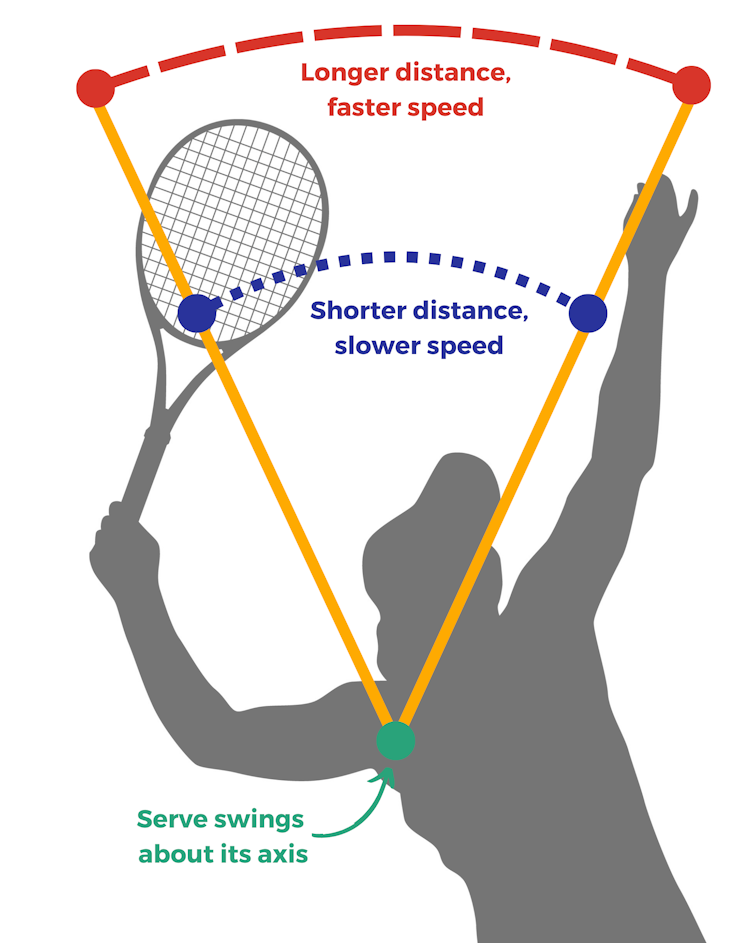
First, taller players generally have longer arms, which act like speed amplifiers.

In physics terms, the speed of your hand (and therefore the racquet) is approximately equal to the length of your arm multiplied by how fast you rotate it, as shown in the figure below. Longer arms equal faster racquet speeds.


The Conversation, CC BY-SA Of course, you might imagine that longer arms would be heavier and therefore harder to move quickly. While that’s true for legs (which is why most of the world’s fastest sprinters aren’t super tall), arms are relatively light. The speed advantage of length wins out over any minor weight penalty. Athletes come in all shapes and sizes, but do taller tennis players get an advantage? A better angle of attack The second advantage is all about geometry. Taller players can hit the ball at point higher off the ground, so it’s easier to clear the net and yet still get the ball to land in the service square on the opposite side of the court. Picture trying to throw a scrunched-up piece of paper into a bin from above it versus from the side. When you’re above the basket, you can throw it down at a steeper angle and still hit your target, but from the side, the paper is as likely to hit the front of the bin or sail over it. The same principle applies in tennis – taller players can hit powerful serves on a downward angle that clears the net but still lands inside the opponent’s service line. This height advantage also means a taller athlete can serve powerfully to any part of the service box, not just over the lowest part of the net down the centre of the court. A shorter player has to be much more precise with their angle to achieve the same effect and usually has to hit their fastest serves down the court’s centre. In tennis serving, angles matter. Technique: the freedom to swing free The third advantage might be the most interesting: taller players can actually use more aggressive serving techniques because they have more room for error. Tennis serves use what’s called a “throw-like pattern”. This is a complex sequence starting from the legs, rotating through the body, and ending with a whip-like motion of the arm and racquet. This movement pattern can generate enormous power but it’s also harder to control. As an example, we use this throw-like pattern to throw a ball as far or fast as we possibly can, but we use a different pattern when we’re trying to hit a bullseye on a darts board. That is, the technique we use for speed is different from the technique for accuracy. Taller players, with their better angles and higher contact point, can afford to use more of the explosive, throw-like technique and still land the ball within the service square of their opponent. Shorter players often need to use a more controlled motion to ensure their serves stay in play – they have less room for error so they need to use a more conservative, but accurate, serving technique. Hope for the not-so-tall But before shorter players despair, we should remember that some of tennis’s greatest players have dominated without towering height. Modern legends Serena Williams (1.78m), Roger Federer and Rafael Nadal (both 1.85m) are hardly giants, yet they’ve got impressive serving records and even more legendary win-loss records. These players demonstrate that serving isn’t just about raw power: balance, accuracy, ball spin, serve placement and the ability to disguise your serve direction are crucial skills that take thousands of hours to perfect. A well-placed serve at 180km/h can be more effective than a 220km/h bullet that your opponent knows is coming. So, while height definitely provides some natural advantages for serving, it’s just one piece of the puzzle. Tennis remains a sport where technique, strategy and dedication to practice can help players of any size rise to the top.

Read more https://theconversation.com/taller-tennis-players-have-a-natural-advantage-but-shorter-athletes-shouldnt-despair-247460

Top Electrical Safety Tips from Inner West Sydney Electricians

While it may not be the most exciting subject to discuss, having an electrically safe home is definitely one of the most critical. Knowing the basics could help you avoid accidents and ensure your home remains in good condition, whether... Read more

When to Escalate a Debt Recovery Matter to Legal Action

Knowing when to transition from informal debt collection efforts to formal legal proceedings is a decision that many creditors find difficult to navigate. Acting too early can damage commercial relationships, while waiting too long can reduce the likelihood of recovery... Read more

Why Slurry Hose Systems Are Essential for Handling Abrasive Industrial Materials

Transporting abrasive mixtures is a common challenge in industries such as mining, dredging, and construction. These mixtures, known as slurry, consist of solid particles suspended in water or other liquids. Moving slurry through pipelines requires specialised equipment that can withstand... Read more

Why Choosing the Right Dental Clinic Matters for Long Term Oral Health

Maintaining good oral health requires regular checkups, preventive care, and professional treatment when needed. Visiting a trusted Dental Clinic plays a vital role in keeping teeth and gums healthy while preventing more serious dental problems in the future. Many people only... Read more

Is Deep Plane Facelift Safe in Thailand?

When you ask whether a deep plane facelift is safe in Thailand, you’re really asking: “Can I get high-quality surgical care with strong safety standards and reliable follow-up while I’m traveling?” That’s a smart question. But the country name alone... Read more

Why Cloud Services Are Now Essential for Business Growth and Security

In today’s fast-moving digital environment, understanding how cloud services support long-term stability has become a priority for businesses across Australia. As expectations shift and workplaces adopt more flexible models, organisations are turning to cloud services to keep systems running smoothly... Read more