

From securing pets to building ‘insect hotels’ – here are 7 ways to attract birds to your garden
- Written by The Conversation
Home gardens can provide vital habitat for Australian birds. But there’s more to it than just planting certain types of shrubs and flowering trees.
After decades of encouragement to include native plants in home gardens, urban environments have come to favour certain species and neglect others including some of our most loved birds, such as fairy-wrens.
Birds that thrive on nectar such as honeyeaters, and bossy birds with bold personalities such as noisy miners, some parrots and magpies, tend to dominate the scene. But it doesn’t have to be this way.
We wanted to explore how urban gardens can best support a wider range of Australian birds. Our new review of research on this topic revealed seven key considerations. These fall into two themes: reducing threats and improving habitat.
We found there’s no point doing just the good things (such as plantings) if we don’t stop doing the bad things (such as killing insects, poisoning owls and letting cats hunt). It’s like trying to fill a bucket with a hole in it.
So let’s acknowledge the complexity of nature and take a broader approach to attracting birds to our gardens, by ticking off the items on this shopping list.
1. Secure pets
Domestic cats kill millions of Australian birds every year. So no matter how innocent your cat looks, it remains a highly evolved predator.
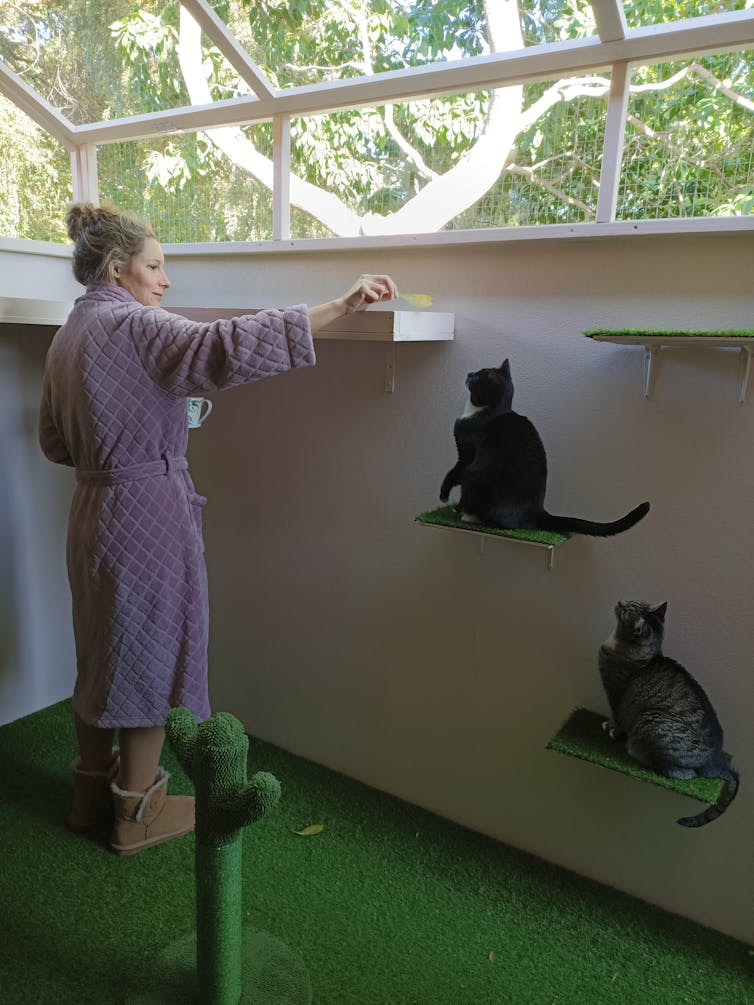
The only guaranteed way to protect birds and other wildlife from cats is to keep them contained inside or in purpose-built enclosures, 24 hours a day. You can find out about building your own cat enclosure from government and retail experts online.
Dogs can also stop birds taking up residence in your garden. The mere presence of a dog can deter some birds. Keeping dogs contained at night can reduce the level of disturbance to nocturnal birds. But if you really want to attract birds to your garden, you may choose to keep your dog inside more.

2. Avoid using insecticides and outside lights
Many flying and ground-dwelling insects are in decline. This is bad news for many birds including fairy-wrens, willie wagtails, fantails and robins who rely almost entirely on insects for food. But we can avoid using insecticides or any other form of lethal control such as bug zappers in our own gardens.
Ideally, accept insects as a natural part of your garden. Don’t try to deter them, unless they pose a risk to public safety, such as swarming European honeybees or hordes of European wasps. You can also consider favouring native plants that naturally are resisitant to unwanted insect attack.
Excess artificial light is also taking a toll on insects. Consider whether you really need to leave that outdoor light on all night. Review your existing outdoor lighting using the five principles for responsible outdoor lighting, ensuring all artificial light is useful, targeted, low-level, controlled and warm-coloured.
 The eastern yellow robin eats insects.
R. Steven
The eastern yellow robin eats insects.
R. Steven
3. Stop poisoning raptors
The use of rat poison, especially those labelled as “fast action”, is killing native owls and other birds of prey at an alarming rate due to secondary poisoning. In other words, raptors are dying after eating rats and mice that have taken the bait.
Many countries have regulated the sale and use of these products for this reason, but Australia is lagging behind. So if you “give a hoot” about our owls, switch to snap traps. There are also various other effective, humane and efficient options available, including removing unwanted fruit from the ground, keeping sheds tidy, and securing compost bins to keep rodents under control.
4. Prevent window strikes
Birds can fly into windows when they’re unable to differentiate between the glass and the surrounding environment. Strikes may be lethal upon impact or result in injury. A stunned bird is also more vulnerable to predators.
In Australia, bird lovers can reduce the risk by using decals which are decorative stickers intended for windows. Screens, hanging plants or mobiles can also be placed in front of windows to help the birds avoid collisions.
5. Create an inclusive garden
The diversity in Australian birds extends to their diets. Beyond honeyeaters, the nation is home to huge numbers of insectivores, carnivores, seed-eaters and fruit peckers.
Australian gardens typically have plenty of bottlebrush and grevilleas, which stacks the deck in the bold honeyeaters’ favour. So when buying new garden plants, try catering for a wider variety of bird species.
Choose dense shrubs with small white, yellow or blue flowers to attract insects. These bushy plants also make excellent habitat for small birds. Retaining trees ensures our larger birds have nesting sites too.
If you get the garden design right, with a variety of plants to suit all tastes, there is no need to feed the birds.
 The red-browed finch eats seeds.
R. Steven
The red-browed finch eats seeds.
R. Steven
6. Encourage insects
Native bees and flies play a crucial role in ecosystems, both as pollinators and food for birds.
You can provide insects with nesting habitat in the form of insect “hotels”, food (namely flowers and other insects) and safety from pesticides. These small gestures can make a huge difference.
 Urban art depicting a native blue-banded bee, which was voted Australia’s favourite insect in 2004.
R. Steven
Urban art depicting a native blue-banded bee, which was voted Australia’s favourite insect in 2004.
R. Steven
7. Water the birds too
With the urban heat island effect and growing frequency of extreme heat waves, birds are in need of reliable sources of fresh water. Offer this crucial resource in a water feature such as a bird bath or pond.
Whole neighbourhoods for birds
Your garden has never been more important for birds. Doing your bit in your own backyard can make a visible difference – you will see the birds for yourself. But true conservation gains can only be made when people work together at a larger scale.
Why not start a conversation with your neighbour about attracting birds to your garden? Creating one garden for birds is great, but when we start talking about whole neighbourhoods for birds, that’s magic!


