

After fleeing the Taliban, the Afghan women’s cricket team is finally playing together – in Australia
- Written by The Conversation
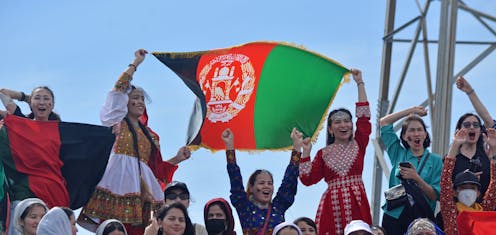
A Twenty20 cricket contest featuring a women’s team made up of refugees from Afghanistan who now live in Australia may “only” be an exhibition game, but it could be the beginning of something much more.
On Thursday, an Afghan women’s cricket team will take on a Cricket Without Borders XI at Melbourne’s Junction Oval.
It is the first time the women will play as a team since migrating to Australia after the Taliban takeover in 2021. The group has since settled in Canberra and Melbourne.
Regardless of the result, it could be a step towards Afghanistan’s women’s team entering international cricket.
Before I explain why, though, it’s important to rewind a bit.
International cricket and Afghanistan
The International Cricket Council (ICC) claims it has “one of the toughest” policies on anti-discrimination in world sport.
The governing body commits to:
promote and encourage participation at all levels regardless of race, colour, religion, descent, culture, ethnic origin, nationality, sex, gender, sexual orientation, disability, marital status and/or maternity status and to ensure that there is no discrimination in the sport.
In the case of its member federation, the Afghanistan Cricket Board, the ICC’s refusal to uphold its own policy is providing both actual and implied support to the Taliban’s gender apartheid regime.
The ICC admitted Afghanistan as a full voting member in 2017, despite being “the only full member to have received that status without having an operational women’s team in place.”
As a full member, Afghanistan was, according to the ICC’s funds disbursement model: “expected to get around $US40 million ($A64 million) for the 2016-23 commercial rights cycle based on projected ICC revenues of $US2.7 billion ($A4.32 billion).”
Meanwhile, the other ICC, the International Criminal Court, recently issued arrest warrants against two of the Taliban leaders for crimes against women.
The Taliban’s policies against women go far beyond sport and make it more reason for the International Cricket Council to act.
On any reading, the ICC’s membership rules on governance ethics requirements in relation to Afghanistan are in breach.
From Afghanistan to Australia
Ironically, it was the Afghanistan Cricket Board’s reluctant and token measure taken to build a women’s team, by issuing contracts to 25 women in 2020, that has allowed them to now play cricket in Australia.
In August 2021, the Taliban took over Afghanistan and banned women’s sports. Athletes were intimidated, harassed and warned of ramifications if they continued playing.
That situation sparked action from a handful of passionate volunteers, including myself, ex-Australian cricketer Mel Jones, and Emma Staples (formerly the head of diversity and community engagement at Cricket Victoria). We knew we needed to get these women out of Afghanistan.
We applied to the Australian government to issue emergency humanitarian visas to the contracted women’s cricketers, with the applications granted.
Now, all they want is a chance to represent their country as a team, and to send a message of hope back to their sisters suffering under the oppression of Afghan gender apartheid.
Put simply, the Afghan women’s team is desperate to be given the same opportunities as its male counterparts.
The team has written several times and asked for meetings with the ICC, to no avail.
The ICC instead has set up an all-male working group on Afghanistan.
It’s not clear what its terms of reference are, or if they have even met.
Possible solutions
Cricket Australia has chosen not to play bilateral matches against Afghanistan, citing the Taliban’s human rights restrictions for women and girls since returning to power.
But boycotts often impact athletes more than government policies.
Instead, the focus should be on supporting Afghan women who want to play cricket. The ICC could implement targeted actions including:
- replacing Afghanistan’s cricket board with ICC-appointed administrators, including women
- adjusting Afghanistan’s funding to reflect they are only developing cricket for less than half the population
- setting up a global development fund for Afghan girls and women to identify talent and to provide coaching.
There are several international sport models – for example, FIFA’s Normalisation Committees and the IOC’s independence requirements – that could serve as models for the ICC requiring Afghanistan’s Cricket Board to comply with the its anti-discrimination policies.
A chance to compete
On Thursday, these Afghan women finally get to play as a team, in the exhibition game organised by Cricket Australia.
The team is keen for this to be an ongoing opportunity to develop skills and represent their nation, not just a one-time event.
The Olympic movement’s model of refugee teams could inspire the creation of a refugee team for Afghan women in cricket, allowing them to participate in future youth and summer Olympic Games and other competitions.


