

Nocturnal basking and deep diving may not be enough to keep crocodiles cool in a warming world
- Written by The Conversation
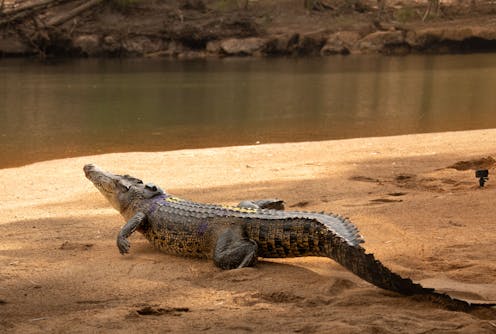
Crocodiles are hardy creatures, capable of adjusting their behaviour to cope with the heat of the tropics. But there’s a limit to their endurance.
Our new research shows the average body temperature of estuarine (saltwater) crocodiles in Far North Queensland has risen steadily over the past 15 years. The peaks align with heatwaves during El Niño events.
We tagged and tracked 203 crocodiles in the Steve Irwin Wildlife Reserve on Cape York Peninsula, to find out how they respond to rising temperatures. We know from our previous research that crocodiles can change their behaviour to quickly cool down, and might do this by diving deeper, seeking shade or hauling themselves out onto the riverbank at night.
We found hot crocodiles displayed more of these cooling behaviours, but this was not always enough to keep their body temperature under control. Crocodile diving performance decreased at body temperatures above 31–33°C. This could compromise other behaviours necessary for feeding, fleeing or reproducing.

How do crocs keep cool?
Crocodiles, like other reptiles, are “ectotherms”. This means their bodies heat up or cool down depending on the temperature of the surrounding environment.
They can’t control or adjust their own internal thermostat like birds or mammals. Instead, they regulate their body temperature by moving to a more comfortable place.
On hot nights the water stays warm, but the air cools down. So crocodiles will move onto the river bank at night to cool off. We call this “nocturnal basking”.
During the day, they might dive down really deep where it’s a bit cooler. Or they might lie on the bank in the shade with their mouth gaping wide, or sit in a cool freshwater creek.
Last year, we published research using data from thumb-sized temperature loggers implanted under the crocodile’s skin. By tracking when their body temperatures rose or fell rapidly, we were able to record “active cooling” and “active warming” periods during the day and night.
Active warming tended to occur on winter afternoons, and was likely achieved through basking in the sun on riverbanks and sand flats.
Active cooling was more common on hot summer nights. We think the crocodiles were either taking advantage of cool night air through nocturnal basking, or spending time in shady spots along the river.
But there’s a limit to how much warming crocodiles can take. Previous research has shown crocodiles have shorter dives at body temperatures above 32-33°C. This can reduce their ability to hunt for food or seek shelter.
How will crocs cope with climate change?
In our new research, we wanted to find out if crocodiles can reduce their exposure to high temperatures through active cooling behaviour.
With the help of Australia Zoo’s croc team, we tagged and tracked 203 wild estuarine crocodiles in the Wenlock and Ducie rivers of the Steve Irwin Wildlife Reserve, between 2008 and 2023.
During this time, the average air temperature in Far North Queensland rose by 0.08–0.30°C. Top temperatures peaked during El Niño events (2010 and 2016), whereas minimum temperatures peaked during La Niña events (2020–23).
We collected data on crocodile body temperature, daily distance travelled and diving behaviour. Then we compared it to local air temperatures.
We found body temperatures increased alongside rising air temperatures and peaked during El Niños such as the summer of 2015–16.
Almost all crocodiles spent time cooling during heatwaves. The hottest crocodiles switched almost exclusively to cooling behaviours, rather than warming behaviours. But in many cases their body temperatures still exceeded 32–34°C and their diving performance suffered.
Even when summer air temperatures rocketed to 40°C, crocodiles were able to limit their body temperature to 34°C. This feat demonstrates impressive resilience to heat.

What’s next for Queensland’s crocs?
While most estuarine crocodiles in Queensland are found in the north of the state, the occasional vagrant makes its way south below its natural range into more populated areas.
This includes the crocodile spotted around Inskip Point near K'gari (Fraser Island) on the Sunshine Coast just last week.
The crocodile population has grown since hunting was banned in 1974. So it is reasonable to wonder about the possibility of a southern expansion as warming continues. But there is currently no evidence to suggest Queensland’s crocodile population is moving south, or that this will become a concern in the near future with a warming climate.
Our new research shows crocodiles in the tropics are responding to higher temperatures. However, very little is known about how crocodiles in the southern, cooler part of their range behave in response to these conditions. This information could help to more effectively manage crocodiles and protect the general public.
Crocodiles are remarkably resilient predators that have evolved to survive in tropical conditions. Our research suggests they have the capacity to buffer themselves against the worst of the heat our current climate throws at them, without leaving their local river system.
But the trajectory of future climate change, coupled with the new findings, suggests crocodiles might struggle in a warmer world.


