

Children of Paradise is the greatest film to come out of France, even 80 years on
- Written by The Conversation
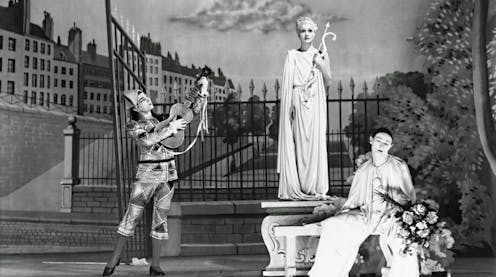
It is March 9 1945 in a swanky cinema in Paris. The audience is settling in for the premiere of Children of Paradise (Les Enfants du paradis) – the latest work by Marcel Carné, best known for his moody 1930s “poetic realist” films. The script is by celebrated poet Jacques Prévert. The curtains part. The film begins.
The audience is quickly plunged into the clutter and chaos of 1840s Paris, with the backdrop of the bustling world of theatre.
Four very different men – the dandified thief Lacenaire, the mime Baptiste, the aspiring actor Frédérick Lemaître, and the wealthy aristocrat de Montray – are in love with the same woman. She is Garance, played unforgettably by Arletty.
What follows will break your heart.
I would argue Children of Paradise is France’s greatest film – its performances, production design and prestige undiminished. It is a heady brew of murder, betrayal, warmth and kindness. It is also a deeply moving love letter to Paris, and to the theatre.
Life as theatre
The “paradise” of the film’s title refers to the highest and cheapest seats in the theatre. Sometimes also called “the gods”, these seats were usually occupied by the poor.
Carné and Prévert’s wonderful flourish is to make Children of Paradise about life in and as theatre.
Frédérick is a fine stage actor, full of bluster and big gestures. But he secretly admires Baptiste, the mime who “speaks with his legs and replies with his hands”. The film looks back at the lost aesthetics of mime and dance with great nostalgia.
We move in and out of playhouses, via backstage, aisles and dressing rooms. There are in-jokes and allusions: de Montray dislikes the theatre (“I don’t like this Monsieur Shakespeare, his debased violence and his lack of decorum”) but is prepared to casually kill in the name of honour.
Performers are fined for making noise in the wings and rival theatre companies fight on and off the stage. Think Moulin Rouge meets Shakespeare in Love, with a dose of French existentialism.
The making of a masterpiece
Even more astonishing is how the film was made.
When the Germans occupied France in 1940, they introduced strict directives about what could and couldn’t be shown. Around 220 films were made in France during the almost five-year occupation, many with pre-approved themes such as submission to authority, patriarchy and the importance of rural life. Making a film about raucous Parisian theatre folk would be tricky.
Many directors fled to Hollywood, while Jewish actors and technicians were outlawed under antisemitic laws. But Carné and Prévert stayed, and began to concoct their masterpiece: a thinly veiled allegory against the political situation at the time. Garance, the woman who refuses to yield to her quartet of suitors, stands for a proud, autonomous prewar France.
Prévert’s script often compares Garance to a bird, the ultimate symbol of freedom. Another character, Jéricho, is a spiteful informer who readily denounces his comrades (there was plenty of that behaviour in the witch-hunt culture of occupied France).
There were several other hurdles. The film originally started as a Franco-Italian co-production, but that idea was abandoned when the Allied forces invaded Sicily in 1943. It took two years of interrupted filming in Nice before Children of Paradise was finally complete.
Composer Joseph Kosma and production designer Alexandre Trauner, both Hungarian Jews, worked on the film clandestinely. And in 1944, one of the main actors, Robert Le Vigan, was forced to flee to Germany due to his pro-Nazi radio broadcasts. His scenes were entirely reshot, this time starring Pierre Renoir (brother of Jean Renoir).
Building the colossal sets required 35 tonnes of scaffolding, 350 tonnes of plaster and 500 square metres of glass. Fabric for the costumes, food for the crew, electricity supplies and film stock were all classified as strategic commodities during wartime. The black market came in handy.

A nationalist project
When Carné first heard of the Allied landings in Normandy in the spring of 1944, he deliberately slowed down filming. He realised that rather than being the last film of the occupation, Children of Paradise could be the first film of post-Liberation France – a patriotic and spectacular film with a distinctively French flavour.
Children of Paradise has been called “the French Gone With The Wind”. The huge sets, long runtime and use of star actors was a conscious attempt to beat Hollywood at its own game.
It’s thematically rich, too. There is a bold exploration of sexuality (Garance is a former prostitute, Baptiste is adulterous and Lacenaire is queer-coded) and a radical fusion of high and low art that feels very postmodern.
The film ends with Baptiste trying to catch up with a departing Garance, but the Paris crowds swallow him up. He’s now a part of the carnivalesque capital that was, in 1945, proudly resisting the enemy and thrumming with excitement at the prospect of liberation.

A lasting legacy
In a radical move, Carné split the film into two parts, each running for 90 minutes. There is a deliberate cliffhanger at the end of part one, followed by an intermission.
Carné, ever the canny businessman, realised he could ask punters to pay double the price for tickets. After all, they were seeing two films! The film became a huge commercial success, playing non-stop for 54 weeks and grossing an estimated 41 million francs – a huge sum at the time.
Audiences and critics were enthralled back then, and remain so now. Legend has it there’s always at least one cinema showing the film somewhere in Paris.
Today, we can find fragments of the film’s DNA in any new French literary adaptation or big-budget melodrama. Films ranging from Queen Margot (1994) to The Three Musketeers (2023) share thematic and visual links.
French filmmaker François Truffaut once admitted “I have made 23 films. I would swap them all for the chance to have made Children of Paradise.” And for critic Pauline Kael, it was a “poem on the nature and varieties of love – sacred and profane, selfless and possessive”.
Eighty years on, it’s time to fall in love again.


