

Sand-sized fossils hold secrets to the history of climate change
- Written by The Conversation
Between 18,000 and 11,000 years ago, the amount of carbon dioxide in the atmosphere suddenly shot up. This caused rapid global warming, the mass melting of glaciers, and the end of the last ice age.
Much of this sudden influx of atmospheric CO₂ came from the Southern Ocean around Antarctica, highlighting the key role this body of water plays in regulating the global climate.
However, we have a poor understanding of how and why CO₂ release from this region changed during periods such as the end of the last ice age. But our new study, published in Nature Communications, reveals how much CO₂ was released to the atmosphere from the polar Southern Ocean during this period – and what factors were responsible.
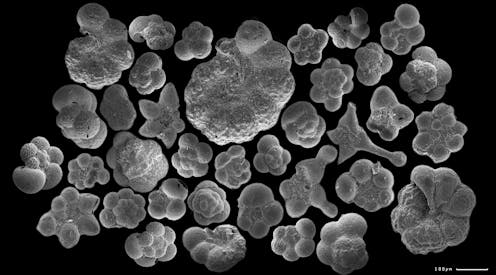
We reached these conclusions by examining the chemistry of sand-sized fossils, called foraminifera, from the seafloor south of Tasmania.
Tiny shells preserved in mud
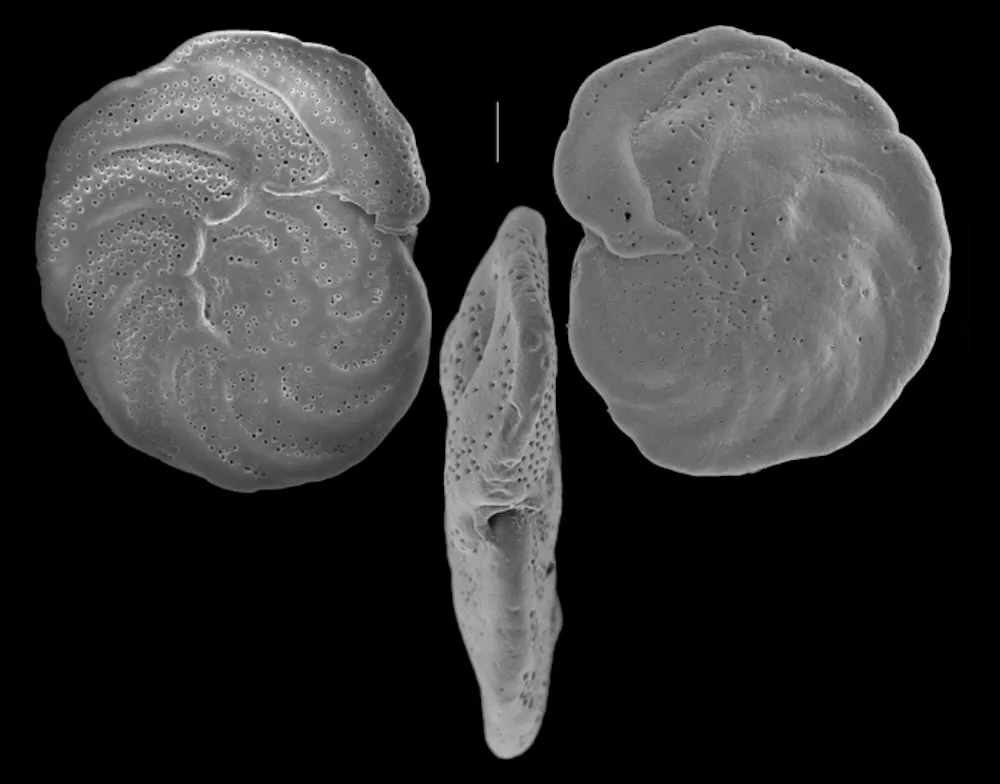
Foraminifera are tiny single-celled organisms, either floating in the ocean surface or living on the seabed. Most of them build shells made of calcium carbonate to protect themselves. After death, these foraminifera shells are preserved in the mud on the seabed.
Newer generations of foraminifera shells stack over older ones, like adding new pages to a book. Over time, these foraminifera shells form a book on the seabed that can be dated back to millions of years ago.
Even more fascinating, trace amounts of elements in the seawater are incorporated into the calcium carbonate shells of foraminifera. In some foraminifera species, the amount of these elements is sensitive to the environment they live in.
For example, the amount of boron in a species called Cibicidoides wuellerstorfi is sensitive to carbonate ion concentrations, and the amount of cadmium in another species (Hoeglundina elegans) is sensitive to phosphate concentrations.
By looking at trace elements in these foraminifera shells found in the sequence of mud on the seabed, we can decipher mysteries about the past seawater condition in the book left by foraminifera on the seabed.
A giant metal straw
How do scientists do this? First we go out to the ocean to collect mud.
In this process, a giant metal straw is dropped to the seabed and then raised to our research ships, fully filled with mud. We take these mud samples back to our lab. There, we slice them into pieces and examine them separately.
This allows us to extract information from each page of the book in chronological order. Foraminifera shells are washed out of the mud, and specific shells are picked out under a microscope, cleaned, and finally analysed for their chemical composition.
Foraminifera have lived almost everywhere in the ocean for millions of years. Based on their chemical composition, scientists have reconstructed a continuous record of seawater temperature during the past 66 million years in great detail.
Among a few places in the ocean where you cannot find foraminifera is the polar Southern Ocean. Although some foraminifera live there, seawater in this region is often too corrosive for their shells to preserve on the seabed. The lack of foraminifera in the polar Southern Ocean brings a huge challenge for scientists eager to understand past changes in CO₂ exchanges between the ocean and the atmosphere.

From Antarctica to Tasmania
We decided to tackle the problem using mud on the seabed 3,300 metres below the surface just south of Tasmania.
Seawater at that depth near Tasmania is ideal for studying the chemistry of the polar Southern Ocean. That’s because seawater from the polar Southern Ocean sinks to the bottom of the ocean, moves northwards, and eventually occupies the seabed south of Tasmania.
Seawater chemistry – including concentrations of carbon, phosphate and oxygen – does change along its way at the bottom of the ocean.
These changes are, however, generally proportional to each other. So if all these concentrations are known for seawater at depth near Tasmania, we can work out their concentrations in the polar Southern Ocean.
Fortunately, there were plenty of foraminifera shells in the mud for all these reconstructions at the site we examined near Tasmania.
Reconstructing ancient chemical concentrations
Using the chemistry of foraminifera, we reconstructed changes in concentrations of carbonate ion (which is largely related to carbon), phosphate and oxygen at the bottom of the ocean near Tasmania during the end of the last ice age roughly 20,000–10,000 years ago. This period is known as the last deglaciation.
Based on these reconstructions, we calculated the amount of CO₂ released from the polar Southern Ocean during the last deglaciation. Some of this CO₂ came from biological processes – changes in the amount of carbon used by microscopic organisms living near the ocean surface. The rest was from physical processes – CO₂ molecules escaping from seawater directly to the air.
We found that biological processes were more important for CO₂ releases during the earlier stages of the deglaciation, while the physical processes contributed more during the later stages.
 From the polar Southern Ocean, seawater sinks to the bottom of the ocean and moves northwards to reach the seabed south of Tasmania.
Steve Todd/Shutterstock
From the polar Southern Ocean, seawater sinks to the bottom of the ocean and moves northwards to reach the seabed south of Tasmania.
Steve Todd/Shutterstock
So why is this important?
Scientists use climate models to predict future climate and to reproduce past atmospheric CO₂ changes.
Our results provide testing targets for climate models to reproduce.
Better reproduction of past changes will improve climate model design for predicting future changes.
This will help us understand how future changes in the polar Southern Ocean can affect atmospheric CO₂, contributing to making effective plans to mitigate CO₂ emissions.
Read more https://theconversation.com/sand-sized-fossils-hold-secrets-to-the-history-of-climate-change-250928


