

Torrential rains created devastating inland seas in outback Queensland. Soon, they will fill Kati Thanda-Lake Eyre
- Written by The Conversation
The small Queensland town of Eromanga bills itself as Australia’s town furthest from the sea. But this week, an ocean of freshwater arrived.
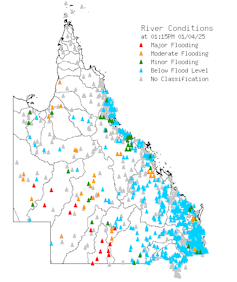
Monsoon-like weather has hit the normally arid Channel Country of inland Queensland. Some towns have had two years’ worth of rain in a couple of days. These flat grazing lands now resemble an inland sea.
One New South Wales man is still missing and dozens of people have been evacuated. Others are preparing to be cut off, potentially for weeks. And graziers are reporting major livestock losses – more than 100,000 and climbing. In some areas, the flooding is worse than 1974, the wettest year on record in Australia.
Why so much rain? Tropical, water-laden air has been brought far inland from the oceans to the north and east. This can happen under normal climate variability. But our ocean temperatures are the highest on record, which supercharges the water cycle.
In coming weeks, this huge volume of water will wend its way through the channels perhaps 600 km to fill Kati Thanda-Lake Eyre, the ephemeral lake which appears in the northern reaches of South Australia. It’s likely this will be a Lake Eyre for the ages.
In the first three months of the year, deadly record-breaking floods hit northern Queensland before Cyclone Alfred tracked unusually far south and made landfall in southeast Queensland, bringing widespread winds and rains and leaving expensive repair bills. Now the rain has come inland.

Why so much rain in arid areas?
Some meteorologists have dubbed this event a pseudo-monsoon. That’s because the normal Australian monsoon doesn’t reach this far south – the torrential rains of the monsoonal wet season tend to fall closer to the northern coasts.
Because the Arafura and Timor Seas to the north are unusually warm, evaporation rates have shot up. Once in the air, this water vapour makes for very humid conditions. These air masses are even more humid than normal tropical air, because they have flowed down from the equator. Many Queenslanders can vouch for the intense humidity.
But there’s a second factor at work. At present, Australia’s climate is influenced by a positive Southern Annular Mode. This means the belt of intense westerly winds blowing across the Southern Ocean has been pushed further south, causing a ripple effect which can lead to more summer rain in Australia’s southeast, up to inland Queensland. This natural climate driver has meant easterly winds have blown uninterrupted from as far away as Fiji, carrying yet more humid air inland.

These two streams of converging humid tropical air were driven up into the cooler heights of the atmosphere by upper and surface low pressure troughs, triggering torrential rain over wide areas of the outback
While these humid air masses have now dumped most of their water, more rain is coming in the aftermath of the short-lived Cyclone Dianne off northwest Australia. These rains won’t be as intense but may drive more flood peaks over already saturated catchments.
This is why it has been so wet in what is normally an exceptionally dry part of Australia.
What is this doing to the Channel Country?
Many Australians have never been to the remote Channel Country. It’s a striking landscape, marked by ancient, braided river channels.
Even for an area known for drought-flood cycles, the rainfall totals are extreme. This is a very rare event.
People who live there have to be resilient and self-sufficient. But farmers and graziers are bracing for awful losses of livestock. Livestock can drown in floodwaters, but a common fate is succumbing to pneumonia after spending too long in water. After the water moves down the channels, it will leave behind notoriously boggy and sticky mud. This can be lethal to livestock and native animals, which can find themselves unable to move.
Where will the water go next?
Little of these temporary inland seas will ever reach the ocean.
Some of the rain has fallen in the catchment of the Darling River, where it will flow down and meet the Murray. The Darling is often filled by summer rains, while the Murray gets more water from autumn and winter rains. This water will eventually reach the Southern Ocean.
But most of the rain fell further inland. The waters snaking through the channels will head south, flowing slowly along the flat ground for weeks until it crosses the South Australian border and begins to fill up Kati Thanda-Lake Eyre. Here, the waters will stop, more than 300 km from the nearest ocean at Port Augusta, and fill what is normally a huge, salty depression and Australia’s lowest point, 15 metres below sea level.
When Kati Thanda-Lake Eyre fills, it creates an extraordinary spectacle. Millions of brine shrimp will hatch from eggs in the dry soil. This sudden abundance will draw waterbirds in their millions, while fish carried in the floodwaters will spawn and eat the shrimp. Then there are the remarkable shield shrimps, hibernating inland crabs and salt-adapted hardyhead fish.
 It’s rare that Kati Thanda-Lake Eyre fills up – but when it does, life comes to the desert.
Mandy Creighton/Shutterstock
The rain event will send enough water to keep Lake Eyre full for many months and it usually takes up to two years for it to dry out again. We can expect to see a huge lake form – the size of a small European country. Birdwatchers and biologists will flock to the area to see the sight of a temporary sea in the desert.
Eventually, the intense sun of the outback will evaporate every last drop of the floodwaters, leaving behind salted ground and shrimp eggs for the next big rains.
As the climate keeps warming, we can expect to see more sudden torrential rain dumps like this one, followed by periods of rapid drying.


