

Friday essay: I work as a sensitivity reader – and racism is harder to spot than you’d think
- Written by The Conversation
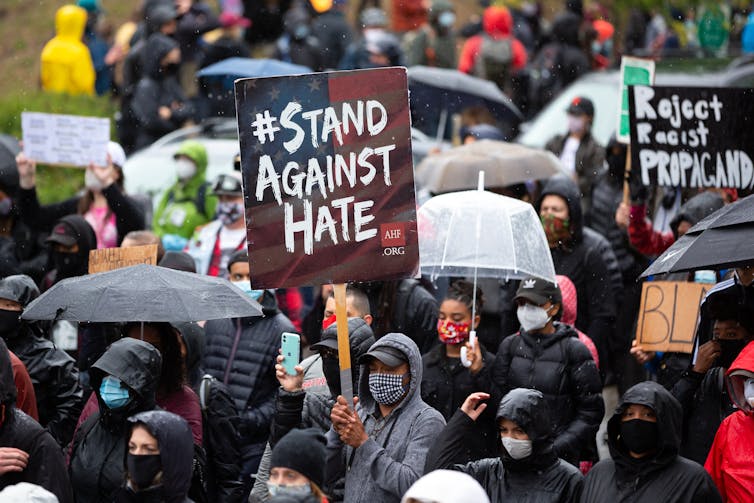
If I asked you to picture a racist, I know exactly what you’d envision. A white hood, or someone screaming slurs, or a person praising slavery.
The reality is that racism and problematic phrases are much more insidious and complex than this “cartoon-like”, moustache-twirling villain version. Racism lies in the misrepresentation of marginalised communities.
I work as a cultural sensitivity reader. In this role, I review literary works pre-publication, looking for potentially offensive content, stereotypes and bias.
Very rarely in my job do I face stories that endorse such outward racisms. Instead, my role is firstly, to help authors create nuanced, truthful representations of Indigenous peoples that move away from negative portrayals and emphasise their strengths and resilience.
Secondly, I help eliminate further perpetuation of harmful misrepresentations in texts that have negatively impacted Indigenous peoples for far too long.
Why do I do sensitivity reads?
As a Barkindji woman, I have been hyper aware, for as long as I can remember, of literature that has misrepresented my culture or even downright portrayed any sort of Blakness as bad or “othered”.
I loved fantasy books by Enid Blyton. However, I remember as a child reading about how the white characters would fret if they got soot on their face. They didn’t want to be dark and “ugly” (I refuse to write the slur they used). There are stories upon stories that paint my Aboriginality as deficit at best, or downright inhuman at worst.
These kinds of narratives affect people’s attitudes and beliefs towards Indigenous people.
For instance, I will always remember attending a ceremony for a scholarship I had won. In conversation, a non-Indigenous woman asked me my background. When I told her I was Aboriginal, she immediately squeezed my arm and announced, “Oh, honey, don’t you ever let that hold you back!”
My job as a cultural sensitivity reader is to combat that type of deficit narrative. This lady had obviously not been exposed to the strength that has lived in our community since time immemorial.
When reading a new work, I’m there to educate non-Indigenous writers who want to do better than their predecessors.

What do I look for when reading?
I interrogate multiple aspects of a work, beginning with its themes and reflecting deeply on the connotations of each word.
For example, I’ll examine characterisations where a Blak woman is only ever portrayed as needlessly hostile. This is a stereotype that has long been used to minimise Indigenous women’s voices when discussing important issues that affect our community. This way, we can be dismissed and ignored with a simple, “Wow, she’s emotional and angry, isn’t she?”
This stereotype of Blakness being “dangerous and angry” is deadly (and not in the good way) in institutions like the police and justice system.
As a cultural sensitivity reader, I also draw attention to the historical contexts of seemingly innocuous words, like “half-caste”. Illustrating how this colonial concept of blood measuring is a racist and harmful principle, originating from such oppressive policies like the Assimilation and White Australia policies.
There are a few common tropes I tend to see
There’s the stereotypical “Blak-cent”, where every second word out of an Indigenous character’s mouth is, “Deadly!”. Or that every Indigenous person has this “mystical” connection to nature.
These stereotypes can seem even humourous to a point, but they are stereotypes nonetheless.
Then comes the ones that aren’t so comedic. Where Indigenous peoples are written as alcoholics. Where Indigenous peoples are written as innately angry and violent criminals.
Tropes I’m glad to be seeing less of are the portrayal of Indigenous characters as inherently ugly and/or unintelligent.
These are the narratives Australia has been presented with as true. This is why I care so much about this work, helping passionate authors who care about doing representation right.
A sanitised version of Australia’s history
Not discussing or examining the impact these horrific policies have has negative effects not only on Indigenous communities, but on the way white Australians view Indigenous peoples.
We must push back on this. Writers must unflinchingly educate others on the truth of Australian history, no matter how uncomfortable.
I pass this knowledge and analysis onto non-Indigenous authors, always making sure to explain why the less cartoony versions of racism still bite, quietly continuing a legacy of misrepresentation of Aboriginal culture.
Am I censoring these authors though? Is that limiting their right to express their ideas and their thoughts about Aboriginal culture, no matter how deficit? Isn’t that just their opinion?
Censorship vs sensitivity
Most non-Indigenous authors seek out a cultural sensitivity read because they don’t want to continue harmful representations of Aboriginal peoples. This can easily happen when the writers are not part of, or connected to, the community they are writing about.
When cultural sensitivity reads aren’t sought or taken on board, the results can be disastrous.
This was very apparent last year with Jamie Oliver’s children’s book. This story perpetuated some of the tropes I’ve talked about and showed a clear lack of understanding of the complexity of such horrific past events like the Stolen Generations.
Wiradjuri author and academic Jeanine Leane has emphasised the importance of non-Indigenous authors seeking out and listening to Indigenous people and communities:
Without knowing us, our histories, our stories, it is impossible to'write’ an Aboriginal story.
To properly do your job as a writer is to research the subjects you don’t know much about.
Crime writers often interview real detectives to make sure they are writing about police procedures realistically in their novels. Cultural sensitivity readings are forms of research that any good writer should seek.
In our modern-day discourse around how to do representation right, when we discuss harmful representations of our own communities, many of us are met with the resounding cry of, “Freedom of Speech! You can’t censor my right to say my own opinions!”
To which my response to this is two-fold:
1. Freedom of speech doesn’t mean freedom from consequence
I can tell writers what I think. But if you don’t listen, that’s on you, doll.
And hate speech is not free speech. As philosopher and social commentator Karl Popper said,
the tolerant have no duty to be tolerant of the intolerance of the intolerant.
To just accept this kind of hate speech is to endanger the human rights of marginalised groups.
If storytellers want to insist on their right to knowingly spread misinformation that continues to harm Indigenous communities, we reserve our right to judge. We reserve our right to point out the inaccuracies and to combat the misrepresentations.
2. Don’t you want to write the truth?
Particular words illustrate the truth of Australia’s Blak history and Indigenous peoples, while other words sanitise, minimise, misrepresent or even outwardly deny this confronting history.
For instance, the British didn’t “settle” Australia; they invaded it.
Aboriginal children weren’t “saved” and “educated” by missionaries when they were stolen from their families. Aboriginal children were beaten and raped by the priests, and refused education.
It’s the opposite of insensitive to represent truth when telling stories of colonialism.
Moving forward
Given Australia’s history of misinformation and censorship, to ensure accuracy through a cultural sensitivity report is not limiting a writer’s artistic expression. It is informing them of my analysis and knowledge as an Indigenous queer woman, information they have asked me to provide.
It is up to us as writers, editors, readers and cultural sensitivity editors to work together, to be discerning of the words we listen to and the words we put out in the world.
We have a responsibility to ensure truth-telling in all that we do and create more unbiased, representations of Indigenous peoples that celebrate our resilience and culture.


