

For making stars, it’s not just how much gas a galaxy has that matters – it’s where it’s hiding
- Written by The Conversation
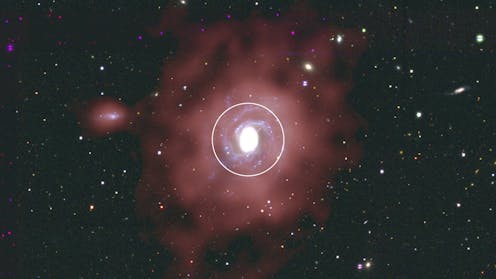
Galaxies are often described as vast star factories, churning out new suns from clouds of gas. For decades, astronomers have assumed that the more raw material a galaxy holds, the more stars it should be able to make.
But our latest study, published this month in the Publications of the Astronomical Society of Australia (PASA), challenges that assumption. We found that when it comes to forming stars, it’s not just the amount of gas in a galaxy that matters – it’s where that gas is located.
Getting the ingredients in the right place
Our research is part of one of the largest efforts to map atomic hydrogen gas in nearby galaxies. This huge project is called the WALLABY survey (or the Widefield ASKAP L-band Legacy All-sky Blind Survey).
Hydrogen is the most abundant element in the universe and the basic building block of stars. But surprisingly, a large fraction of this gas in galaxies lies far from where stars actually form – out in the faint outer regions, well beyond the bright stellar disk.
Think of atomic hydrogen as the flour in a cake recipe. It’s the essential ingredient for making stars. But what really matters for the recipe is not how much flour there is in the bag, but how much ends up in the mixing bowl.
In the same way, to understand how stars form, we need to focus on the gas that’s in the right place. In a galaxy, that means within the stellar disk, where it can actually be used.
A closer look
Until now, most measurements of atomic hydrogen in galaxies have focused on their total gas content, without showing where that gas is located. That’s because earlier observations – especially those made with single-dish radio telescopes – couldn’t detect where in a galaxy hydrogen gas was located.
However, the Australian Square Kilometre Array Pathfinder (ASKAP) telescope in Western Australia has a very wide field of view and moderate resolution. This means astronomers can use it to efficiently map the hydrogen gas across large areas of the sky and within individual galaxies.
Using the ASKAP telescope, the WALLABY survey should eventually detect more than 200,000 galaxies and provide detailed hydrogen maps for many thousands of them.
A puzzle resolved
Our study, led by PhD student Seona Lee, draws on hydrogen maps for around 1,000 galaxies. This is an unprecedented sample size for this kind of analysis.
The results reveal a clear trend. The amount of star formation is much more closely linked to the amount of hydrogen gas within the stellar disk than the gas farther out. That outer gas, even when it is plentiful, appears to play little immediate role in fuelling new stars.
This helps explain a long-standing puzzle – why some galaxies with large gas reservoirs form relatively few stars. It turns out much of their gas may be sitting idle in the galactic outskirts, too far from the regions where stars actually form.
In short, measuring the total gas content of a galaxy doesn’t give the full picture. To understand star formation, we need to zoom in – not just total up the ingredients, but see where they’re actually being used.


