

School playgrounds are one of the main locations for bullying. How can they be set up to stop it?
- Written by The Conversation
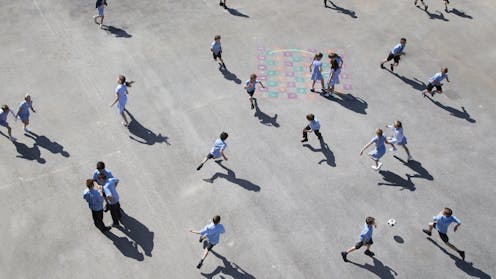
Children spend thousands of hours in playgrounds at school. A lot of this time does not have the same levels of teacher preparation and supervision as classrooms do.
Research shows school playgrounds are one of the main locations where bullying occurs.
The federal government is doing a rapid review into what works and what else needs to be done to stop bullying in schools. School playgrounds can sometimes be overlooked when considering anti-bullying approaches.
What is the relationship between playgrounds and bullying? And how can we better set up playgrounds to help prevent this damaging behaviour?
Why do play spaces matter?
The reasons for bullying are complex and stem from a range of factors.
But research suggests bullying is more common in confined or contested spaces – for example, when students are mixing with other year levels.
This research also suggests some students are more likely to bully other students, lash out and break rules when they are bored and frustrated in school play spaces.
A new report from not-for-profit group Play Australia estimates just 2% of all Australian schools are using innovative, research-informed strategies that best encourage and support healthy play behaviours.
An example of ‘loose parts’ play for children. Well established in early childhood, yet innovative in primary schools.What happens in Australia?
School play spaces are not regulated in the way playgrounds are for younger children. For example, there are no minimum space requirements per student in high schools. There are some emerging primary school space guidelines, but these are not always followed.
The lack of regulation for playground space has also seen classroom buildings taking over play areas and rules stopping students from moving in some areas (for example, no running or ball games).
Many primary schools still rely on fixed play equipment installed in the 1980s. But primary school students report they get bored of playing on the same equipment over and over again.
In public high schools, playgrounds tend to be large open spaces with ovals, hard-surfaced courts and picnic tables or benches.
Not only is this not particularly stimulating or inviting, the design can lead to some (typically male) students dominating the open spaces with games.
This can exclude other students from the playground. Research suggests if students lack a sense of community and belonging to their school, they are more likely to bully others.
What should primary schools do?
A growing body of research based on interviews with teachers and student observations suggests positive behaviours can be encouraged if primary students have more options and fewer restrictions on how they engage in play.
Resources that can be moved, adapted and selected by students (with varying colours, shapes, sizes, quantities and types) can help develop problem-solving and teamwork skills and reduce bullying because children are busy and engaged.
Examples of resources include both natural (rocks and twigs), loose sports equipment (small hurdles, bats and frisbees, balls) and other manufactured items (blocks, boxes, pipes, planks and crates).
Research also suggests teachers’ engagement with students in the playground can help reduce bullying and antisocial behaviour.
The “active supervision” method is recognised as one of the most effective ways to to do this, as it can improve students’ sense of belonging and safety.
The method includes adults using positive language, showing an interest in supporting play and modelling positive play behaviours, which increase students’ participation and cooperation.
What about high schools?
Research with school architects suggests high school spaces with well maintained, diverse features can help promote a more positive social culture.
It also suggests multiple spaces for students – as opposed to a single dominant space in a playground – can support students to feel as though there is space for them, and they belong at school.
It is important for high school students to be consulted about what they want – they are the main users and have evolving needs as they progress through school.
A 2025 Australian study found high school students want opportunities to retreat and be themselves.
Examples include maintained gardens and courtyards to help relax after the stresses of classroom rules and routines. Students suggested trees, rocks and gardens could break up open spaces. Providing sufficient shade can also ensure students have more accessible space to engage with each other throughout a school year.
What next?
Improving playgrounds to better address student needs will require more resources from governments.
But addressing bullying is complex and we know physical settings can impact social dynamics. So we need to look more closely at school playgrounds as a key place where bullying occurs and the role they play in this behaviour.


