

Here’s why some people suffer from motion sickness – and which remedies actually work
- Written by The Conversation
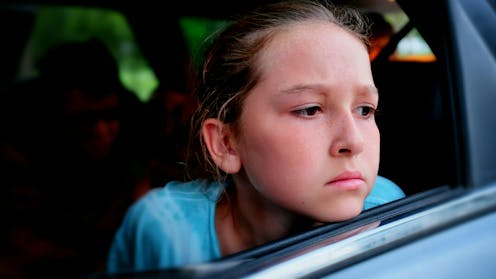
Cars may be a modern phenomenon, but motion sickness is not. More than 2,000 years ago, the physician Hippocrates wrote “sailing on the sea proves that motion disorders the body”. In fact, the word nausea derives from the Greek naus, meaning ship.
Whether you’re in a ship, car, plane, or riding a rollercoaster, motion sickness (also called travel sickness or seasickness) can make you retch, vomit, sweat and become pale, and feel nauseated, dizzy and tired.
For some people, watching dizzying scenes in a television show or simply thinking about moving can make us feel woozy. Playing video games or using virtual reality headsets can also lead to motion sickness (in this case, called “cybersickness”).
But why does it happen? And why doesn’t it affect everyone?
What is motion sickness?
Motion sickness can happen in response to real or perceived motion.
We don’t understand the exact mechanisms underlying motion sickness, although there are various hypotheses.
The most accepted theory is that our brains like to know what’s going on around us. If our body is moving, but our brain can’t work out why, this creates some internal confusion.
Within our brains, the “vestibular system”, which includes sensory organs in your inner ear, helps maintain balance. It has trouble doing this when you’re constantly being moved around (for example, inside a car) and sends the signals throughout our body which make us feel woozy.
Supporting this theory, people who have damage to some parts of their inner ear systems can become completely immune to motion sickness.
Why does motion sickness affect some people and not others?
Very rough movement will make almost anyone motion sick. But some people are much more susceptible.
Women tend to experience motion sickness more than men. There is evidence that hormonal fluctuations – for example during pregnancy or some stages of the menstrual cycle – may increase susceptibility.
Some other conditions, such as vertigo and migraines, also make people more likely to experience motion sickness.
In children, motion sickness tends to peak between ages six and nine, tapering off in the teens. It is much rarer in the elderly.
In a car, the driver is normally in charge of the motion, and so their brain can anticipate movements (such as turning), leading to less motion sickness than for passengers.
Are some modes of transport worse?
Motion sickness is typically triggered by slow, up-and-down and left-to-right movements (low-frequency lateral and vertical motion). The more pronounced the motion, the more likely we are to get sick.
This is why you might feel fine during some stages of an air flight, but become nauseous during times when there is turbulence. It’s the same at sea, where the larger and more undulating the waves, the more chance there is passengers will feel sick.
Recent reports have suggested electric vehicles make motion sickness worse.
This may be because electric vehicles tend to launch from a standstill with a fast acceleration. Sudden movements like this can make some occupants more nauseous.
The silence of an electric vehicle is also unusual. Most of us are used to hearing the engine running and feeling the vehicle’s rumble as it moves. The silence in an electric vehicle removes these prompts, and likely further confuses our brain, making motion sickness worse.
Interestingly, when an electric vehicle is put into autonomous (self-driving) mode, the driver becomes just as susceptible to motion sickness as the passengers.
What helps motion sickness?
For some people it never goes away, and they remain susceptible to motion sickness for life.
But there are ways to manage symptoms, for example, avoiding travelling in bad weather, looking out the window and focusing on stable points (such as the aeroplane wing during a flight) or a distant stationary object (such as the horizon). This reduces conflicting signals in your brain.
It may also help to:
Medicines can help. Your doctor or pharmacist can recommend a variety of over-the-counter medications, such as antihistamines, which may help alleviate symptoms.
Some people find alternative treatments helpful, including ginger, anti-nausea wrist bands (sea-bands or pressure bands). However we still don’t have enough consistent scientific evidence to endorse these remedies.
There are longer-term options such as prescription medications and skin patches. However, many have potential side effects, so you should discuss these with a health professional.
Not all of these medications will be suitable for children. However, there are some options which may help alleviate serious cases, and these can be talked through with your family GP.
Does it ever go away?
Sometimes, repeated exposure to the activity (called habituation) can help reduce motion sickness. The ancient Romans and Greeks reported the more experienced a sailor became, the less prone they were to sea sickness.
While inconvenient, motion sickness may also have some evolutionary advantages. It’s thought species prone to motion sickness (including humans, fish, dogs, cats, mice and horses) avoid dangerous patches of rough water or high windy branches.
We’re safest when firmly on land and not moving at all. Perhaps motion sickness is simply one way that our body works to keep us out of harm’s way.


