

Men traded wares – but women traded knowledge: what a new archaeological study tells us about PNG sea trade
- Written by The Conversation
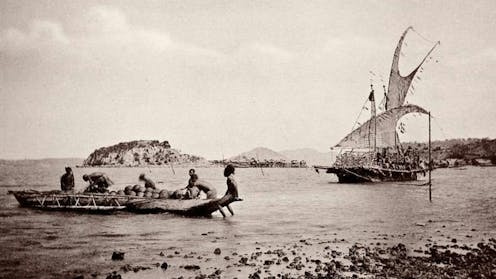
Australia’s closest neighbour, Papua New Guinea, is a place of remarkable cultural diversity. Home to cultures speaking more than 800 languages, this region has been interconnected by seafaring trade networks for thousands of years.
Because seafaring was most often undertaken by men, it has long been assumed by anthropologists and archaeologists that information sharing between different cultures came via men.
Our new archaeological research sheds light on the often overlooked role of women in developing past trade relationships. We found knowledge being shared that couldn’t have been shared among men – pointing the direction towards complicated relationships between women in cultures based hundreds of kilometres apart.

The adventurous deeds of male seafarers
In 1883, Papua New Guinea was colonised and annexed by Britain. Foreign anthropologists such as Darwin’s collaborator Thomas Huxley, Charles Seligman and Bronislaw Malinowski arrived shortly after.
These male anthropologists became enamoured of the region’s seagoing trade networks, featuring huge sailing canoes, dangerous voyages and complex trade relationships.
Their accounts often focused on the seafaring heroics of the men of Papua New Guinea. This is partly because they spoke to men almost exclusively, and partly because they admired fellow seagoing, risk-taking adventurers.
The best example of this is Malinowski’s famous book Argonauts of the Western Pacific (1922), where he likens the voyagers of the Trobriands to Jason’s band of male adventurers in Greek mythology.
Women seldom took centre stage in these histories.
Yet crucially, women maintained the knowledge of how to make the earthenware pottery used for trade.
Tracing trade through pottery
These early anthropologists left us with detailed but male-focused accounts of trade networks. It is left to today’s archaeologists to trace histories of trade back in time, using material culture and carbon dates to see when it began.
Most of the archaeology over the past six decades has taken place around Port Moresby, Papua New Guinea’s capital.
This is the homeland of the Motu people (among others), famous for their long-distance trade.
In the late 19th century, Motu men sailed west each year in fleets of up to 20 ships carrying some 20,000 pots. These were then traded for food with people in the Gulf of Papua.
Archaeologists who began researching seafaring and trade on Papua New Guinea’s south coast in the 1960s were enthralled by early anthropological accounts. When they started to uncover similar-looking pieces of pottery across 400km of coastline, they thought it was probably made in one location and carried by seafarers.
The most famous archaeological site near Port Moresby is Motupore Island. Excavations in the 1970s and 1980s recovered a staggering four tons of pottery fragments.
In 2022, we began new excavations at Hood Bay, 100km to the east of Motupore Island, in partnership with the local Keapara communities. We found pieces of pottery with the same decorations as those found at Motupore Island. Yet there was no evidence of pottery ever being made in Hood Bay.

Reflecting on what anthropologists had earlier written, it seemed reasonable to think that pottery was brought to Hood Bay by seafaring traders. But a crucial puzzle piece was missing: where was the pottery made?
Shedding light on women’s roles
We used an advanced type of scanning electron microscopy to compare the minerals and clay in pottery from Hood Bay and Motupore.
Earthenware pottery is mostly made from clay and sand. By finding out what types of sand minerals are in the pottery we can see where it might have been made.
To our surprise, we found the pottery was indeed locally made and was not traded by sea from Port Moresby. This is the first evidence of pottery being made in Hood Bay, a practice that was lost sometime in the past 300 years.
So why did the pottery from two distant locations look so similar? If the pottery was not being traded, people must have been exchanging ideas about how to make it.
Like the pottery, women’s tattoo designs at the two locations were also the same. This suggests community relationships were maintained through women sharing knowledge.
Tattooing was an important women’s cultural practice in these regions, and tattoos signified major life stages such as marriage.
Interestingly, the marriage tattoos used in Port Moresby and Hood Bay were identical in the 19th century, but no one that anthropologists spoke to remembered why. The tattoo designs suggest that Motu and Keapara women were once in very close contact.
Successful pottery production requires precise skills. Becoming a proficient pottery maker was a long learning process for Motu women who acquired the skills needed from their aunts and mothers.
The identical decoration on pots made by Motu and Keapara women can only be explained if ideas about pottery decoration were shared by women among each other and passed down through generations. Men were not involved in making pottery, so this knowledge was not shared by seafaring men.
This means it was not the trading ventures of men that connected coastal villages, but women’s know-how.
Women moved between villages and carried with them the knowledge of how to make and decorate pottery and shared ideas about tattoo designs.
Hundreds of years ago it was women who caused cultural traditions to spread – possibly through intermarriage – linking communities along Papua New Guinea’s south coast.


