

‘I’m going to send letters’: the deadline for Trump’s ‘reciprocal’ trade tariffs is looming
- Written by The Conversation
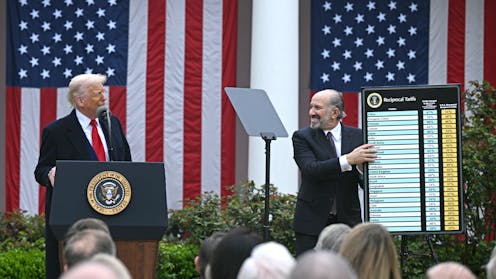
US President Donald Trump’s 90-day pause on implementing so-called “reciprocal” tariffs on some 180 trading partners ends on July 8.
How are countries responding to the threat, and will the tariffs be re-applied from July 9?
What the US thinks ‘reciprocal’ means
The United States is demanding four things from all trading partners, while offering little in return. So these negotiations are anything but “reciprocal”.
The main demand is to rebalance bilateral goods trade between the US and other countries. Nations with trade surpluses – meaning they export a greater value of goods than they import from the US – will be encouraged to import more from the US and/or export less to it.
The US is also pushing countries to eliminate a range of “non-tariff barriers” that may affect US export competitiveness. These barriers are drawn from the United States Trade Representative’s (USTR) March 2025 report and include a variety of perceived “unfair” practices, from value-added taxes (such as the Goods and Services Tax) to biosecurity standards such as those Australia applies to agricultural imports.
In a nod to the “tech bros”, (alleged) restrictions on digital trade services, such as Australia’s media bargaining code, and digital service taxes must be removed, along with taxes on the tech giants. On Monday, Canada dropped a new digital service tax on firms such as Google and Meta after Trump suspended trade talks.
Countries must also agree to reduce reliance on inputs from China in any exports to the United States. That means companies that moved manufacturing from China to countries such as Vietnam during President Trump’s first term trade wars will face challenges in sourcing input components from China.
Put together, this is a difficult package for any government to accept without securing something in return.
Who holds the cards?
Trump has been fond of saying the United States holds “all the cards” in trade negotiations.
It’s not known precisely how many countries are negotiating bilateral deals with Washington. Between 10 and 18 countries are priority “targets”, or to use an early, colourful phrase, were targeted as the “Dirty 15”.
Category 1 likely comprises many more countries than those in the US’s naughty corner. These countries were saddled with large reciprocal tariffs despite the tariff formula’s evident shortcomings. To paraphrase Trump, these countries don’t hold the cards and have limited negotiating power.
They have no choice but to make concessions. The smarter ones will take the opportunity to make reforms and blame the bully in Washington. Mostly these are developing countries, some with high dependency on the US market, including the poorest such as Bangladesh, Cambodia, and Lesotho.
To make matters worse, they must keep one eye on China for fear of retribution in case Beijing perceives any promises to reduce dependence on Chinese inputs would compromise Chinese interests.
Category 2 consists of countries that “hold cards”, or have some degree of leverage. Some, such as Canada, Japan, India and the EU, will secure limited US concessions although they may resort to retaliation to force this outcome. From discussions with our government and academic sources, Japan and India likely won’t retaliate, but Canada has previously and the EU likely will.
Australia’s Prime Minister Anthony Albanese initially said he would not negotiate and has repeated US reciprocal tariffs “are not the act of a friend”.
However, the Australian government is wisely looking to bolster its negotiation cards, such as creating a critical minerals strategic reserve.
No doubt policy makers are also reminding the US of their favourable access to Australia’s military infrastructure which could be essential to any US-China military confrontation.
China is category 3.
The Chinese government is determined not to kowtow to Washington as they did in Trump’s first term. The so-called “Phase 1 deal” was signed but instantly forgotten in Beijing.
Beijing has several cards, notably dominance of processed critical minerals and their derivative products, particularly magnets, and the US’s lack of short-term alternative supply options.
After China expanded export controls on rare earths and critical minerals, shortages hit the auto industry around the world and Ford was forced to idle plants.
What happens next?
Kevin Hassett, director of the National Economic Council, suggested on Friday more deals may be signed before July 8. But Trump is likely to undermine and/or negate them as his transactional whims change.
The British, after announcing their US deal that included relatively favourable automotive and steel export market access, watched in horror as Trump doubled tariffs on steel imports to 50%, and reimposed the 25% tariff on the UK.
The UK government was reminded this US administration cannot be trusted. That is why countries negotiate binding trade treaties governed by domestic and international laws.
Many countries are waiting on the outcomes from various US court battles testing whether the president or Congress should have the power to impose unilateral tariffs. After all, if there is a chance the Supreme Court rules Trump cannot change tariffs by decree, then why negotiate with a serially untrustworthy partner?
The Japanese government, for example, recently announced it is pausing negotiations after the US demanded increased defence spending.
‘I’m going to send letters’
Trump on Sunday suggested he would simply send letters to foreign nations setting a tariff rate. “I’m going to send letters, that’s the end of the trade deal,” he said.
That does not bode well for countries negotiating in good faith. It’s likely tariffs will be reimposed and bilateral negotiations will drag on to September or beyond as Treasury Secretary Scott Bessent has said.
After all, even the US government has limited bandwidth to process so many simultaneous negotiations. Category 2 trading partners will increasingly test their own political limits. And the rest of the world is hoping for a favourable Supreme Court ruling that may, like the character Godot in the play Waiting for Godot, never come.


