

Queensland’s horrific lion attack shows wild animals should not be kept for our amusement
- Written by The Conversation
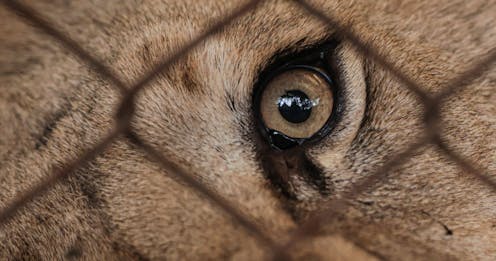
Last weekend, a woman was mauled by a lioness at Darling Downs Zoo in Queensland, and lost her arm. The zoo, which keeps nine lions, has been operating for 20 years and had never experienced an incident such as this.
The victim was a relative of the zoo owner, Steve Robinson, who told the media the lions were not aggressive and the lioness was thought to be “just playing”.
Although attacks like this are extremely rare, they are obviously of great concern. The incident should prompt a rethink of our approach to wild animals in captivity, and whether it’s morally acceptable – or safe – to keep them there at all.
Why do zoos exist?
Zoos, aquariums and other settings where wild animals are kept captive exist for two main reasons: human entertainment and profit-making.
Surveys show zoo visitors have a preference for large mammals such as elephants, primates and big cats.
Some animals are more tolerant of captivity conditions and exposure to humans than others. Fish, for example, seem to respond more neutrally to human presence than most other species.
But a recent study found captive animals generally demonstrate abnormal behaviour more often than non-captive ones.
For most wild animals, captivity deprives them of the ability to engage in natural behaviour, which harms their welfare. For example, free-living dolphins and whales have long-range migration patterns which require vast ocean spaces. They are also highly social and display complex communication behaviour.
Some countries have banned keeping dolphins and whales in captivity for entertainment because it causes the animals to suffer sensory deprivation and stress, among other harms.
Captive dolphins were once common in aquariums and marine parks across Australia. But now only one facility, Sea World in Queensland, still breeds dolphins for entertainment.
And earlier this year, the last elephants at Perth Zoo were moved to a 12-hectare habitat in South Australia to improve their welfare.
Another important welfare question is whether the captive animal has “agency” – that is, whether it can make choices as it would in the wild.
Can it choose, for example, which other animals it has relationships with? Or whether it has privacy? Having control over such decisions enhances the quality of life for the captive animal.
It’s important to note that some zoos can deliver positive outcomes for animals. Many play an important conservation role, such as running captive breeding programs for endangered species.
An example is a long-running program across several Australian zoos and other organisations to recover populations of the critically endangered Regent Honeyeater. The program has released more than 400 zoo-bred birds into the wild.
However, such conservation programs do not necessarily need to involve zoos to succeed.
Weighing up the risks
No matter how domesticated they might seem, some wild animals in captivity will always pose a risk to humans. Their behaviour can be unpredictable and, as the recent Queensland example shows, even a “playing” lioness can cause enormous physical harm to people.
Wild animals are called wild for a reason. To be kept in captivity, most animals require training so they can be safely handled. The Darling Downs Zoo incident shows despite this precaution, things can still go wrong.
But humans will, understandably, always be fascinated by other animals, and want to see them up close. So what are the alternatives to zoos?
Open range-zoos, such as the one to which the Perth elephants were moved, can offer a better option for some animals.
Another option is to recreate the zoo experience using technology. Artificial intelligence, virtual reality and augmented reality can be used to create images of animals that look and seem real.
In Australia, examples include Brisbane’s Hologram Zoo and a high-tech puppetry experience touring Australia which replicates a real shark dive.
Overseas, animatronic displays have been created to replace dolphin shows.
Questions about animals kept in captivity require us to consider how much risk to human safety we accept, and the extent to which we prioritise human amusement over animal welfare. In searching for answers, we can start by asking whether we need zoos at all.


