

Washington’s war demands – Australia right to refuse committing to a hypothetical conflict with China over Taiwan
- Written by The Conversation
The United States can count on Australia as one of its closest allies.
Dating back to the shared experiences in the second world war and the ANZUS Treaty signed in 1951, Australia has steadfastly worked to help ensure the US remains the principal security guarantor in the Indo-Pacific.
Australia’s track record speaks for itself. Yet additional demands are being placed that rankle.
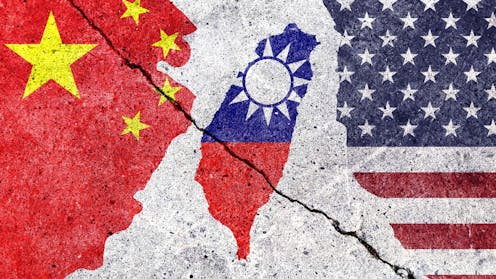
The Pentagon wants to know how Australia – and other allies such as Japan – would respond in the event of a war with China over Taiwan.
Making these demands – which are being sought as part of the review of the AUKUS nuclear submarine agreement – is both unjustified and unreasonable.
‘100 years of mateship’
Since federation in 1901, Australians have found themselves alongside US counterparts in almost all the major conflicts of the 20th century and beyond.
It is this shared experience that led former Ambassador to Washington, Joe Hockey, to coin the term “100 years of mateship”.
The pinnacle of the security relationship is the ANZUS Treaty which is a loosely worded document barely 800 words long.
However, it is important to remember AUKUS is just that – a technical agreement, albeit premised on the century-spanning trusted collaboration across the full spectrum of national security ties.
Goldilocks solution
More recently, the US administration has made demands of allies, including Australia, the likes of which have not been seen in living memory.
This spans not just tariffs, but also increased defence spending. American policymakers appear oblivious or unconcerned about the blowback they are generating.
It is this context which makes the US demands for a broad-ranging and largely open-ended commitment over the defence of Taiwan, in advance of any conflict, so extraordinary and unhelpful.
Australia has long had a fear of abandonment. Ever since the searing experience of the fall of Singapore in 1942, officials have been eager to burnish ties with US counterparts. Conversely, there has always been a strong element in the community that has feared entrapment in yet another US-led war in Asia.
The experience in the Korean and Vietnam wars, let alone Afghanistan and Iraq, left many guarded about the efficacy of hitching the wagon to US-led military campaigns.
In essence, though, Australian policymakers have long sought the Goldilocks solution: not too enthusiastic to trigger entrapment and not too lukewarm to trigger abandonment.
No guarantees
Now Australia, Japan and others face a surprising new push by American officials for a commitment to a hypothetical conflict, under open-ended circumstances.
The irony is that American demands for a commitment fly in the face of the loosely worded ANZUS alliance – which stipulates an agreement to consult, but little more than that.
The AUKUS agreement includes no such guarantees either. The overt and confronting nature of Washington’s demands means Prime Minister Anthony Albanese effectively has no option but to push back:
We support the status quo when it comes to Taiwan. We don’t support any unilateral action […] we want peace and security in our region.

Defence Industry Minister Pat Conroy was adamant Australia would not be committing forces ahead of any “hypothetical” conflict:
The decision to commit Australian troops to a conflict will be made by the government of the day, not in advance, but by the government of the day.
A further irony is Australia, like Japan, is already hugely invested in its US military relationship, particularly through its military technology.
The purchase of the F35 Joint Strike Fighter aircraft, for instance, was meant to help enable the generation of interoperable forces, yet no such demand has been made when it comes to an advance commitment over their use in support of US ambitions.
So why invoke AUKUS in such a way?
Evidently, the way the US is trying to stand over Japan and Australia is harmful to its own interests. Such adversarial and unduly transactional behaviour could provoke a popular backlash in Australia and elsewhere.
The government has rightly rebuffed the calls saying it would be up to the government of the day to make such a decision. It is likely this will not be well received by the Trump administration. The PM is right though, to say it’s hypothetical and not worthy of a public endorsement.
Strategic ambiguity
Yet a further irony is that this is mostly a moot point.
The key benefit of alliance collaboration is already in place – and that relates to the efforts to deter China from ever acting on its desire to change the status quo in the first place.
As former PM and now ambassador to Washington, Kevin Rudd explained in his book, The Avoidable War, geo-political disaster is still avoidable, particularly if the US and China can find a way to coexist without betraying their core interests through managed strategic competition.
This strategic ambiguity is meant to complicate a potential adversary’s military planners and political decision makers’ thought processes over the advantages and disadvantages of going to war.
China already knows a clash over Taiwan would mean US allies like Japan and Australia would find it virtually impossible to avoid being entangled. The strategic ambiguity can be maintained ad infinitum, so long as an outright invasion is averted.
And the likelihood of conflict over Taiwan? I remain sanguine that conflict can be avoided.
But to do so would involve clear and compelling messaging: both through diplomatic channels and through the demonstration of robust military capabilities that war would be too costly.


