

The southern hemisphere is full of birds found nowhere else on Earth. Their importance has been overlooked
- Written by The Conversation
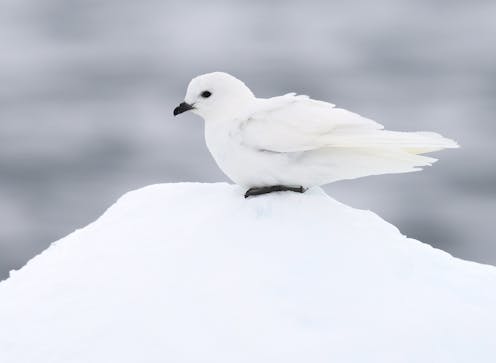
The snow petrel, a strikingly white bird with black eyes and a black bill, is one of only three bird species ever observed at the South Pole. In fact, the Antarctic is the only place on Earth where this bird lives.
It isn’t alone in this. Antarctica and the sub-Antarctic harbour a large number of endemic species, which means these species are only found in one or a few locations in the world.
In other words, these regions have a high degree of “endemism” – an important metric that tells us where to focus species conservation efforts.
But our new study shows that the degree of endemism in Antarctica and the sub-Antarctic – and in the southern hemisphere more generally – has been underestimated.
This is important because areas with a high degree of endemism harbour species with restricted ranges, unique evolutionary history or unique ecological functions. This makes them potentially more vulnerable to disturbances such as climate change, fundamental changes in habitat, or invasive introduced species.
If the degree of endemism is underestimated, conservation efforts may overlook the sites that are home to irreplaceable birds.
Biased measurements
There are two reasons why global patterns of species endemism aren’t well defined. First, the most common method used to calculate endemism tends to give higher values to places with more species overall – this is known as species richness.
In addition, global studies of diversity often exclude areas that are comparatively species-poor. These areas are mainly in the southern hemisphere – most notably the Antarctic region. When sites that only contain a few species are left out, this influences the estimates of endemism for all other sites.
An alternative way to calculate endemism takes into account a site’s “complementarity”. This metric considers whether species found at a site are also found elsewhere. With this method, we can find sites that have the highest percentage of species with a restricted range.
At such highly endemic sites, the local ecosystem relies heavily on species with restricted ranges to function, which makes them all the more irreplaceable.

Global hotspots for endemic species
This is the approach we used in our new study to reassess the endemism of birds worldwide. In our study, we also considered other aspects of bird diversity. We measured endemism with regard to whether sites hold irreplaceable evolutionary history and ecological functions of birds.
We found that southern-hemisphere communities showed higher rates of local endemism than northern-hemisphere communities across all aspects of diversity. The sub-Antarctic islands and the High Andes, as well as several regions in Australia, Aotearoa New Zealand and southern Africa, stand out as global hotspots of endemism.
These regions hold many charismatic birds with unique evolutionary histories or unique ecological functions, and these birds are largely restricted to the southern hemisphere.
Among these are the palaeognaths – the bird lineage that includes kiwis, emus, cassowaries and ostriches. They also include the lyrebirds and the New Zealand wrens, as well as iconic Antarctic species such as penguins and albatrosses.

Not much land, a lot of ocean
The higher rates of endemism in the southern hemisphere are likely related to the uneven global distribution of landmass. Put simply, there is much more available landmass in the northern hemisphere. As you go further south, landmasses become increasingly separated by vast expanses of ocean.
Because of the smaller and separated landmasses, species in the southern hemisphere have much smaller ranges than species in the northern hemisphere. Consequently, local species communities share fewer species with each other. This leads to the higher observed endemism in the southern hemisphere.
 The black-breasted buttonquail is a secretive rainforest bird whose range is restricted to a tiny area in south-east Queensland, Australia.
Matthias Dehling
The black-breasted buttonquail is a secretive rainforest bird whose range is restricted to a tiny area in south-east Queensland, Australia.
Matthias Dehling
A heightened vulnerability
Our findings suggest that birds in the northern and southern hemisphere might react differently to environmental pressures. Unfortunately, most studies on the impact of climate change to date are from the northern hemisphere.
In response to climate change in particular, species are expected to shift their ranges towards cooler climates. While northern-hemisphere birds are likely free to shift their ranges across large stretches of uninterrupted landmass, birds in the southern hemisphere are hindered by vast expanses of ocean that separate the different landmasses on which they live.
For species at the southern tips of South America, Africa or Australia, the nearest major landmass towards the south is Antarctica. But it is unsuitable for most bird species.
The potentially heightened vulnerability of southern-hemisphere birds suggests they deserve more protection. In addition to known species diversity hotspots that hold large numbers of species, conservation efforts should consider areas that might hold only a small number of species, but irreplaceable ones that aren’t found anywhere else.


