

Does play belong in primary school? New research suggests teachers are not sure
- Written by The Conversation
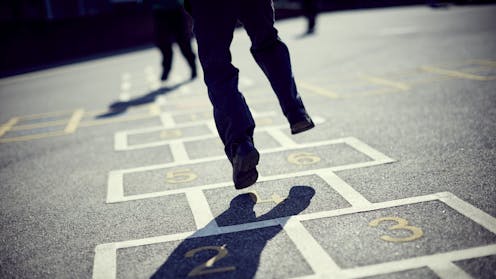
Play is one of the most important parts of early childhood education in Australia.
We know children learn about the world through play and it helps them build creativity and independence.
There is also broad agreement among early childhood educators and policymakers about the importance of play from birth to five years.
But once children start school, there is less certainty. Despite growing research about the importance of play in primary school, play is not often used for learning in these years.
Our new study with Australian primary teachers highlights significant confusion about the role of play in their schools.
Play can benefit older kids
There is nothing to suggest the importance of play suddenly stops when children reach school age.
Research shows play can support learning well into the primary years, helping students develop critical thinking, problem-solving and social skills.
Recent studies even show play has learning benefits well beyond childhood. Young adults (aged 19–25) who engage in regular play have shown improved emotional intelligence and resilience.
What do we mean by play?
When we are talking about play in primary school, it is more than just playground time during recess and lunch.
Play is what children do naturally, whereas play-based learning is when teachers use that natural playfulness as a teaching tool. Teachers will deliberately incorporate various types of play with specific learning goals and varying levels of adult guidance.
For example, children might explore mathematical concepts such as geometry and spatial reasoning through LEGO construction. Teachers would guide discovery of patterns, measurements and problem-solving, and then step back to allow students to be creative.
There is also evidence play can support literacy, numeracy and other academic goals, because it supports attention, memory and planning skills that underpin academic learning.
Research shows it can also help maintain students’ enjoyment of and engagement in their studies.
So when used effectively, it could be used across the school curriculum.
Our research
To better understand what teachers think about play and why they hold these views, we surveyed 238 teachers across Australia primary schools. Teachers ranged from those teaching the first year of primary school through to Year 6.
Most of the teachers were from public schools. We used an online questionnaire and recruited participants through email and social media.
Teachers’ different views on play
The results revealed some inconsistencies in teachers’ views.
Teachers strongly agreed play benefits children’s development. More than three-quarters (77%) strongly agreed students develop social skills through play, with similar numbers supporting play’s role in emotional, physical and language development.
One teacher described play as “magic” and “where real learning happens”.
However, only 52% strongly agreed students develop academic skills during play, revealing uncertainty about play’s educational value. As another teacher told us:
Play is something that children do and it’s fun for them, however, [it] should be out of school. School is for learning.
Some teachers still viewed play as separate from learning, with 61% agreeing that “play is a necessary break from learning” – suggesting they see play and learning as distinct entities rather than integrated.
Adding to this confusion, teachers often used the terms “play” and “play-based learning” interchangeably, despite these being different concepts.
How should play-based learning be structured?
Even when teachers valued play in principle, they struggled to provide time for it in their classrooms. Teachers reported feeling caught between covering mandated content and providing meaningful play experiences. As one teacher told us:
Play is fantastic for children but a challenge when there is so much limited time to cover such a huge curriculum.
Teachers were also divided about their role in children’s play. Should they structure it? Leave kids alone? Supervise but not interfere?
Our analysis revealed several distinct approaches, from hands-off supervision to active involvement. This reveals confusion about best practice (the research suggests different approaches can work, depending on the context).
What can we do instead?
Our research suggest there is missed opportunity when it comes to structuring play as part of learning in primary schools.
To address this, we need several changes. Teacher education programs should include training in practical ways to use play as a teaching tool. For example, how to teach science concepts through games and experiments that feel like play to children.
Professional development should also help existing teachers understand how to structure meaningful play that supports the curriculum.
At a policy level, we also need better alignment between the early education and primary years, to ensure play does not disappear at the school gate.


