News Daily

The Times

Australia

  • Written by The Conversation
South Australia’s algal bloom may shrink over winter – but this model suggests it will spread to new areas in summer

South Australia is desperate for help to tackle an unprecedented harmful algal bloom that has decimated marine life up and down the coast. While the extent of the damage is still unknown, my preliminary research suggests there’s no end in sight. It may just get better over winter before it gets worse next summer.

The Karenia mikimotoi bloom first appeared in March on two surf beaches outside Gulf St Vincent, about an hour south of Adelaide. It has since spread, killing all kinds of marine organisms – from crabs and small fish to sharks and rays. Only the neighbouring Spencer Gulf, far west coast and southeast coasts have been spared. For now.

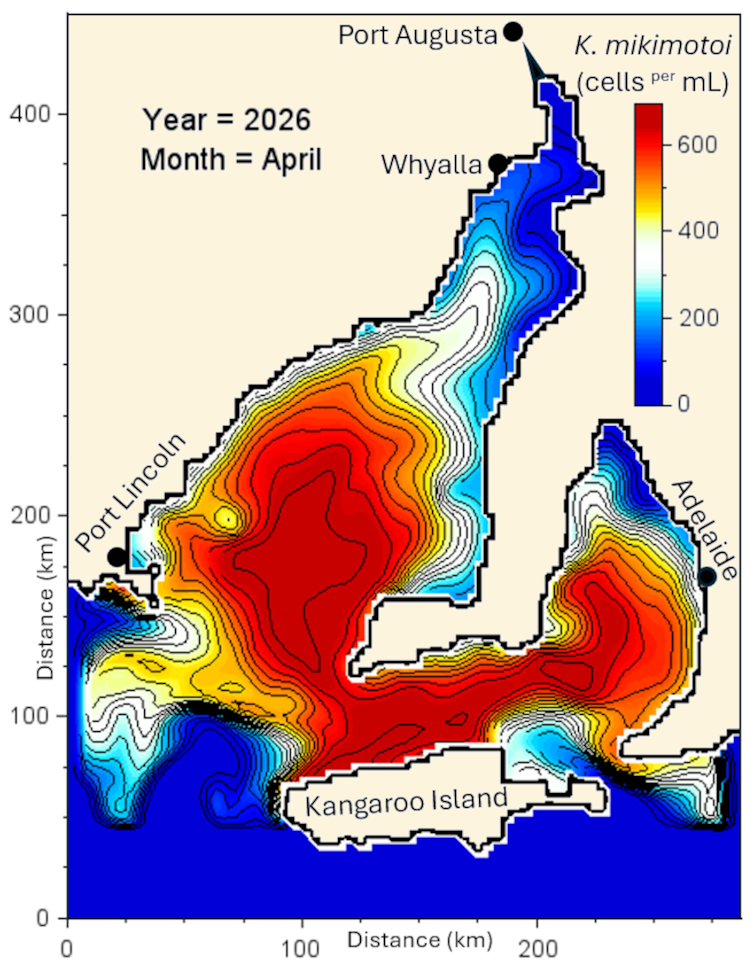
In preliminary research now undergoing peer review, I have predicted the bloom’s future spread using a new computer model. In the worst-case scenario, the harmful algal bloom would reach the Spencer Gulf and spread – from Port Lincoln to Whyalla and across to Port Pirie – next summer and autumn. That would be extremely bad news for the thriving seafood, aquaculture and tourism industries. They may need help to prepare.

Some help is on the way. Federal Environment Minister Murray Watt yesterday announced A$14 million in federal funding. SA Premier Peter Malinauskas convened an Emergency Management Cabinet Committee meeting today and signed off on a $28 million support package.

A map of South Australian showing worst-case scenario predictions from the model for April 2026, with high concentrations of harmful algae in both gulfs.
The worst-case scenario forecasts high concentrations of K. mikimotoi in both South Australian gulfs next April. Jochen Kaempf

A rolling disaster

The algal bloom was first noticed when dozens of surfers and beachgoers on the southern coast of the Fleurieu Peninsula fell ill after exposure to seawater in March.

Soon, dangerous sea foam appeared. Then the killing began in earnest. Many marine species started washing up dead or dying.

The bloom began to spread. In mid-April, K. mikimotoi was detected in water samples from Edithburgh and Coobowie on the southeastern corner of Yorke Peninsula.

In early May, the Kangaroo Island Council announced the bloom had spread across the Investigator Strait affecting the island’s northern coastline.

Wild weather in June pushed the bloom through the Murray Mouth into the Coorong.

By July, the state government had detected K. mikimotoi along Adelaide’s metropolitan coastline. Videos of fish kills near the Ardrossan Jetty in the northern Gulf St Vincent also emerged.

So far, the bloom has not been detected in Spencer Gulf. But my modelling suggests it’s only a matter of time.

Predicting the future

I was the first to discover the seasonal upwelling of nutrients in several regions along SA’s southern coastal shelf. This nutrient source fuels the marine food chain. It’s a big part of the reason why the marine life in our Great Southern Australian Coastal Upwelling System is so diverse.

I also simulated the ocean currents in South Australian gulfs using computer models as early as 2009.

I have now developed a computer model to predict where the algae will spread next.

Preliminary results from this research have been submitted to the journal Continental Shelf Research and are being reviewed. But given the speed at which this situation is developing, it’s worth sharing a preprint of this manuscript.

My model matches what’s known about the early spread of the bloom. It began in the coastal waters of the southern Fleurieu Peninsula. It then invaded Investigator Strait, between the Yorke Peninsula and Kangaroo Island, before slowly spreading in a clockwise circulation across the wider Gulf St Vincent.

When the model is used to forecast how the algae bloom will evolve, the story becomes deeply concerning. It predicts the algal bloom will weaken over this winter, as the growth rate will slow in cooler water. In my model, the algae had already invaded the lower Spencer Gulf in May 2025 but at very low concentrations. Then, in the worst-case scenario of high growth rates and nothing stopping it, the model predicts the bloom will affect both gulfs – Gulf St Vincent and Spencer Gulf – and Investigator Strait, with severe conditions predicted for the coming summer. A bloom in the Spencer Gulf could decimate stocks of Australian sardine in the lower gulf, and potentially also western king prawns and the giant Australian cuttlefish in the upper Spencer Gulf. Some research suggests algal growth may be limited in the hypersaline upper reaches of the gulfs, but the spread of the algae as far as Ardrossan indicates otherwise. Under the best-case scenario, the algae’s natural predator, zooplankton, would eat more of the algae, suppressing future flare-ups. So there is some hope, but more research is needed to better understand how zooplankton could control these algae. SA also needs to make continuous efforts to monitor K. mikimotoi concentrations. This includes analysis of water samples in both gulfs. It’s important to note satellite images only show the peak phase of the toxic algal bloom, and can be misleading as they also display other species including blooms of “good” algae. Fortunately, the $28 million support package includes $8.5 million for early detection and monitoring of harmful algal bloom species. This will involve real-time sensors (buoys), satellite imagery and oceanographic modelling. A new $2 million national testing laboratory will check for toxins, while $3 million will be spent on a rapid assessment of fish stocks and fisheries. But if the algae stick around, there may be little anyone can do to protect our marine environment.

Read more https://theconversation.com/south-australias-algal-bloom-may-shrink-over-winter-but-this-model-suggests-it-will-spread-to-new-areas-in-summer-261549

How Coworking Desks in Melbourne Support Flexible Work

Flexible Seating for Daily Work Coworking desks Melbourne arrangements can provide freelancers, remote workers and small business operators with a professional place to work without needing an enclosed office. Shared desks offer a setting where people can complete projects, use workplace... Read more

Split Corrugated Conduit for Flexible Cable Protection

For wiring assemblies in vehicles, machinery and equipment, choosing suitable cable protection helps keep cables organised and reduces direct contact with surrounding parts. Mojak Plastics supplies plastic tubing and conduit options for different installation needs, and split corrugated conduit can... Read more

Trailers Melbourne Buyers Can Compare: When Box Trailers Make Sense

For many homeowners, businesses and tradespeople, trailers Melbourne customers use every week need to be versatile enough for changing loads. A box trailer can be particularly useful because its enclosed sides help contain cargo while providing a straightforward loading area... Read more

Bottle Label Printing That Balances Design and Readability

Product labels need to attract attention while making information easy to find and understand. On a bottle, the available space may be limited by the container’s shape, so every design decision matters. Bottle label printing should account for visual hierarchy... Read more

Office Cleaning Melbourne: Planning a Consistent Workplace Routine

Businesses looking for office cleaning Melbourne need a plan that reflects the way their workplace operates. A clean office supports day-to-day organisation, helps shared spaces remain presentable and gives employees and visitors a more orderly environment. Eco Green Cleaning Management... Read more

Pinboard Solutions for Offices, Schools and Shared Information Spaces

Why a Pinboard Remains Useful A pinboard provides a simple way to display information that needs to remain visible without being rewritten. Lawdex supplies fabric and cork options for offices, schools, staff areas and other environments. A pinboard can be used... Read more