

Ultra fast fashion could be taxed to oblivion in France. Could Australia follow suit?
- Written by The Conversation
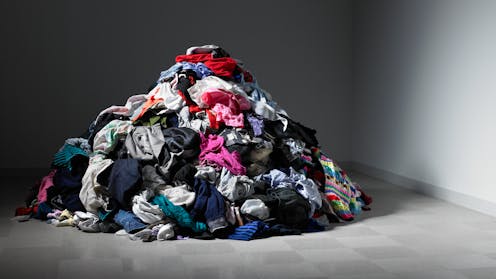
For centuries, clothes were hard to produce and expensive. People wore them as long as possible. But manufacturing advances have steadily driven down the cost of production. These days, clothing can be produced very cheaply. In the 1990s, companies began churning out fast fashion: low cost versions of high end trends. In the 2010s came ultra fast fashion, where clothes are produced extremely rapidly and intended to be almost disposable.
Ultra fast fashion is deeply unsustainable. Producing it is energy intensive and many low quality items go rapidly to landfill.
In response, France is planning to add a A$16 tax to each item of ultra-fast fashion, require mandatory environmental disclosures and ban advertising and influencer promotions.
To date, Australia has done little about the problem – even though every Australian bought an average of 53 new pieces of clothing as of 2023 and we send 220,000 tonnes of clothes to the dump annually. Responses so far have focused on voluntary schemes, which have done little to help. Policymakers should look overseas.

Why is ultra fast fashion such a problem?
About 117 billion pieces of clothing were purchased worldwide in 2023 – about 14 pieces per person. That’s well beyond the limit of five new garments per year experts recommend if we’re to live within our planetary boundaries.
There are many problems with buying too many cheap clothes. Textile manufacturing is surprisingly energy intensive. At present, the industry is responsible for about 2% of global emissions and this is expected to rise steadily. Millions of barrels of oil are used each year to make synthetic fibres such as polyester.
Ultra fast fashion items rely heavily on synthetic fibres. When washed, they produce large volumes of microplastics which go into rivers and oceans. The European Union estimates textiles account for about 20% of freshwater pollution annually. Many ultra cheap clothing items have question marks over how ethically they were produced. Nearly all of these cheap clothes only have one owner before going to the dump.
Australia’s response is minimal
Australia has no national policy on clothing. Circular economy policies and strategies at both federal and state levels don’t tend to focus on textiles.
Australian consumer laws regulate greenwashing of products. In 2023, Australia’s peak competition regulator flagged the textile industry as one with a high rate of concerning claims.
Similarly, Australia’s modern slavery laws require large corporations to identify and address risks of slave labour in their operations. Fashion brands often source materials and labour from regions with high exploitation risks Unfortunately, these laws don’t have penalties attached.
These laws are positive, but still far from the EU’s large-scale efforts to regulate the textile industry.
One promising effort is the voluntary Seamless textile scheme. Voluntary schemes like these are often used as a way to introduce reforms to a previously unregulated sector or industry.
The goal of this scheme is to help brands take responsibility for the entire lifespan of the garments they make or sell. Participating brands and retailers pay a levy which is used to promote clothing repair and rental, expand recycling and run information campaigns. Seamless is meant to help the industry prepare for a potential mandatory scheme in the future. Former Federal Environment Minister Tanya Plibersek said she was “not afraid to regulate” last year, but nothing has happened since.
To date, participation has been very limited. Around 60 brands and retailers have signed up. Ultra-fast fashion brands such as Temu and Shein aren’t covered by the scheme, as they’re based overseas.

Time for laws with teeth?
France’s planned ultra fashion laws are directly aimed at high-volume, low-cost clothing producers with binding measures such as taxes and advertising bans. If the laws come into effect, France would likely see a substantial drop in the flows of these clothes and the textile waste produced.
By contrast, Australia’s efforts so far aren’t changing things. The Seamless scheme is voluntary, while greenwashing and modern slavery laws rely on disclosures and lack enforcement powers and penalties.
It wouldn’t be easy. At present, Australia lacks laws focused on textiles, while responsibility for clothing imports is split between different government departments and levels of government. The issue of fast fashion often hits local governments hardest in the form of increased waste volumes, for instance, but local governments have no power over the problem. If policymakers did introduce a French-style tax, they would face resistance from the industry and from some consumers.
The upside? France’s approach is far more likely to actually curb the damage done by ultra-fast fashion.


