

Kneecap’s stance on Gaza extends a long history of the Irish supporting other oppressed peoples
- Written by The Conversation
Love them or hate them, there’s no doubt Irish hip-hop trio Kneecap are having a moment.
Their music – delivered in a powerful fusion of English and Irish – is known for its gritty lyrics about party drugs and working-class life in post-Troubles Ireland. More recently, the group has made headlines for its outspoken support for the Palestinian people.
British police have charged member Liam Óg Ó hAnnaidh (known by his stage name Mo Chara) with a terrorism offence. Ó hAnnaidh was charged in May, after being accused of displaying a Hezbollah flag at a London concert in November.
But this isn’t the first time an Irish republican group has courted controversy for backing other oppressed peoples. This has been happening for almost two centuries.
Unsanitised and vocal support
Ireland is composed of 32 counties. Twenty-six are in the Republic of Ireland, while six are part of the United Kingdom in Northern Ireland. When the British government withdrew from most of Ireland in 1921, the Irish Free State was largely Catholic, while Northern Ireland was more heavily Protestant. But these divisions are becoming increasingly irrelevant.
While Ireland is still split across two nations, public support for Irish unity remains strong, particularly among citizens of the Republic.
Kneecap’s members are from Belfast, the capital of Northern Ireland. They are also fierce republicans, which means they want to see Ireland united as one nation. One of their most popular songs, Get Your Brits Out, calls for the British state’s withdrawal from Northern Ireland.
The group has experienced a meteoric rise in recent years, helped by a semi-autobiographical film released last year.
They have reclaimed the term “Fenian”, often used as an anti-Irish slur. Their decision to rap in Irish is also a cultural milestone, as the language was suppressed in Northern Ireland for most of the 20th century, only achieving official language status in 2022.
Despite being undeniable provocateurs, they claim they aren’t interested in reigniting Catholic-Protestant conflict. They celebrate the similarities between both groups, rather than highlight their differences.
Ó hAnnaidh’s alleged terrorism offence came after he waved a Hezbollah flag at a London gig and chanted “Up Hamas, up Hezbollah”. Both Hamas and Hezbollah are considered terrorist groups in Britain. He will face court on August 20.
Irish-Māori solidarity
Kneecap is carrying on a long tradition of Irish groups who faced controversy for denouncing the oppressive acts of powerful states.
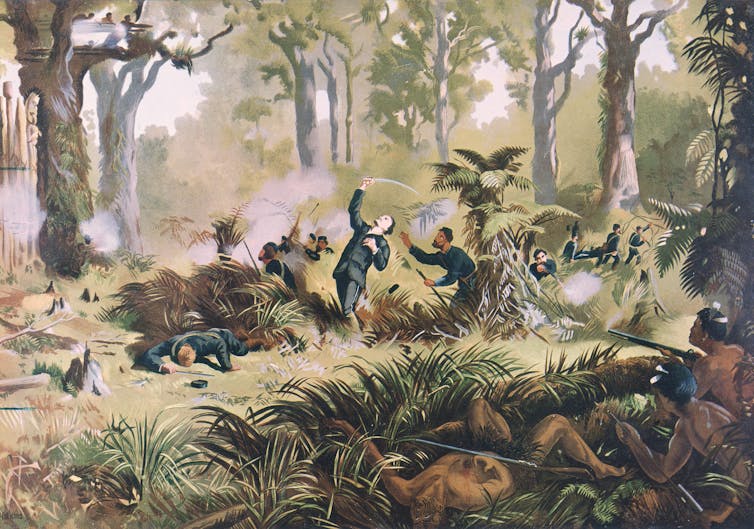
In the 19th century, several Irish nationalist groups expressed solidarity with other colonised peoples, especially Māori in Aotearoa New Zealand. Groups such as the Irish Republican Brotherhood (whose members were called Fenians) arguably saw Māori and Irish as co-victims of a tyrannical state.
Irish nationalist newspapers often wrote sympathetically about the colonisation of New Zealand, and tried to inspire Ireland to resist British subjugation, like Māori seemed to be doing.

In July 1864, the Fenian newspaper The Irish People stressed British hypocrisy. It wrote, “savages we call [Māori], using the arrogant language of civilisation, but, honestly, they deserve to be characterised by a much better word”.
It also scoffed at the “unconquerable propensity of the Anglo-Saxon to plunder the lands of other people – a propensity which manifests itself most strikingly alike in Ireland and New Zealand”.
Similarly, in December 1868, the nationalist newspaper The Nation contrasted “valiant” Māori with “terrified” British. It sarcastically described Māori as “rebels (men fighting for their own rights on their own soil)” and mocked the British forces as “valiant men who could bully a priest”.
The article finished on a sombre note: “Mere valour will in the end go down before the force of numbers and the cunning of diplomacy”.
Rumours of a secret rebellion
Other Irish leaders, such as the nationalist Michael Davitt, saw inspirational parallels between the nonviolent campaign of Charles Stewart Parnell, the 19th century leader of the Irish Home Rule movement, and Māori leader Te Whiti-o-Rongomai.
In Ireland, Parnell encouraged poor tenant farmers to pause rent payments to their British landlords. In New Zealand, Te Whiti encouraged Māori to dismantle colonially-constructed fences and plough the land for themselves. Both were arrested in 1881 within three weeks of each other.

So strong was the sense of kinship between Irish and Māori that, in the 1860s, there were persistent rumours of a joint Irish-Māori rebellion reported in the media and even New Zealand’s parliament.
In March, 1869, the conservative New Zealand newspaper Daily Southern Cross reported a large number of Māori “have decided on joining the Fenian Brotherhood, and have adopted the green flag as their national emblem”.
Later that year, the paper reported the supposed Fenians told a Māori resistance group that, “like the Maori, they hate the British rule, and are prepared to make common cause […] to overthrow that rule in New Zealand”.
However, these rumours were probably no more than a conspiracy fuelled by racist anti-Irish paranoia.
Actions and outcomes
Any tangible results of cross-cultural sympathy from 19th century Irish nationalists were mixed, at best. My ongoing research shows solidarity with Māori was partly motivated by humanitarian motives, but was also often used to make a point about Ireland.
Identifying with another oppressed peoples within the context of a corrupt empire was a powerful way to argue for improved political recognition within Ireland. Irish nationalists generally didn’t do much other than declare their sympathy.
Kneecap, on the other hand, seems willing to bear the legal and financial consequences of being vocal about human rights abuses in Gaza. Some of their shows have been cancelled, and funding providers have withdrawn.
While curated rebellion can be lucrative in show-business, Kneecap says the controversy following them is a distraction. They insist the world should focus squarely on Gaza instead.


