

Researchers watched 150 episodes of Bluey – they found it can teach kids about resilience for real life
- Written by The Conversation
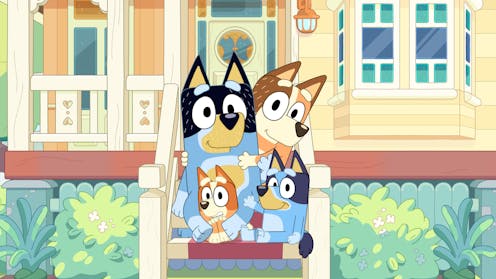
She’s six years old, lives in Brisbane and might just be one of the best resilience coaches on television.
We’re talking about Bluey, the animated Aussie pup whose adventures have captured the hearts of families around the world.
But as our new study reveals, Bluey isn’t just entertaining kids, she’s modelling how to to deal with life’s ups and downs.
Why is resilience so important?
Resilience isn’t just about “toughing it out”. It’s the ability to cope with challenges, adapt to setbacks and recover from difficulties. It’s a vital part of healthy child development.
Research shows resilience helps children manage stress, regulate their emotions, build better relationships, and even perform better at school. Without it, children may be more vulnerable to anxiety, depression and poor coping skills later in life.
Children today face growing mental health challenges, including around anxiety and emotional dysregulation. For example, a 2023 national resilience survey of almost 140,000 students found more than one in four primary and one in three secondary students reported high levels of psychological distress.
Research shows the earlier we support resilience-building, the better. Early interventions help build healthy coping skills before negative patterns take hold.
How TV can help
Storytelling in films, books and TV can show children how to navigate challenges – not through lectures, but by modelling behaviours like emotional regulation, problem-solving and empathy.
Animal characters in storytelling also offer valuable learning opportunities for children, who are naturally drawn to animals.
Bluey first aired in 2018. It has since become Australia’s most successful children’s program, with billions of views worldwide.
It is known for its realistic portrayal of young family life. Yet until now, no one had systematically examined how it – or any kid’s TV show – presents resilience on screen.
So we watched all 150 Bluey episodes
In our study, we analysed every episode of Bluey from seasons one to three. The 150 episodes added up to 18 hours of Bluey, Bingo, Chilli, Bandit and their friends.
For each episode, we looked closely at the storyline, characters and themes, identifying moments where a character faced a challenge and showed a resilient response.
To guide our analysis, we used the Grotberg Resilience Framework. This is a widely recognised model in psychology that breaks resilience into three key elements.
1. I have: involving the support systems around a child, such as family, friends, and community role models they can rely on.
2. I can: involving practical coping skills, like solving problems, managing emotions and asking for help when needed.
3. I am: involving a child’s inner strengths like confidence, optimism, emotional regulation and a sense of self worth.
‘It’s out of our hands’
Our research found nearly half of all episodes (73 out of 150) included a clear resilience message as either a primary or secondary theme.
Nearly two-thirds of the resilience moments were facilitated by a parent — most often Bluey’s mum. This fits with the “I have” category of resilience, which highlights how children draw strength from caring adults when things get tough.
For example in The Show (season two episode 19), Bingo accidentally drops a breakfast tray and bursts into tears. Mum gently models emotional coaching explaining her coping process: “I have a little cry, I pick myself up, dust myself off, and keep going.” Research shows that when caregivers model how to acknowledge distress, express feelings, and then recover with calm, children gradually learn to manage negative emotions effectively.
Later in the episode, Bingo repeats those exact words when things go wrong again.
‘Well, that was fun’
Bluey and her sister also frequently demonstrate practical coping skills on their own.
In Keepy Uppy (season one, episode three), the final balloon in a game pops. The kids pause, take it in, and smile. “Well, that was fun,” they say.
In a single moment, we see disappointment, emotional regulation, and reframing – the core of the “I can” category.
Everyday moments, powerful messages
We also see characters overcoming challenges with their own inner strength. In Seesaw (season two, episode 26) Pom Pom shows determination and self-confidence to get to the top of the seesaw and save her friends, in an example of “I am”. As she declares, “Pomeranians are a small but hardy breed”.
We found Bluey touches on almost all of the core elements of resilience: trusting relationships, emotional communication, problem-solving, self-regulation, empathy and more.
In Sheepdog (season three, episode 11), mum Chilli tells her family she needs “20 minutes” of alone time. Bluey is worried she’s done something wrong. Later, during play, Bluey gently echoes her mum’s words to a toy: “It’s hard work looking after you. I just need 20 minutes.”
That simple moment models self-care and perspective-taking as well as empathy. For kids, learning that grown-ups need rest too is a powerful message.
How to watch Bluey with your kids
Of course, no screen can replace real relationships. But when parents watch shows like Bluey with their kids, they become powerful teaching tools.
So the next time your child wants to watch an episode for the tenth time, don’t feel guilty – join them. When parents watch too, those moments become conversation starters. For example, “What do you think Bluey felt then?”, “Have you ever felt like that?” or “What would you do in that situation?”
Talking about what kids see on screen can help them reflect, process, and build the skills they need to cope, adapt and grow.
CQUniversity student Kelly Bohl and co-host of Bluey podcast Gotta Be Done Mary Bolling contributed to the original research on which this article is based.


