

From ScoMo to Albo: how a new cast of characters poses a challenge for cartoonists
- Written by The Conversation
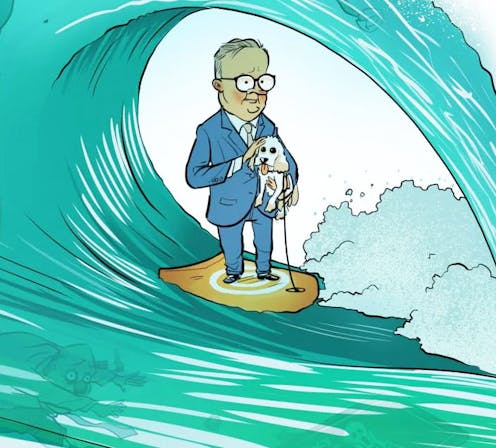
There are three, not entirely compatible, things to say about how cartoonists are coping with the recent change of government in Canberra.
First, there is the usual mild distress at having lost a pet set of ministers who seem to get uglier and more recognisable with age. Cartoonists can be like chooks returning to an empty feeder: the cartoonists’ Robert Menzies “stayed on” long after his retirement in 1966; so too did Gough Whitlam and Malcolm Fraser well into the 1980s, and Bob Hawke and Paul Keating into the later ’90s.
Bill Leak’s classic whinge in The Australian in late 2007 sums up the problem. Every cartoonist, he said, had the right to feel
extremely disappointed, depressed or even downright angry at what Rudd and his cohorts have given us to work with […].
The cause of his disappointment? “Handsome men and attractive women make life hell for cartoonists, and the Rudd ministry is chock-a-block with them.”
Although time works grotesque wonders, that’s usually how a ministry looks when it steps out of the shadows. Add to that the debilitating instinct to give the not-yet-guilty party the benefit of the doubt.
Cathy Wilcox, for one, suspended judgement of the new government for a honeymoon moment, and instead turned her ire on the broader media, which seem utterly at a loss without the Coalition:
Interestingly, Bill Leak singled out one new minister with potential in 2007: >Anthony Albanese, whose open mouth looks like a cemetery after an earthquake, should prove valuable as long as he continues to resist calls to visit a dentist.
Perhaps “Albo” took notes: for many of the long, last months of the Gillard and second Rudd ministries, he was afflicted with braces.
The Albanese transformation was completed by his carb-free, grog-reduced 2021, resulting in the almost photoshopped presentability depicted in David Pope’s cartoon at the top of this article.
The grotesques are still those from the previous cast of characters — “ScoMo the Clown” and Kooyong Josh, with their pork barrels, swept away by the teal wave. That’s because where there is real satirical ordure, it attaches largely to the mess left by the departing government, as demonstrated in this typically grotesque image by David Rowe.
The second thing to say is that temporary immunity for a new leadership team is disappearing very rapidly among cartoonists at the News Corp papers, where Johannes Leak, Mark Knight and Warren Brown had already warmed-up with a few anti-Albanese visual tropes. Leak was probably the first to nail down a really first-class negative “Albo” caricature, while the far more ligne claire style of Knight and Brown has struggled with the subtleties of the “new new” Labor PM.
Our study of election campaign cartoons suggests that, even in the most pro-Coalition newspapers, the gathering chaos in the Morrison-led campaign prompted some harsh cartooning.
Brown was unimpressed by a Liberal leader who had come to self-identify as a bulldozer. Leak regularly deployed his pink-shirted, pony-tailed “spin doctor” to pillory the all-image-and-no-substance Morrison mob, just as he did to smirk at how much better Labor did in the polls when Albanese was in isolation with COVID.
So, after the easy bit of making his debut on the international stage, Albanese had better get used to seeing himself in the papers looking like this:
As he and his government take wear and tear, he will be joined by the more prominent ministers – even debonair ones like Penny Wong and Jim Chalmers.
Meanwhile, the third thing to say about post-election cartooning is a sad sign of the sectarian times. There is now very little dissonance between the cartoonists and the editorial line of their newspapers. Perhaps it lingers only at The Age – where Michael Leunig’s much-reduced role has made space for new talents and new ideas to shine – and via the genius of David Rowe at the Australian Financial Review.
There used to be more of this, particularly when cartoonists were often broadly to the left of the corporate lines their newspapers tread. But we do not mean this as a simple left-wing complaint. Guardian readers are no more likely to have their convictions challenged by First Dog on the Moon than are Australian readers by Spooner or Leak.
Read more: The Australian helped political cartoonists sharpen their edge
We are far from suggesting cartoonists are bending to editorial direction. That simply doesn’t happen, because it is well recognised among editors that cartoonists have to be free to be funny.
But the editorial cultures of newsrooms – assailed as they are by a fraying business model derived from the print age – seem to be getting tighter and narrower. They appear to be drawing cartoonists into line, either by selecting cartoonists who fit the polemical bent of the paper or by projecting a sort of team spirit in precarious financial times.
Either way, readers seem less likely to be surprised by the box of graphic mayhem in the paper than to get a blast of confirmation bias. We can be confident that cartoonists are devious enough jesters to overcome this situation if alerted to it. Not least because they are just as much forward-looking and -thinking as they are conscious of the past.
Our thanks to Lucien Leon, who collaborated with us on this article.


