

Instant ramen: a short history of a long noodle
- Written by The Conversation
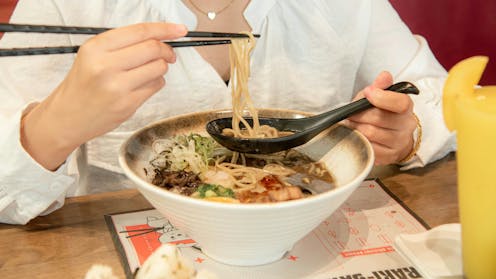
Food prices remain high even as inflation eases, and instant noodles are at the top of the list of cheap options.
More than 100 billion servings of instant ramen are consumed each year, making it one of the world’s most popular convenience foods.
Instant noodles are a global commodity. But when were they invented, and has ramen always been a “struggle meal”?
Read more: Can I eat instant noodles every day? What does it do to my health?
Early origins
Most people attribute ramen’s global popularity to its low price and easy preparation, but a look at the origin story behind the noodles reveals working-class roots and innovative cooking techniques.
In 1910, Ozaki Kan'ichi, a former Japanese customs official, abandoned his career to open a Chinese restaurant in Asakusa, a working-class district in Tokyo. Rai-Rai Ken was the first Chinese restaurant owned by a Japanese national.
Before it was called ramen, thin Chinese wheat noodles in soup were called chūka soba (literally, Chinese noodles). Kan'ichi’s menu featured a soy-flavoured soup with noodles, roast pork, dried seaweed and fish cake. The broth and toppings were new additions to previous versions of Chinese noodle soups served in Japan, making a more substantial meal.

An ancient Chinese technique using alkaline water, kansui, made the noodles curly, chewy and a light yellow colour.
Timing for the new food was perfect, as workers moved away from agriculture in rural areas to urban centres for work, education and training.
Chūka soba became a popular and affordable choice, served from cafes, pushcarts and informal Chinese and Western-style restaurants catering to students and industrial workers at all hours.
Postwar Japan
During World War II, restaurants and food carts (yatai) were prohibited in Japan, in an effort to preserve scarce food resources.
After the war, US forces in Japan enforced rationing and continued the wartime ban on restaurants. To make up for rice shortages, large quantities of US wheat were imported to prevent famine. The food-distribution system, however, was inefficient, insecure and prone to corruption.
Wheat made its way onto the black market, where it was turned into noodles and sold from illegal carts in bombed-out cities.
A Taiwanese immigrant, Momofuku Ando, saw the long lines of hungry people patiently waiting for noodles and was inspired to find a way to invent noodles that would be quick and easy to make at home.

In his autobiography, Ando shared his vision for the future after witnessing postwar hunger:
Peace will come to the world when all its people have enough to eat.
By the 1950s, restrictions on wheat rationing eased and led to a boom in noodles sold from yatai. In the home, rice shortages continued and bread consumption increased out of necessity, although many hoped this was a short-term trend.
There was a gap in the market for a more familiar product that was made from wheat but was as convenient as bread.
Invented in the garden shed
Ando worked in a shed in his back yard, experimenting with an old noodle machine and a wok. After watching his wife make tempura, he saw that deep frying not only cooked the food, it also made water vaporise. He realised this was the key to creating noodles that could cook in only two minutes, but would not get soggy or stale on the shelf.
 Momofuku Ando, photographed at 94 in 2004.
Kazuhiro Nogi/AFP via Getty Images
Momofuku Ando, photographed at 94 in 2004.
Kazuhiro Nogi/AFP via Getty Images
On August 25 1958, Momofoku Ando launched “Instant Cook Chikin Ramen” – referred to as magic ramen in Japan. The noodles were already seasoned and cooked, cutting down on time and labour, but delivering the protein content of bread flour. Ando chose “chikin” as the flagship flavour, as it didn’t raise dietary issues for any religion.
Ando popularised the term “ramen”, another name used in Japan for chuku soba, borrowed from the Chinese word lāmiàn for a type of hand-pulled noodles from the north. Japanese ramen are actually rolled and cut, not pulled, and are modelled after noodles from Guangdong in the south – but the name stuck.
The first instant noodles cost six times more than regular ramen, which took ten minutes to cook and were not flavoured. Prices fell quickly as the instant noodles became popular, and Ando’s Nissin corporation went into large-scale production.
In 1971, instant ramen was packaged in polystyrene cups, making it even more convenient – just add hot water.
Noodles, noodles, everywhere
The cultural importance of instant ramen in Japan cannot be overstated. It was named the most important invention of the 20th century in a poll at the end of 1999.
While there are two museums in Japan dedicated to instant ramen, the appeal is also global. Vietnam has the highest per capita consumption, followed by Korea and Thailand.
Instant noodles are ubiquitous, even behind bars. Ramen packets became a de facto currency in US prisons, replacing cigarettes after smoking bans were introduced in 2004. Budgets cuts at correctional facilities reduced spending on food, making ramen an essential supplement for inmates and a frequent purchase at the prison commissary.
 Specially formulated ramen has even made it to space.
JAXA/NASA, CC BY-NC-SA
Specially formulated ramen has even made it to space.
JAXA/NASA, CC BY-NC-SA
Instant ramen really is available everywhere, even in outer space. “Space Ram” accompanied Japanese astronaut Soichi Noguchi on his 2005 expedition. Naturally, these were a special edition, designed for eating in a zero-gravity environment.
In Thailand, Mama Noodles launched a noodle index in 2005 as an economic barometer, showing how sales increased during tough economic times.
Food prices are still high and the global economy remains uncertain, but at least we can rely on instant ramen remaining an affordable option around the world.
Read more https://theconversation.com/instant-ramen-a-short-history-of-a-long-noodle-263271


