

Expressing strong opinions can put your job at risk. Clearer laws would help
- Written by The Conversation
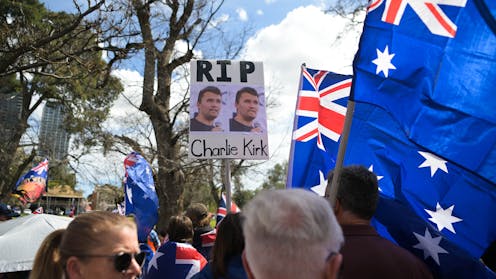
Within days of American conservative Charlie Kirk’s assassination, people posting on social media or commenting on his death – including TV host Jimmy Kimmel, teachers, pilots, a football team employee, and a US Secret Service employee – were being censured, suspended or sacked.
Whether you support or oppose those decisions, it’s striking they occurred in the United States, which has strong constitutional protections for free speech. But even those rights don’t necessarily shield people from workplace consequences when reputational harm or breach of conduct is alleged.
Australians don’t have a constitutional right to free speech. Instead, we rely on a narrow, implied freedom of political communication, which offers limited protection and rarely applies to employment disputes.
Recent high-profile disputes have tested the boundaries of what Australians can say at work and outside it. Think journalist Antoinette Lattouf, rugby player Israel Folau and pianist Jayson Gillham.
Without clearer legal guidance in Australia, disputes over workplace speech — especially on social media — are likely to keep ending up in court.
Lattouf vs the ABC
The Fair Work Act is Australia’s main legislation outlining the rules for employee and employer relationships.
But it offers only limited protection for political opinion. It also lacks a direct or general mechanism for balancing employees’ rights to express personal views with employers’ legitimate interests.
That legal ambiguity has been at the heart of several high-profile cases, most recently a Federal Court decision involving the ABC and Lattouf.
Lattouf was dismissed mid-contract in 2023, after the ABC claimed she breached its social media guidelines and ignored a direction not to post about the conflict in Gaza.
However, in June this year the Federal Court found no such direction had been issued and no actual breach identified. It held her dismissal was unlawful under section 772 of the Fair Work Act, which prohibits termination based on political opinion.
This ruling didn’t break new legal ground. But it was significant for highlighting the fragility of employee protections, when codes of conduct are vague or inconsistently applied.
Other high-profile Australian cases
Lattouf’s case joined a growing list of disputes with a common thread: the lack of consistent standards and guidance on workplace speech.
Israel Folau’s dismissal by Rugby Australia for posting religious views on Instagram sparked national debate on freedom of religion and expression in 2018. His case, settled out of court the following year, left unresolved how far codes of conduct can override statutory protections.
Similarly, pianist Jayson Gillham’s dispute with the Melbourne Symphony Orchestra — centred on political expression during a performance last year — reflects the same tension.
Read more: Who really gets fired over social media posts? We studied hundreds of cases to find out
It’s unclear what ‘political opinion’ even means
Codes of conduct serve legitimate purposes: preventing harassment or discrimination, ensuring impartiality, and managing safety.
But when used to suppress dissent or punish unpopular views, they risk undermining democratic values.

In the Lattouf vs ABC case, Justice Darryl Rangiah pointed out that section 772 of the Fair Work Act reflects Australia’s international human rights obligations – specifically Article 26 of the International Covenant on Civil and Political Rights. It was a reminder that our employment laws don’t exist in a vacuum.
Yet the Fair Work Act does not define “political opinion”, and courts elsewhere have struggled to apply it.
Does it include attending rallies? Sharing memes? Criticising policy? The answer remains unclear.
Legal solutions could clear up confusion
Legislative reform would help.
One option would be to amend the Fair Work Act to define “political opinion” more clearly. This definition could include not just party membership or views on government policy, but also civic participation – such as protests or petitions – and moral or ideological beliefs with political dimensions.
It could also clarify that political expression includes both verbal and non-verbal acts, such as social media posts or peaceful protest attendance.
But definition alone isn’t enough.
Currently, the Fair Work Act offers limited protection. Employers can often justify disciplinary action by pointing to breaches of workplace policy or failure to follow lawful directions, effectively sidestepping the issue of political belief.
Provisions like section 772 of the Fair Work Act offer no clear framework for weighing an employer’s right to protect its reputation and maintain a safe workplace against an employee’s right to express personal views.
A federal Human Rights Act could offer a more robust solution. There’s also a strong case for an independent oversight body — perhaps a Workplace Rights Commissioner or an expanded Fair Work Ombudsman — to offer guidance, mediate disputes early, and help balance the rights of employees with the needs of employers and others affected.
Legal scholars Joellen Riley Munton and Therese MacDermott have proposed expanding the Fair Work Commission’s unfair dismissal and bullying jurisdictions to handle such disputes.
Reform won’t be easy. But unless we want more workplace conflicts playing out in court for years to come, a clearer legal framework is urgently needed — for everyone’s sake.


