

New measles cases in Queensland show ‘herd immunity’ is more important than ever
- Written by The Conversation
The World Health Organization (WHO) declared Australia free of measles in 2014.
Historically, high childhood measles vaccination coverage and thorough follow-up of suspected cases have helped prevent outbreaks.
But in the last six weeks, a growing outbreak in Queensland – along with cases and clusters in Western Australia, Victoria and New South Wales – shows measles can still spread here.
In 2021, no cases were recorded in Australia. But case notifications have continued to climb since, with 57 reported in 2024 and 122 so far in 2025 – and it’s only September. Some of these cases are in children too young to be vaccinated, but most are in adults.
So, what’s going on? Is Australia at risk of losing its herd immunity with lower vaccination rates? Let’s unpack the evidence.
What is herd immunity?
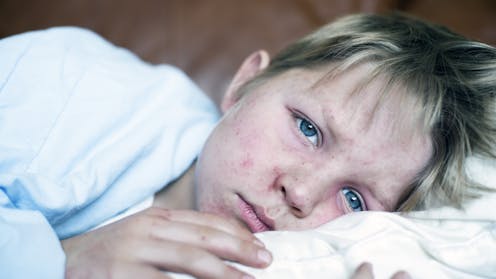
Measles is one of the most contagious human diseases. Symptoms generally include red sore eyes, a runny nose, cough and fever. The distinctive rash usually doesn’t appear until a few days into the illness, meaning the infection may spread to others before measles is suspected.
An unvaccinated person with measles will on average transmit the virus to 12–18 people in a non-immune population. This reproductive rate is six times higher than the original strain of COVID-19.
For this reason, the WHO recommends at least 95% of the total population receive two doses of the measles vaccine in childhood.
This is to create “herd immunity”.
This means a large proportion of the population is immune, either through vaccination or previous infection, protecting the most vulnerable – including those who can’t get vaccinated.
The measles vaccine contains a very weakened form of measles virus. So it can’t be given to people whose immune systems will struggle to contain it, for example, those undergoing chemotherapy.
The measles “herd immunity threshold” is 93–95% in the total population. It is higher for measles than many other diseases because it is so contagious.
If immunity falls below this level, infection may start to spread more widely and large outbreaks can occur.
How do vaccines work in Australia?
Australia has had a nationally funded measles vaccination program since 1972.
The measles vaccine is recommended in two doses, either in combination with mumps and rubella (as MMR vaccine) or with varicella to also prevent chickenpox (the MMRV vaccine).
Under the National Immunisation Program, children get the first dose (MMR) at 12 months and the second (MMRV) at 18 months of age.
Infants as young as six months can safely receive the MMR vaccine for free in certain cases, such as when travelling to countries where measles is occurring.
This currently includes many countries across the world, including in North America and the United Kingdom.
Are vaccination rates going down?
In Australia, immunisation rates in Australia had been increasing prior to the COVID-19 pandemic.
In 2002, the proportion of five year-olds who’d had two doses of the measles vaccine was just 82%. By the time the pandemic arrived, in 2020, this had risen to 96.8% – and was 94% among two year-olds.
However, since 2020 rates of “fully vaccinated” young children – meaning they have had most recommended vaccines – have fallen year on year.
The proportion of two year-olds who’d had two doses of the measles vaccine fell to 93% in 2023.
The timeliness of measles vaccination has also fallen. Around one in three children now get their first dose late. This means more children are at risk of catching measles at a younger age, when the disease tends to be more serious.
These trends are concerning.
In terms of overall herd immunity, the impacts at this stage may be relatively small. But measles immunity gaps are much greater in some parts of Australia, such as the north coast of New South Wales and the Gold Coast in Queensland.
Measles immunity is also lower in some adults, because vaccination rates were lower when they were children. A second dose of measles vaccine was not added to the National Immunisation Program until 1992.
Read more: Why people born between 1966 and 1994 are at greater risk of measles – and what to do about it
Why is coverage dropping?
There is a mix of reasons vaccination coverage has been falling in Australia since the COVID-19 pandemic.
These include an increase in questions about the need for, safety and effectiveness of vaccines.
The enormous rise in false and misleading information can sow doubt about the benefits of recommended vaccines.
Concerns about vaccination should be addressed in a respectful way, making use of accurate and up-to-date information, such as that available on the Sharing Knowledge About Immunisation (SKAI) website.
But we also need to minimise practical barriers to accessing vaccination, such as the cost, or difficulty making or getting an appointment.
To maintain herd immunity, we need to ensure all adults under 60 and children from one year are two dose measles vaccinated.
In Australia, free catch-up measles vaccination is available for anyone born after 1966 who doesn’t have proof of two doses of measles vaccine.
Amid a global resurgence of measles and more cases in travellers, supporting international efforts to boost immunisation rates in all countries is critical. This will further reduce the chance of outbreaks here.
We would like to thank Zoe Croker for assistance in drafting this article.


