

Grattan on Friday: Combatting the neo-Nazis is a ‘wicked problem’ for governments
- Written by The Conversation
When neo-Nazi leader Thomas Sewell appeared last week in a Melbourne court for a bail hearing, after jail time over the attack on an Indigenous camp, his supporters were there in force.
A lawyer in the building at the time reports how intimidating the security staff and others found the very presence of these men, dressed in their signature black clothing.
Earlier this month, footage of about 60 black-clad men outside the New South Wales parliament sent a chill through many Australians, certainly those with a sense of history.
The demonstrators had an anti-semitic banner (Abolish the Jewish Lobby) and chanted the Hitler Youth slogan “blood and honour”.
Among officialdom, the rally has had a galvanising effect. The federal government this week took one of the demonstrators, South African Matthew Gruter, into immigration detention, readying to deport him.
Home Affairs minister Tony Burke says he is having continuous conversations with agencies to ensure federal laws are adequate to deal with the neo-Nazis.
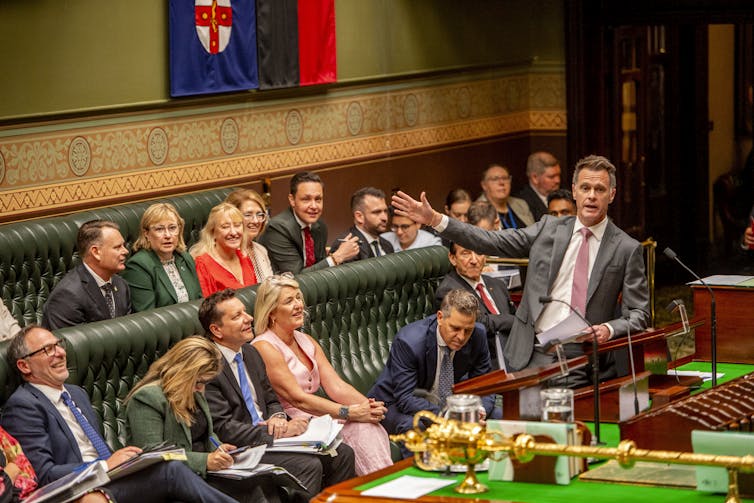
The NSW Labor government introduced legislation “to ban conduct which indicates support for Nazi ideology by invoking imagery or characteristics associated with Nazism”. NSW Attorney-General Michael Daley said in a statement that while the state already banned Nazi symbols, “the disgraceful rally outside the parliament […] highlighted the need to strengthen current laws”.
The move is controversial. NSW Council for Civil Liberties president Timothy Roberts had already said “you do not fight fascists with laws that erode civil liberties”.
In a speech early this month, ASIO boss Mike Burgess highlighted the threat, and challenge, the neo-Nazis are posing.
Burgess said that currently there were “multiple, cascading and intersecting threats” to Australia’s social cohesion. These were “fuelled by three distinct but connected cohorts: the aggrieved, the opportunistic, and the cunning”.
He put the neo-Nazis into the “opportunistic” category, pointing to how they had attempted to leverage the anti-immigration marches.
“The biggest neo-Nazi group, the National Socialist Network – or White Australia as it is rebranding itself – identified the demonstrations as a vehicle to raise its profile,” he said.
“It strategically and opportunistically exploited the organisers’ complaints about immigration and the cost of living.
"This is a key part of the network’s broader strategy to ‘mainstream’ and expand its movement by focussing on issues with broader appeal.”
The growing activities and more prominent presence of the neo-Nazis are raising issues for Australia’s democracy that are out of proportion to their small numbers. Combatting them is complicated, because it tests the interface between societal harm and political rights.
The neo-Nazis are now canvassing the prospect of registering a political party and running candidates for parliament. To register in NSW would require just 750 members, or 1500 to become a party federally.
If the neo-Nazis did get party status it is not impossible they could have a candidate elected to the NSW upper house, or even – a long shot, admittedly – to the Senate.
Assuming the neo-Nazis meet the criteria, any attempt to stop them registering a party would run up against the constitution’s implied right of political communication. As would an attempt to ban them.
Peter Wertheim, co-CEO of the Executive Council of Australian Jewry, says the prospect of neo-Nazis in parliament “spewing their hate under the protection of parliamentary privilege is intolerable. It would put our country on the slippery slope to normalising racism.”
Wertheim proposes giving effect to Australia’s obligation under the International Convention for the Elimination of All Forms of Racial Discrimination “to declare illegal and prohibit organisations which promote and incite racial discrimination”.
But, he says, “any legislative action would need to be framed as a means of regulating or proscribing clearly-defined conduct, rather than specific persons and bodies”.
Rosalind Dixon, professor of law at UNSW, writing in the Sydney Morning Herald this week, argued the electoral registration laws should be revisited to give federal and state electoral commissions “express power to ban parties that espouse racial hate and vilification as founding policies and values”, or else do so through a demonstrated pattern of conduct.
That would likely run into opposition from the electoral commissions. The Australian Electoral Commission is on record as strongly opposed to proposals it should be a watchdog on truth in political advertising.
But Dixon suggests that such powers could be subject to robust judicial oversight, or possibly even given to courts under well-defined legislative criteria. This, she says, would address the concerns about politicisation of the AEC, and ensure that the power was subject to appropriate limits and oversight, necessary to meet constitutional requirements.
Liberal frontbencher Julian Leeser, prominent on Jewish issues, says parliament’s Joint Standing Committee on Electoral Matters should be asked to look at whether it is possible to restrict the neo-Nazis’ political participation. Leeser believes, on the basis of previous High Court cases, that a legal counterweight could be found to the right to political communications.
While the case for banning terrorist groups is obvious, trying to outlaw groups like the neo-Nazis, even if possible, is problematic, however attractive it sounds in theory.
Leaving aside arguments about free speech and association, driving these people underground could be counterproductive, helping them attract supporters and making them harder to track.
The neo-Nazis exploit feelings of alienation among a section of the community. Making martyrs of them could play into their hands.
State and federal laws to deal with hate speech have been strengthened as governments have grappled with threats to social cohesion in the wake of the attack on Israel in October 2023, the ensuing Gaza war, pro-Palestinian demonstrations and encampments, and anti-semitic attacks.
These events have triggered a torrent of hate speech, particularly from the extremists elements among the pro-Palestinian activists.
Trying to stop hate speech turns into an ever-escalating pursuit. While action is desirable, at some point it runs into pushback on grounds of free speech.
Finding ways to curb the presence of extremist groups such as, but not only, the neo-Nazis falls into the category political scientists call “wicked problems” to which there are no simple, direct answers.
It’s understandable to turn to new or strengthened legal remedies and, to an extent, appropriate. But it can only be part of the answer and often comes with unintended or unacceptable consequences.
In the end, these groups may be best countered more indirectly, by vigorously promoting positive measures that advance social cohesion in the community. But unfortunately that’s a long term answer to an immediate problem.


