

Impacts of colonisation on dingoes are ‘written in their bones’, new research finds
- Written by The Conversation
Dingoes are no ordinary dogs. They trace their roots back to an ancient Asian lineage and made their way to Australia more than 3,500 years ago.
Since then, they’ve become integrated into Australian ecosystems. They hold deep cultural meaning for many Indigenous Australians — woven into songlines, ceremonies, and family life, and often regarded as kin.
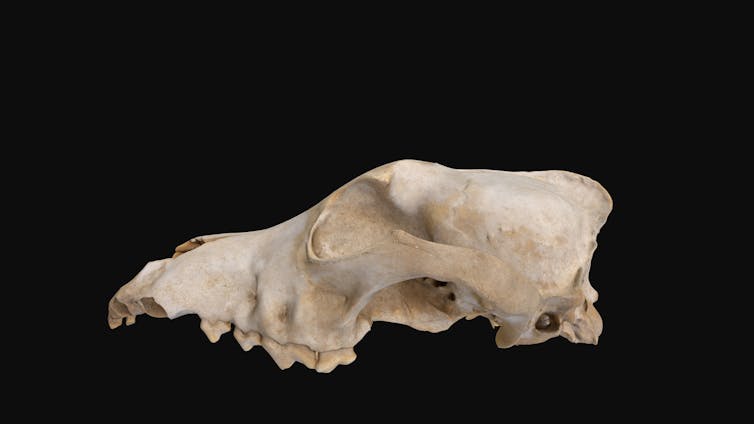
In research published today in PNAS, our team sought to unravel how European colonisation has shaped dingoes over the last two centuries. Like everyone and everything else in Australia when the First Fleet arrived in 1788, dingoes had to adapt to a new reality – and that adaptation is written in their bones.
Colonial conflict with dingoes
The arrival of Europeans in Australia irrevocably changed Indigenous communities, ecosystems and the continent’s apex predator, the dingo. With the First Fleet came livestock and many European dogs including greyhounds, terriers and spaniels.
During the past 237 years, public attitudes to dingoes have been shaped by the creatures’ conflict with livestock. Trapping, shooting, bounties and poison baiting have become commonplace.

Some have been concerned that interbreeding between dingoes and European dogs may lead to dingoes losing their unique identity.
However, recent DNA studies have suggested such interbreeding is uncommon, at least in the modern era.
But the extent of the historic genetic influence of dogs on dingoes has still been unclear.
Analysing ancient tissue
For our new research, we used a combination of stable isotope and ancient DNA analysis of pre-1788 and post-1788 dingoes from the Nullarbor Plain in Western Australia. Stable isotope analysis looks at the chemicals found in once-living tissues to determine diet and environmental conditions.
We also compared the genomes of modern dingoes to these historic baselines to uncover the timing and extent of gene flow from modern dogs into dingoes.
Our analysis showed changes in the chemical signatures (carbon and nitrogen) of Nullarbor dingo bones post-1788. This suggests dingo diets diets changed after European arrival.
Europeans managed the landscape in completely new ways. They introduced sheep, cattle and rabbits. By killing dingoes Europeans facilitated the eruption of kangaroo numbers. This altered the native vegetation and changed which prey animals were available for dingoes to hunt.
Maintaining a distinctive identity
With pre-1788 dingoes as a baseline we can detect the presence of historic European dog DNA in many modern dingo populations, particularly in southeastern Australia.
However, little European dog DNA is detected in dingoes from central and western Australia. Despite historic hybridisation, dingoes have maintained their distinctive identity.
We found that gene flow from European dogs into dingoes peaked during the mid 20th century (1960s to 1980s). We can tell this from the length of the DNA fragments inherited, with modern dingoes carrying many small chunks of historic European dog DNA rather than long stretches.
Many dingoes have had no dog ancestors in the last 10 generations (roughly five years per generation). The timing of gene flow into dingoes coincided with the intensification of large-scale dingo culling programs.
These programs may have increased opportunities for breeding between dingoes and dogs by breaking down dingo social structures and reducing the availability of dingo mates.
Overcoming inbreeding
We found that pre-1788 dingoes had high levels of inbreeding, which reflects long-term isolation and a small founding population.
After 1788, the fragments of European dog DNA present in many dingoes were important sources of genetic diversity. This extra DNA variation may be helping dingoes to overcome inbreeding.
We also found evidence that positive selection is acting to retain these fragments of European dog DNA in dingo populations. This could explain why European dog DNA is persisting through so many generations.
While gene flow between species is typically considered detrimental, we now understand that gene flow can help species adapt to challenges and changing environments.
For example, in areas with low winter snow the local snowshoe hares have gained a brown winter coat as a result of gene flow from jackrabbits.
Dingo management is divisive
Dingoes are a serious threat to livestock such as sheep. But they play an important role in maintaining healthy ecosystems and are deeply valued by many Aboriginal peoples.
Lethal control of wildlife often comes with unintended consequences. For example, reducing dingo numbers could increase the risk of hybridisation with domestic dogs, as it does with wolves and coyotes in North America.
Studies have also shown ecosystems without dingoes are less resilient. These ecosystems are also characterised by shifts in vegetation due to an increase in plant consumption and a loss of small prey species.
Our findings challenge the idea that hybridisation is negative. Historical gene flow may provide the genetic variability for dingoes to overcome inbreeding and meet the challenge of changing Australian environments.

There is a complex interplay between historic inbreeding, gene flow from dogs and the consequences of culling. Establishing historic baselines is crucial to disentangling complex evolutionary histories and informing conservation policy in a world where hybridisation is an increasingly common occurrence.
Australian policy makers should prioritise maintaining large and connected dingo populations. This will allow evolutionary forces to get rid of unhelpful European dog DNA variants while retaining beneficial diversity.
More broadly, conservation must move move beyond simplistic notions of “purity”. Worldwide, hybridisation is a growing conservation threat. But it can also be a critical tool for threatened species recovery.
Many wild canids – wolves, coyotes and jackals – have experienced gene flow from dogs. Importantly for dingoes, despite some historic gene flow, they remain ecologically and genetically distinct from dogs – as they have been since before European colonisation.


