

NZ’s rejection of emission targets fuels risk of international law breach
- Written by The Conversation
The New Zealand government’s decision this week to reject all of the Climate Change Commission’s emission target recommendations was just the latest in a string of policy statements that weaken the country’s action on climate.
Collectively, the current climate policy settings raise three important (and not hypothetical) questions.
Does weakening domestic action on climate change risk New Zealand being found in breach of international law? Yes.
Could other states take legal action against New Zealand for failing to comply with its international obligations? Yes.
Does a failure to comply with those obligations undermine New Zealand’s commitment to the international rules-based order? Yes.
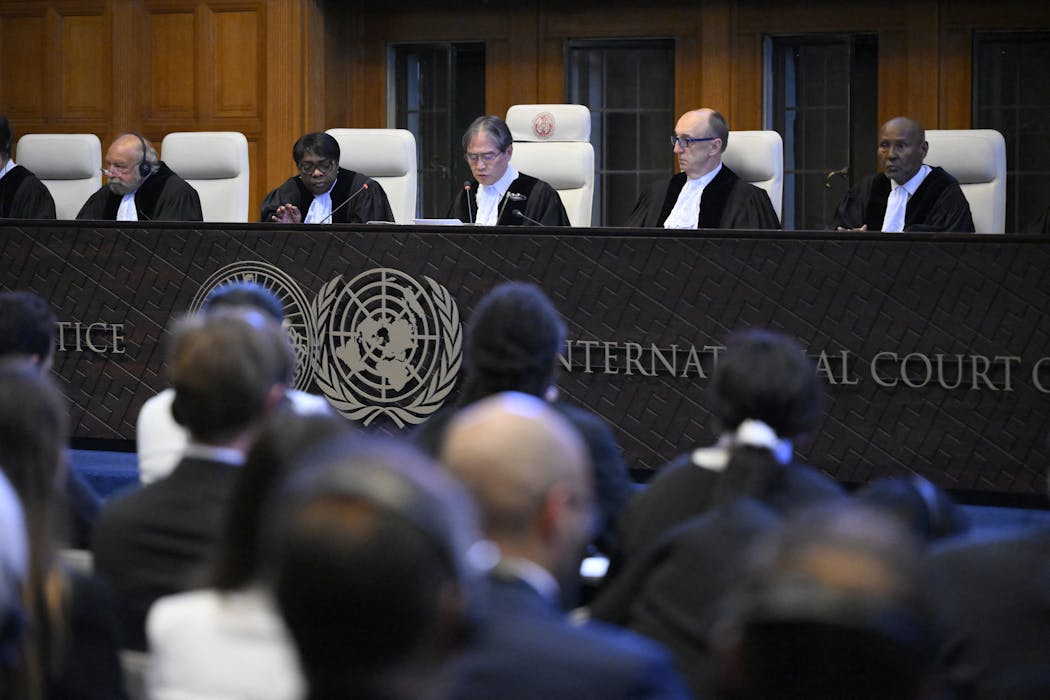
At the centre of this sits the landmark advisory opinion issued by the International Court of Justice In July. This set out clearly and authoritatively the obligations on states to address climate change, and the rights of other states to take legal action against those that don’t live up to their commitments.
While the opinion is not itself legally binding, the legal obligations identified by the court are – on all states, including New Zealand.
Climate climb-downs
As well as the most recent decision to reject the Climate Change Commission’s emissions target recommendations, the government has also:
What international law says
While the International Court of Justice’s advisory opinion is complex, five legal findings are particularly significant.
New Zealand must contribute to efforts to limit global temperature rise to no more than 1.5°C above pre-industrial levels. This replaces the target of “below 2°C” as set out in the Paris Agreement, and reflects science-based consensus and subsequent practice and decisions since 2015.
New Zealand’s Nationally Determined Contribution emissions target is legally binding. It must reflect the “highest possible ambition” and be developed to “achieve the object and purposes” of the Paris Agreement and the 1992 United Nations Framework Convention on Climate Change (UNFCCC). It must be prepared with “stringent due diligence”. New Zealand has an “active obligation” to pursue scientific information; the more certain the information is, the more stringent the level of obligation.
New Zealand’s domestic measures to implement its NDC target can be independently assessed on the basis of its “stringent due diligence” obligation. Those measures must address production and consumption activities (including fossil fuel production) and apply to private actors under the jurisdiction or control of New Zealand.
As well as its commitments under the UNFCCC regime, New Zealand has obligations to address climate change under the law of the sea, biodiversity law, human rights law and customary international law (legal principles derived from state practice). Even if New Zealand takes action to comply with its obligations under the Paris Agreement, this may not be enough to comply with its customary duty to prevent significant harm to the environment or to cooperate to address climate change.
Any state may bring legal proceedings against New Zealand for failing to comply with climate change obligations under the general rules of “state responsibility”. They will need to prove New Zealand failed to comply with a treaty or customary obligation. They will not need to prove such a breach of international law caused actual harm in order to hold New Zealand responsible (although a causal link would need to be established if that state demands reparation).
Undermining the rules-based order
New Zealand cannot simply ignore these obligations. They must be considered in the development of policy, the adoption of domestic climate change measures and by the courts if cases are brought against the government.
Legal action, while complex, could be brought by states unhappy with New Zealand’s lack of meaningful climate action, including Pacific Island states such as Palau, which recently criticised the lowering of methane targets.
It is hard to see how the recent policy announcements meet the standards of “highest level of ambition” and “stringent due diligence”.
More generally, however, New Zealand risks undermining the international rules-based order it relies on by framing those obligations as being merely about making “best efforts”.
The rules-based order is like a game of Jenga. The rules, including obligations to address climate change, are the building blocks. While some states are overtly taking a wrecking ball to the tower, others are undermining it by ignoring those rules, essentially removing individual blocks.
But small states need that tower to remain intact. Supporting the international rules-based order by complying with its climate obligations would allow New Zealand to show leadership when it is most needed.


