

Ancient African bedrock reveals the violent beginnings of life on our blue planet
- Written by The Conversation
You have probably seen the images of the surface of Mars, beamed back by NASA’s rovers. What if there were a time machine capable of roaming Earth during its remote geological past, perhaps even going right back to its beginnings, beaming back pictures of similar quality?
This is not science fiction. In remote corners of the world, geologists have found tiny relics of Earth’s very ancient surface.
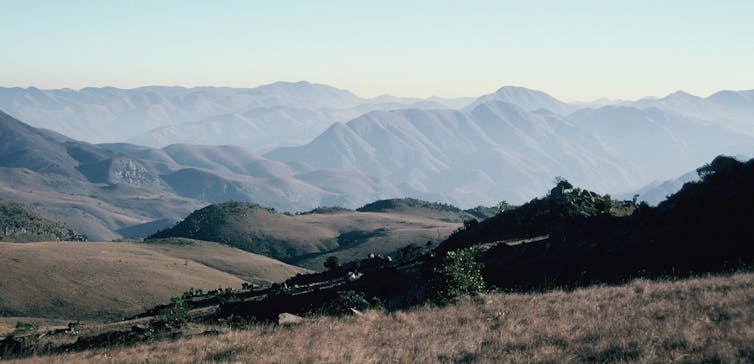
I have been part of this scientific endeavour, looking at the treasure trove of information in the bedrock of the Makhonjwa Mountains in South Africa and the adjacent small kingdom of Eswatini.
These rocks reach back more than three quarters of the way through our planet’s long history of nearly 4.6 billion years. In my new book, The Oldest Rocks on Earth, I describe the graphic images “beamed back” by this geological time machine.
World of oceans
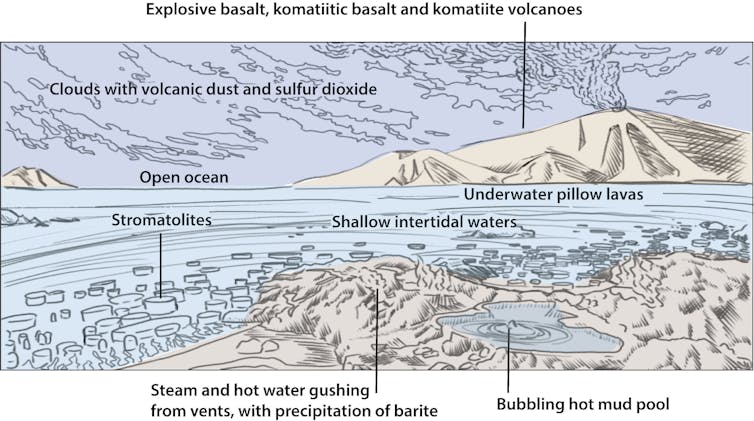
The ancient rocks reveal a world with extensive oceans and intense volcanic activity on the sea floor.
Deep beneath the crust, Earth was much hotter than today, giving rise to an unusual white-hot magma, rich in elements from its interior. Huge volumes of super-heated water continually gushed out of underwater cracks, building up chimneys of valuable metals. And life was thriving around these undersea vents.
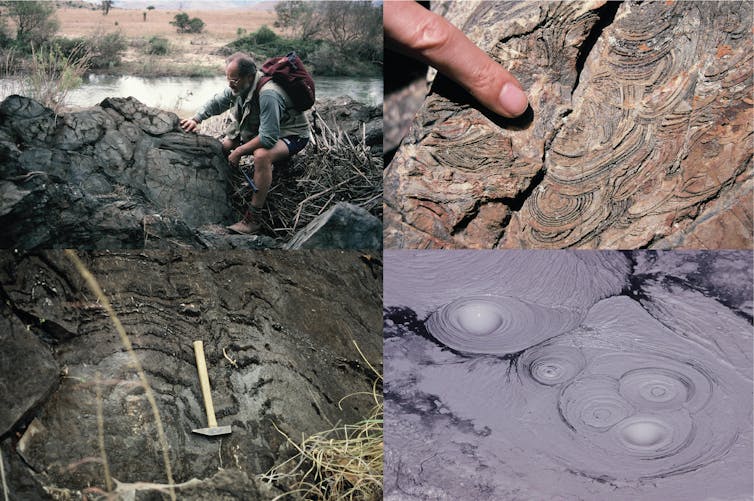
Volcanic islands rose up from the ocean depths. These were dangerous places. Pools of hot bubbling mud dotted their shores, and clouds of volcanic ash periodically exploded from volcanic craters.
Life was already there, forming microbial mats in the sheltered nearshore waters.
Periodically, large earthquakes violently shook the bedrock, triggering submarine avalanches that cascaded down into the deep ocean, creating vast jumbles of rock on the sea floor. Giant asteroid impacts disturbed this world, but crucially, did not extinguish it.
Deep-seated forces were pushing up new land, creating the early continents.
Ocean waves moved back and forth on sandy beaches along coastlines with bays, lagoons, inlets and estuaries, with tides similar to those today.
During floods, large rivers brought muddy water from the continental interior. Farther in the distance, their headwaters drained a mountainous terrain, often enveloped in thick cloud.
It was a blue planet because, like today, the oceans scattered light in the blue part of the colour spectrum.
But the atmosphere contained a lethal cocktail of gases, including high concentrations of methane and carbon dioxide. These greenhouse gases kept the surface at the right temperature for liquid water, at a time when astrophysicists calculate the Sun was much weaker. But there was no oxygen.
The earliest life forms were anaerobic microbes, although brightly coloured – pink or purple have been proposed.
Oceania today
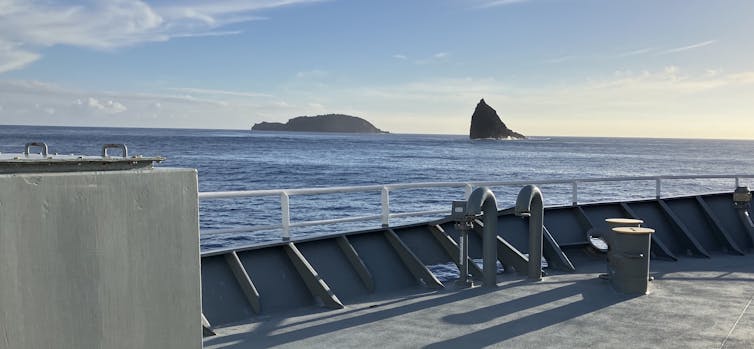
Oceania, in the southwestern Pacific, may illustrate best what this early world was like. Here, the ocean is peppered with volcanic islands and small continents, rocked by great earthquakes where tectonic plates rub against each other. There are even clues to how life began.
The 2022 eruption of the Hunga volcano, near Tonga, created a mushroom cloud of ash that burst out of the ocean and reached up into space with an estimated energy of a 60-megaton atomic bomb. It generated more than 200,000 lightning strikes and left behind a deep underwater crater filled with a chemical soup derived from numerous underwater hot vents.
Experiments show that lightning strikes can trigger the synthesis of basic organic molecules needed by living organisms. Millions of Hunga-like eruptions on early Earth would have created myriad opportunities to kick start the chemistry of life in underwater volcanic craters – life was born out of extreme geological violence.
Staying blue
Going back in time beyond the Makhonjwa Mountains, we still find evidence for oceans, life and, I argue, plate tectonics. Earth became blue within the first tenth of its history.
Mars and Venus may have started this way, too. But our planet uniquely lies in the so-called Goldilocks Zone, receiving just the right amount of solar energy to avoid becoming a boiling Venusian hell or freezing Martian world.
It is also big enough to have a magnetic field and pull of gravity sufficient to retain its atmosphere. And right at the start, a dramatic collision with a Mars-sized asteroid spalled off our Moon, stabilising Earth’s spin axis so that day and night were less extreme.
Finally, the biochemistry of living organisms may have played a key role in keeping Earth this way by helping the bedrock absorb greenhouse gases in the face of a steadily warming Sun.
We must not be the first to let Earth lose its distinctive life-giving blue, a colour so wonderfully referred to in the Siswati language of Eswatini as luhlata lwesibhakabhaka, literally “green like the sky”.


