

Equivalent to 1,800 tonnes of TNT: what we now know about the meteor that lit up the daytime sky above New Zealand
- Written by The Conversation
Meteorites hit New Zealand three or four times a year, but the fireball that shot across the sky above Cook Strait last week was unusual.
It had the explosive power of 1,800 tonnes of TNT and was captured from space by US satellites. It set off a sonic boom heard throughout the southern parts of the North Island.
Witnesses described a “giant bright orange fireball” and a flash that left a “trail of smoke that hung around for a few minutes”.
The fireball was most likely caused by a small meteor, up to a few metres in diameter, traversing Earth’s atmosphere. It was one of only five impacts of greater than a thousand tonnes of energy globally in the past year. Most meteors are tiny, creating “shooting stars” that only briefly skim the atmosphere.
The fragmentation of the meteor produced a shock wave strong enough to be picked up by GeoNet, a network of earthquake seismometers, with a flash bright enough to be recorded by a global lightning-tracking satellite. The Metservice’s Wellington radar picked up the leftover smoke trail south of the tip of the North Island.
But what is the chance of finding any of the its fragments, or meteorites, that dropped to Earth?
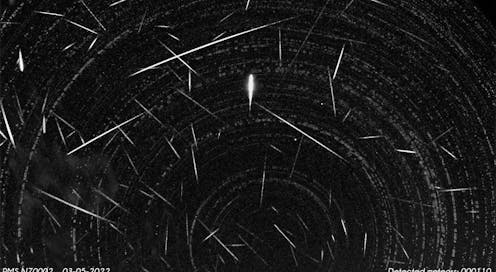
As part of Fireballs Aotearoa, a recently established collaboration between the universities of Otago and Canterbury and the astronomy community to track down freshly fallen meteorites, we are deploying specialised night-sky meteor cameras across New Zealand.
Fireballs Aotearoa’s meteor cameras only operate at night, but the compiled witness reports reveal the July 7 fireball travelled from northwest to southeast and most likely fragmented over the ocean. Unfortunately, any meteorites are therefore probably inaccessible.
Meteorites on Earth
Earth mainly gets meteorites from the asteroid belt, the Moon and Mars. They range from those only visible with a microscope to gigantic ones, such as the roughly 10km-wide meteorite that triggered the extinction of dinosaurs 65 million years ago.
Meteorites are scientific goldmines. Some contain material from before the Sun formed. Others tell us about the history of the young Sun’s planet-forming disk, when dust circulating around it began to clump into larger rocks and, eventually, planets.
Lunar meteorites show the Moon originated from the collision of a small planet with Earth. Martian meteorites tell us about the surface and interior of our closest planet. We don’t even need to send a spaceship.
If a meteor is recorded by several night-sky cameras, then its trajectory can be calculated and any resulting meteorites potentially located. The trajectory also tells us the meteor’s pre-impact orbit, allowing us to estimate where in the Solar System it originated.
How to help find a meteorite
New Zealand has nine known meteorites. Although the fireball wasn’t seen, the most recent was the Auckland meteorite that crashed through an Ellerslie roof in 2003. Our analysis shows this rock belongs to the ordinary chondrite group and therefore was part of a small asteroid only slightly younger than the Sun.
Last year, the British citizen-led fireball network UKFall captured footage of an enormous fireball over southern England. The debris was located on a driveway in Winchcombe, Gloucestershire – where the owner initially assumed someone had emptied their barbecue.
Now on display in the Natural History Museum in London, the Winchcombe meteorite turned out to be a type incredibly rare on Earth.
It is similar to the 5g of material returned in 2020 from asteroid Ryugu by the Hayabusa 2 spacecraft, except the meteorite gave scientists a hundred times as much to work with.
Read more: What are asteroids made of? A sample returned to Earth reveals the Solar System's building blocks
Although the Wellington fireball on July 7 probably didn’t drop a meteorite on land, the next one might. And you can join the meteorite hunt by reporting any sightings to Fireballs Aotearoa.
We would like to acknowledge Jim Rowe and Jeremy Taylor, our colleagues at Fireballs Aotearoa, for help with compiling this article.


