

Uncanny, curious and awesome: an expert in psychology breaks down what we feel in the face of Ron Mueck’s sculptures
- Written by The Conversation
I recently experienced Ron Mueck: Encounter at the Art Gallery of New South Wales. I have no training in art appreciation or history, and I went with minimal prior knowledge about Mueck’s work or the pieces in the exhibit.
I had, however, heard his works are psychologically evocative. So I approached the experience with an open mind, and a social psychologist’s inquisitiveness.
If I had to choose three words to capture my naive experience, they would be uncanny, curious and awesome. I’ll explain.
Uncanny
The most dominant feature of my experience was a deep sense of uncanniness.
The uncanny valley is the point where the normally positive linear relationship between how human-like a robot is, and how familiar and likable it is, dissolves. Robots in the uncanny valley are perceived as creepy and eerie, and elicit repulsion instead of attraction.

The concept also applies to art. Many of Mueck’s works are uncanny. His sculptures are superbly realistic. The wrinkles at an elbow. The whites of the toenails. The curve of a nose.
But Mueck also plays with features that undermine realism, tipping into hyperrealism. Many pieces are too large, or too small, to actually be human. The viewer’s mind is trapped: how can the sculpture seem so real but also be so obviously not real?

My visceral reaction to Dark Place, a large 1.4 metre face of a man with a menacing expression, epitomises the uncanny valley. Just as soon as I stepped into the darkened viewing area, I backed away quickly, saying “nope!” (hopefully quietly) to myself. Yes, I knew he wasn’t real. But he felt so real. I was, he was, we were in the uncanny valley.
One explanation for the uncanny valley is “violated expectations” where a human replica seems real – but the realisation it’s not brings about a sense of unease.
At first glimpse, it wouldn’t be implausible that Ghost, a woman in a swimsuit leaning against a wall, would turn her head, push off the wall and walk away. But of course she can’t – she’s not real. Uncanny.
 Ron Mueck Ghost 1998/2014, mixed media, 202 × 65 × 99 cm, YAGEO Foundation Collection, Taipei.
© Ron Mueck, photo: Alex Delfanne
Other explanations of the uncanny valley call on mind perception, whereby human mental capacities are attributed or denied to entities in the world. Human replicas such as artworks don’t have the capacity to think and feel as humans do – but are often depicted as being able to do so.
Mueck’s faces invite the viewer to contemplate what’s being thought or felt. A poignant example of this is Spooning Couple, featuring a couple in bed. The pair’s body positions are telling – including the man’s arm tucked at his chest rather than over his partner’s body, and the slight gap between them. But their contemplative faces present a depth of thought that is – without a better word – uncanny.
 Ron Mueck, Spooning Couple 2005, edition 1/1, mixed media, 14 x 65 x 35 cm.
Collection Glenn and Amanda Fuhrman NY, image courtesy the FLAG Art Foundation
Based on all of this, you might surmise I didn’t enjoy the exhibit. But, esthetic experience is multidimensional. It wasn’t all eerie, aversive uncanniness.
Curious
Most notably, I experienced moments of acute curiosity, the emotional experience of wanting to fill a gap of the unknown.
Mueck’s work drives the audience to wonder why he made the decisions he did. This is perhaps most pronounced in Young Couple, which depicts a pair of adolescents standing next to one another. Intriguing even from the front, my curiosity was spiked on walking around the back and seeing the acute angle and tightness of their held hands.
 Installation view of the Ron Mueck: Encounter exhibition, featuring Young Couple 2013, YAGEO Foundation Collection, Taipei.
© Ron Mueck, photo © Art Gallery of New South Wales, Felicity Jenkins
My reaction was instant: what is happening here? A moment of reproach? Conflict? Possession? There’s no way to know.
Other curious choices peppered the exhibit. The consistent flat-footedness of Mueck’s figures. The odd selection of non-humans included a chicken, dogs, a pig. The juxtaposition of solo statues and pairs of people with a large group of oversize growling dogs.
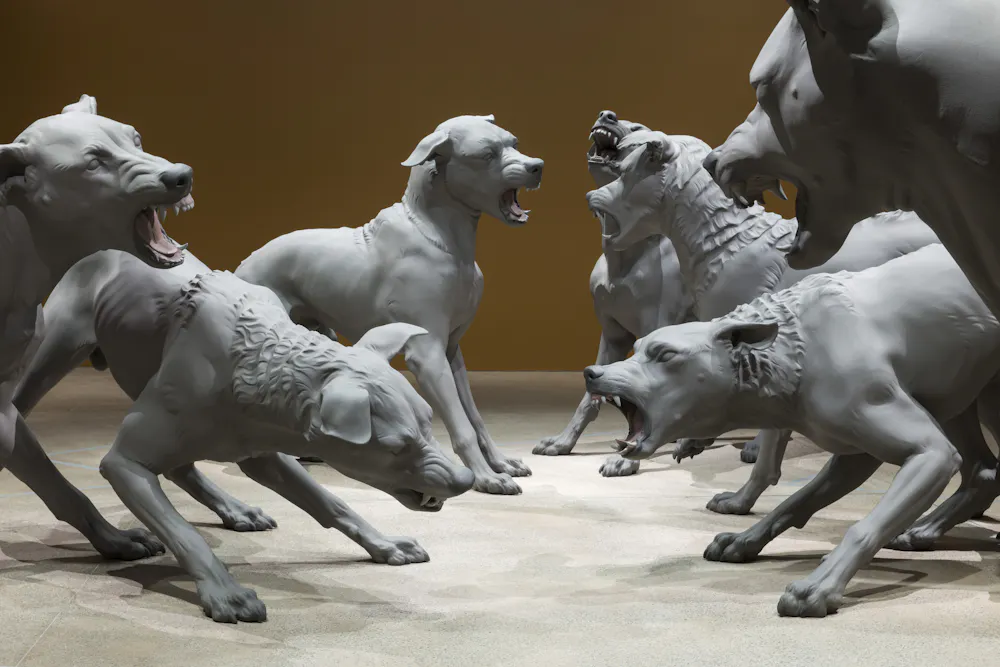 Installation view of the Ron Mueck: Encounter exhibition, featuring Havoc 2025, courtesy the artist and Thaddeus Ropac, London – Paris – Salzburg – Seoul – Milan.
© Ron Mueck, photo © Art Gallery of New South Wales, Anna Kucera
Unfulfilled curiosity can sometimes be frustrating. At the exhibit, though, sitting with the questions was satisfying. One point of art, it seems, is to raise more questions than answer them. In this, Mueck has succeeded.
Awesome
Rounding out the trio of characteristics of my experience is awe: the emotion experienced when we witness something outside our understanding, often vast or complex. The experience is wonder and amazement.
Mueck’s works dance in the space between possible and impossible, just beyond the line of comprehension. I lost count of how many times I thought in wonder, “How did he do that?”
It’s unfathomable to me that someone can create something so very lifelike and evocative. To consider the skill required to produce his pieces was a process of expanding my own mind.
 Installation view of the Ron Mueck: Encounter exhibition, featuring Couple Under an Umbrella 2013, Giverny Capital Collection.
© Ron Mueck, photo © Art Gallery of New South Wales, Felicity Jenkins
Speaking now as a positive emotion researcher, I think the key to the impact of Encounter rests in what we know about the outcomes of experiencing awe.
This unique emotion shifts the way we think about the world, creating what’s been coined the “small self effect”. In awe, we feel smaller in relation to the world around us. This change in perspective is powerful. It prompts curiosity and critical thinking. Awe also drives a desire for social connection, a sense of satisfaction with life and generosity.
By evoking awe, Mueck is shifting the way people see and interact with their worlds. That is powerful indeed.
Ron Mueck: Encounter is at the Art Gallery of New South Wales until April 12.


