

They escaped appalling conditions in scam factories. Now, they are living on the streets in Cambodia
- Written by The Conversation
“I was running from the war, and I got to a war again.” This is how Eric, a young man from central Africa, described how he ended up at a scam compound in Cambodia – and then stranded in the country with no way out.
Eric’s story is like that of many people deceived into the scamming world. After fleeing conflict in his home country and living in extreme deprivation, Eric received an email offering a US$2,000 (A$2,800) monthly job in Cambodia. The recruiter quickly persuaded him to accept. (We are using a pseudonym and not disclosing his country of origin to protect him.)
Upon arriving in Phnom Penh late last year, he was taken directly from the airport to a notorious scam compound near the Thai border, where he was forced to defraud people through online scams.
When he tried to warn one of his targets that he was being scammed, the managers found out and savagely beat him to the point he thought he might die. In the following weeks, he witnessed others being severely abused and the disappearance of co-workers. One jumped from a window in an apparent suicide and was never seen again.
A month later, Eric managed to escape when the Thai military began bombing Cambodia in a skirmish over their shared border. His freedom was short-lived, though. He was re-trafficked to another compound and spent another month in captivity before finally fleeing in mid-January.
Government crackdown
Eric is now stranded in Cambodia, along with thousands of other foreigners who were freed from scam compounds in recent weeks as rumours spread of a massive government crackdown on the industry.
The crackdown began last month after the arrest of Chinese tycoon Chen Zhi, whom the US Justice Department called “the mastermind behind a sprawling cyberfraud empire”.
Chen’s arrest added to growing international pressure on Cambodia to finally confront its role in the booming online scam industry, which brings in billions of dollars a year in illicit revenue and has seen hundreds of thousands of workers trafficked into appalling “scam factories” in Southeast Asia and beyond.
Cambodian authorities have raided compounds before, but these operations have been limited and appeared mainly tokenistic.
The recent crackdown felt different – much broader in scope. Multiple compounds suddenly opened their doors to let people out in January, and a prominent Cambodian businessman linked to the industry and several high-ranking Cambodian officials were arrested.
Stuck in limbo
The mass exodus of workers from the compounds, many of whom lack passports, money or anywhere to go, has now led to what Amnesty International is calling a “growing humanitarian crisis”.
Two of us (Ling and Ivan) were in Cambodia to monitor scam compounds when the crackdown occurred. We saw desperate people without documents queuing in front of their embassies in Phnom Penh, trying to get help to return home.
The Indonesian embassy said more than 3,400 people have sought consular assistance. Based on our conversations with embassy officials, Uganda and Ghana have about 300 stranded nationals each, and Kenya has more than 200.
Read more: Scam Factories: the inside story of Southeast Asia’s brutal fraud compounds
The Chinese and Indonesian embassies have managed to convince the Cambodian government to move their citizens into facilities while they await deportation. Kenya has obtained a waiver of any fines their citizens may face for lacking documents or overstaying their visas and stranded Kenyans are now scrambling to raise funds to pay for their flights.
Survivors from other countries, however, have been stonewalled by the Cambodian bureaucracy.
Most of the Africans we met are in dire situations. They are from countries without diplomatic representation in Cambodia and have been turned away from international agencies and their local partners because of purported “resource constraints” and limitations imposed by local regulations.
Many survivors have pooled their resources to rent rooms in guesthouses that accept undocumented people, while others are being forced to sleep on the streets or rely on the charity of good samaritans. Many live in fear of arrest because the police are conducting inspections of homes and hotels to check people’s documentation.
Eric is one of the relatively fortunate who have secured temporary shelter, but his future remains deeply uncertain. He has no passport, no family and no country to return to. When asked about his hopes, he says simply he wants a place where he can start over – it doesn’t matter where. He is also desperate to start searching for his family back home. He doesn’t even know if they are still alive.
End of an industry?
Cambodian officials have framed the operations as a decisive break with the past. They have vowed to eradicate the powerful online scam networks in the country by April.
However, it’s unclear if the raids signal a sustained policy shift or are a temporary response to heightened diplomatic scrutiny. Although this is the most comprehensive action Cambodia has taken to date, it is far from the first time the government has cracked down. The industry has always survived.
Empty compounds remain guarded, but we managed to visit one since the crackdown. While the computers, cameras and other items have largely been removed, the physical infrastructure remains intact and ready to be reactivated.
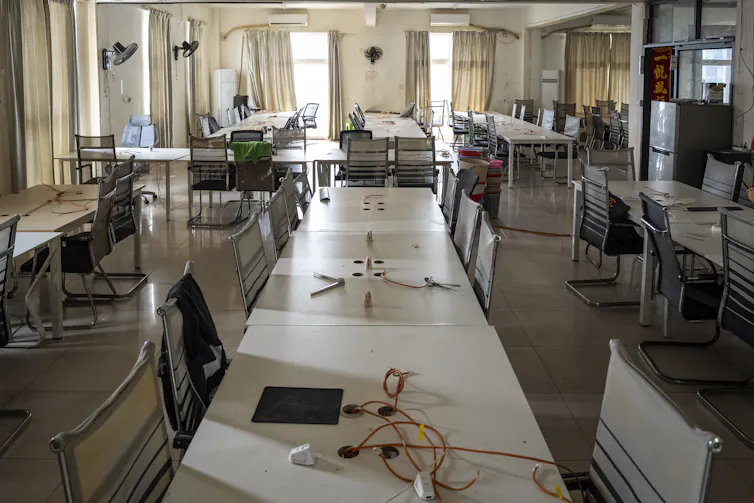
And pockets of the industry remain active. Based on our monitoring of Telegram groups used by scammers and conversations with industry insiders, many are still operating in areas such as Koh Kong and Poipet.
Moreover, scam groups are continuing to recruit workers trapped inside the country. Many of the stranded victims have told us of being approached with job offers, presented as an easy way to earn enough money for a flight home.
Job advertisements are also circulating on Telegram, targeting these same individuals with purported “opportunities” at precisely the moment when they are most vulnerable. Many have endured severe abuse and are in urgent need of psychological support.
So far, the survivors’ appeals to the international community have largely gone unanswered. Without a timely and coordinated intervention to help them, the outlook is bleak, and the advantage will once again lie with the scammers.


