

Make Japan strong again: Sanae Takaichi’s plan to transform her country’s military
- Written by The Conversation
Japanese Prime Minister Sanae Takaichi and her ruling Liberal Democratic Party (LDP) got a historic landslide victory in last week’s parliamentary elections.
This marks the first time since its founding in 1955 that the conservative LDP controls a two-thirds supermajority in the lower house. If necessary, Takaichi’s cabinet could also overrule any opposition in the upper house of the Diet (Japan’s parliament), where her coalition still lacks a majority.
Given this, Takaichi now has a massive mandate to push her agenda. This includes boosting defence spending, strengthening the military and even potentially revising Japan’s pacifist constitution, which constrains the role of the Self-Defence Forces and forbids going to war.
So, does this mean Japan could become a more militarised state under Takaichi? And if so, what are the implications for regional security?
Countering China’s rise
Takaichi has portrayed herself as Japan’s Margaret Thatcher and the standard-bearer of former Prime Minister Shinzo Abe’s legacy.
Abe, who led the LDP back to power in 2012, had pledged to “restore a strong Japan”. During his eight-year rule, Japan adopted a so-called “proactive pacifism”. Under this new security strategy, Japan began to depart from its postwar pacifism through a number of ways:
- strengthening the military
- lifting bans on arms exports
- building new security partnerships (including with NATO, the European Union and the Quad)
- consolidating its alliance with the United States.
In 2014, a new interpretation of the constitution also permitted Japan to engage in “collective self defence”, or aid an ally under attack.
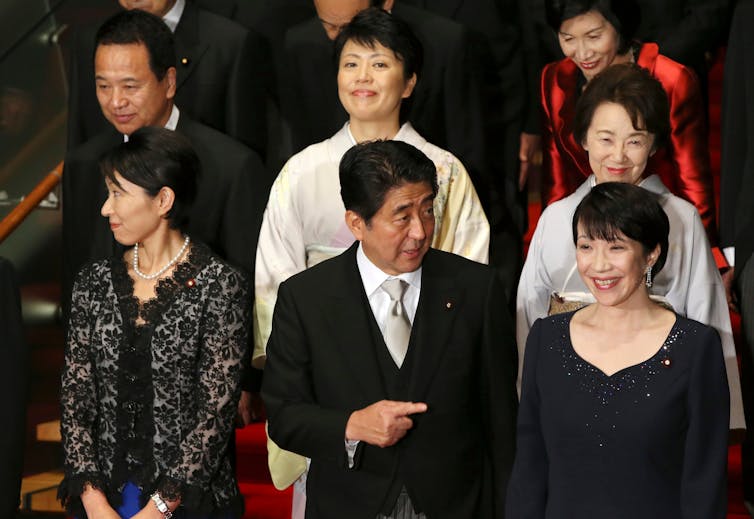
Takaichi now sees her job as continuing Abe’s work. And her direction is clear.
Shortly after becoming prime minister last year, Takaichi triggered a spat with Beijing when she suggested Japan would come to Taiwan’s defence if it was attacked by China. Beijing retaliated with economic pressure and coercive rhetoric, but Takaichi refused to back down.
Neither Takaichi nor China’s leader, Xi Jinping, are in a hurry to improve diplomatic relations.
Beijing has urged Chinese tourists not to travel to Japan and warned that Takaichi’s moves threaten regional security and the international order.
Takaichi, meanwhile, is hoping an assertive China will help her overcome domestic opposition to her security agenda. So far, the public supports her government, too. In a poll after the election, 69% approved of her cabinet’s performance.
How Takaichi wants to transform Japan’s military
Takaichi’s government will soon begin work on a revision of its National Security Strategy from 2022. It is likely to adopt her declared “crisis management” approach, combining security and economic objectives with industrial policy.
Despite mounting public debt, Takaichi has already increased defence spending to 2% of Japan’s GDP ahead of schedule, and has pledged to spend more.
Her government is also considering acquiring nuclear submarines and has announced plans to further deregulate arms exports, ultimately allowing the transfer of lethal weapons.
Japan has already permitted the export of Patriot PAC-3 air defence missile systems to the United States to replenish stocks sent to Ukraine and Israel. Japan has also agreed to sell Mogami-class frigates to Australia and has signed deals with Italy and the United Kingdom to co-develop a next-generation fighter jet.
In addition, Japan is participating in a NATO-led initiative to supply Ukraine with military equipment. While Japan’s involvement is limited to non-lethal arms, this could lead to more defence cooperation with NATO overall.
On the domestic intelligence front, Takaichi has pledged to pass a new anti-spy law, establish a National Intelligence Bureau modelled on the Central Intelligence Agency (CIA) and issue a national intelligence strategy.
These initiatives are intended to bolster the country’s intelligence capabilities, which have often been hindered by bureaucratic infighting. The long-term aim is eventually joining the “Five Eyes” network.
Stronger ties with the Trump administration
Faced with threats from China, North Korea and Russia, Japan has little choice but to maintain its security alliance with the US.
At the top of Takaichi’s agenda, therefore, is managing the US–Japan alliance in the era of the so-called “Donroe doctrine”. This is Trump’s new security strategy that shifts the focus of US security towards the Western hemisphere, potentially distracting from the Indo-Pacific.
Trump endorsed Takaichi during her election campaign. And when she goes to Washington on March 19, she will likely attempt to influence the White House’s China agenda before Trump visits Beijing in April.
In order to offset the potential impact of a trade deal between the US and China, Takaichi could also use her new political capital to accelerate the implementation of Japan’s own US$550 billion (A$777 billion) investment pledge in the US.
Big challenges ahead
Ten years ago, Angela Merkel, then-chancellor of Germany, was hailed as the “new leader of the free world”. Now, Takaichi is being celebrated as the “world’s most powerful woman”.
How she uses her new-found power to manoeuvre in a world of great-power rivalry and uncertain alliances will define her legacy and shape the region for years to come.


