

Morgan le Fay was King Arthur’s sister – but also a healer, mathematician and murderer
- Written by The Conversation
Morgan le Fay is one of the most infamous characters of Arthurian mythology. A powerful sorceress and, in later stories, King Arthur’s half-sister, Morgan was a healer, a mathematician, murderer, adulteress and queen.
In later versions of the legends, Morgan is shown most often as the lover or enemy – and sometimes both – of many of Arthur’s closest allies, including Sir Lancelot and the powerful wizard Merlin.
Her surname, le Fay, is thought to be a combination of the French and Gaelic words for fairy, and refers to her fantastical powers.
Modern versions of Arthur’s story, such as the BBC program Merlin (2008–12) or the Irish/Canadian series Camelot (2011), continue this trend. They pair Morgan with Mordred, the knight who kills Arthur, pitting the two of them against the king and his knights in epic battles of good and evil.
Off screen, however, Morgan’s story starts completely differently.
A healer and mathematician
We first see her in approximately 1150 as part of an epic poem called Vita Merlini (Life of Merlin), by Welsh cleric Geoffrey of Monmouth.
She appears when Merlin brings the mortally wounded Arthur to Avalon (an island of magic) in the hope Morgan can heal him.
Curiously, this journey to Avalon is the only part of Morgan’s story consistent to nearly every version of Morgan that we see in later texts.
Unlike later versions, Morgan’s earliest form in the Vita Merlini is entirely positive.
The queen of Avalon, she rules alongside her eight sisters, of whom she is the most beautiful.
As a healer, she is an expert in herbology. She is also a shape-shifter, allowing her to visit cities famous for being centres of learning in medieval Europe.
Geoffrey also tells us Morgan teaches mathematics to her sisters. In 12th-century terms, this means she was probably trained in maths, finance and astronomy. While nearly every noblewoman of this time would have known enough maths to run her castle, Morgan’s education is definitely outside the norm.
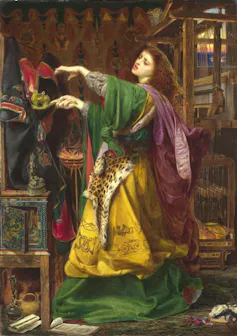
The powers Geoffrey of Monmouth gave her reflected the early forms of natural philosophy, the earliest form of the scientific process. Natural philosophy was about seeking to understand nature and the world around you through reasoning, rather than religion.
Morgan’s powers fall under two key branches of natural philosophy: the science of medicine, and the science of necromancy according to physics.
The science of medicine is pretty much as it sounds. The science of necromancy according to physics, however, was not about bringing people back from the dead – it was the study of what was and was not possible.
In a period before biology and physics, many of the simplest processes – such as the creation of frogs from frog spawn – were considered occult.
The ability to manipulate these processes was considered the educated (and thus proper) practice of magic.
This early version of Morgan, although not herself a real person, was partly based on a very powerful medieval woman who was actually real – the Empress Mathilda, daughter of King Henry I.
Geoffrey was a supporter of the empress and this likely influenced his decision to depict Morgan as positive and chaste.
A personality change
As Arthurian legends were adapted by the French chivalric romances (a 12th–15th century literary genre), Morgan began to change.
She is still a fantastic healer, but is no longer queen of Avalon.
Instead, she has become Arthur’s half-sister (same mother, different fathers).
In the slightly later texts, she becomes vindictive, jealous and cruel, and begins to use her magic selfishly. Instead of healing, she becomes a master of illusion and enchantment, often using her magic to trap Arthur’s knights (particularly Lancelot).
In one example, from a text called the Lancelot-Grail cycle, Morgan is rejected by a knight who loves another woman.
Furious, Morgan creates the Valley of No Return (or the Valley of False Lovers). No man who has been unfaithful to his lover, even just in thinking, can leave the valley. The spell lasts for decades, until it’s broken by Lancelot and the men are freed.
We also see sleeping enchantments in texts from this time, which Morgan uses to kidnap Lancelot.
In later texts, things get much darker. Morgan enchants a mantle, a type of cloak, so it will burn its wearer to death. She sends it to Arthur as a gift.
He is stopped from putting it on by the Lady of the Lake, who suggests the messenger puts it on instead. Morgan’s assassination attempt is foiled.
This shift in Morgan’s character happened, among other reasons, because of increasingly complicated beliefs about what it meant to be a witch in medieval Europe.
Powerful, independent and vindictive
Finally, the nature of chivalric romance also had some influence.
This type of storytelling operated by strict rules in which a knight and his lover faced various obstacles in their attempt to be together.
Morgan, as a very independent figure even when she is married, helps fill the role of the obstacle for the knight – the bad guy.
Even so, Morgan le Fay is a much-loved character of the Arthurian legends.
Powerful, independent and vindictive, Morgan set the standard for witchy women.
Her influence appears today in everything from fairy tales to comic books – think of the wicked fairy from Sleeping Beauty, the White Witch from The Chronicles of Narnia and as herself in both DC and Marvel comics – making her possibly the most famous medieval witch we have.


