

Justin Bieber’s Coachella performance wasn’t ‘lazy’ – and actually references 50 years of music history
- Written by The Conversation
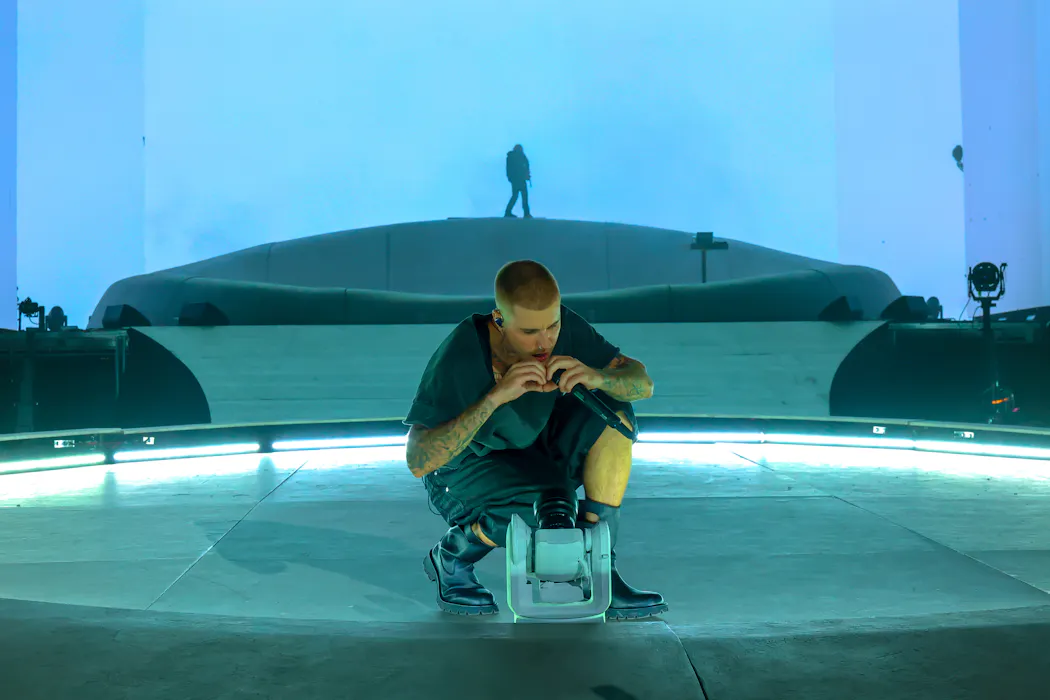
After a four-year break from touring, Justin Bieber is headlining Coachella’s main stage. In a controversial section of the show he sang along to YouTube clips – and at times didn’t sing at all.
Up to 125,000 punters attend Coachella each weekend. The festival is also livestreamed to an enormous international audience: 5.89 million people subscribe to the YouTube channel.
Audiences and reviewers argued over whether Bieber’s performance was a clever statement on nostalgia or a lazy display of disrespect.
But, placed in a historical context, Bieber’s performance can actually be read as an interesting contribution to “live” performance.
What happened during Bieber’s performance?
The controversial section ran for around 20 minutes of the 90-minute set.
Coachella is known for guest appearances, and in other sections of the performance, Bieber welcomed Dijon, Tems, Wizkid, Mk.gee and The Kid Laroi. Much of the set played out like a typical festival show.
Still, there were early hints at something different. After performing Speed Demon, Bieber peered directly into the camera to shout-out his “living room” audience, and Coachella’s giant screens showed the chat feed on the festival’s livestream.
When the show approached 50 minutes, Bieber addressed the audience again: “tonight is such a special night, but I feel like we gotta take you guys on a bit of a journey. You guys remember this song?”
Sitting at a laptop, he typed “baby” into the YouTube search bar displayed on screen. The video for his 2010 hit appeared and he sang along, omitting certain lyrics and silently mouthing others.
Modern performances are increasingly supported by backing tracks, but often attempt to hide this fact. Today’s Bieber, the backing vocalist, sounded far more adult than his high-pitched, former self. It was a duet of sorts.
After the main hook, Bieber cut the song abruptly and revisited the “going back” theme: “But how far back do you go?” He pressed play on 2009’s Favorite Girl and again sang over the chorus before another abrupt ending.
As he moved quickly through a range of YouTube hits, Bieber apologised only once, not for the backing tracks but for the swift ending to 2013’s Confident: “I’m sorry to cut it but these are just little snippets.”
He played early YouTube cover versions of Chris Brown and Ne-Yo songs, then his commercial hits Sorry and Where Are Ü Now.
After feigning a wifi dropout, the focus switched to pop culture references: a blooper reel included footage of young Bieber walking into a glass door and falling through a stage floor, followed by a more recent rant about paparazzi and privacy.
As a producer of live-shows and researcher of performance technologies, I was fascinated and entertained. I’m hardly a Belieber, but I liked how this performance challenged expectations around “liveness”.
I wonder if the “lazy” reviewers realise that every pause and anecdote in this section was likely rehearsed, and that the on-screen “typing” was produced in advance? There is too much at stake in a performance of this scale to leave it to chance.
What makes music ‘live’?
There is a long history of artists interacting with their recorded selves and confusing the audience.
In 1967, The Doors brought a television on stage to watch themselves in a pre-taped variety show performance. In the next decades, Kraftwerk presented themselves as robots rather than virtuosi. In the 21st century, Deadmau5 exposed conventions for pre-recorded festival sets in electronic dance music.
In using pre-recorded or sequenced audio in place of playing their instruments live, these artists played with audience expectations about what is seen and how it connects to what is heard.
As a child, I watched Natalie Cole’s 1992 Grammy performance alongside her deceased father, Nat King Cole. My parents found it moving, I found it creepy.
Other duets with the deceased include a hologram of Tupac Shakur “performing” at Coachella in 2012 and a hologram of Maria Callas “singing” with the Melbourne Symphony Orchestra in 2023.
These holograms offer access to otherwise inaccessible performances and attempt to keep the past alive.
In a way, the Bieber performance attempted something similar as he engaged directly with his own past performances.
He not only called upon pre-recorded materials, but his own viral history. His self-referential performance was directly inspired by online cultural consumption. His interaction with YouTube was relatable and human, rather than detached and lazy.
YouTube and performance
As a DJ, I first became aware of YouTube’s impact on the presentation of performances through the emergence of Boiler Room, a channel that shows videos of DJs performing while surrounded by punters.
Eventually, the optics of these videos informed how clubbing might look: nightclubs and festivals configured “Boiler Room setups”, with DJs surrounded by a dancing audience instead of elevated and separated.
Despite encouraging a generation of overt posers, it showed how what we see online influences what is presented on stage.
Bieber takes this thinking to a much larger audience, demonstrating real engagement with his presence in pop culture online. In turn, how we react to this performance might inform future live shows.


